
Qualcomm Files Patent to Stop Headsets From Storing the Same Pixels Twice
Your eyes only see sharp detail in a tiny spot, so headsets can blur the rest of the picture. Qualcomm's patent points out that the blurry layers still store the pixels hidden behind the sharp center, and it proposes to stop saving them.
What Qualcomm's overlap-skipping headset memory does
A headset camera shows you the room around you while you stare at a coffee mug. The mug is sharp. The edges of the scene are a little blurry, and you never notice, because your eyes only pick up fine detail in a small spot anyway.
The catch is how the picture gets stored. The headset keeps a wide, blurry view, a medium view, and a sharp center as separate streams, and the wide view still includes the patch where the sharp center sits. That patch gets recorded two or three times. Qualcomm's patent skips storing the duplicated part, so the memory that holds the video can be smaller.
In the filing's example, the combined width of the stored data drops from 60 units to 40. You would never see the difference in the picture. The savings show up in less memory and less power.
obtain, at a contiguous portion of memory, a first set of data lines associated with first pixels for a first field of view (FOV) of image data …
Translation: The system grabs a continuous block of memory to hold pixel data for the primary viewing area.
How the buffer waits for neighboring rows
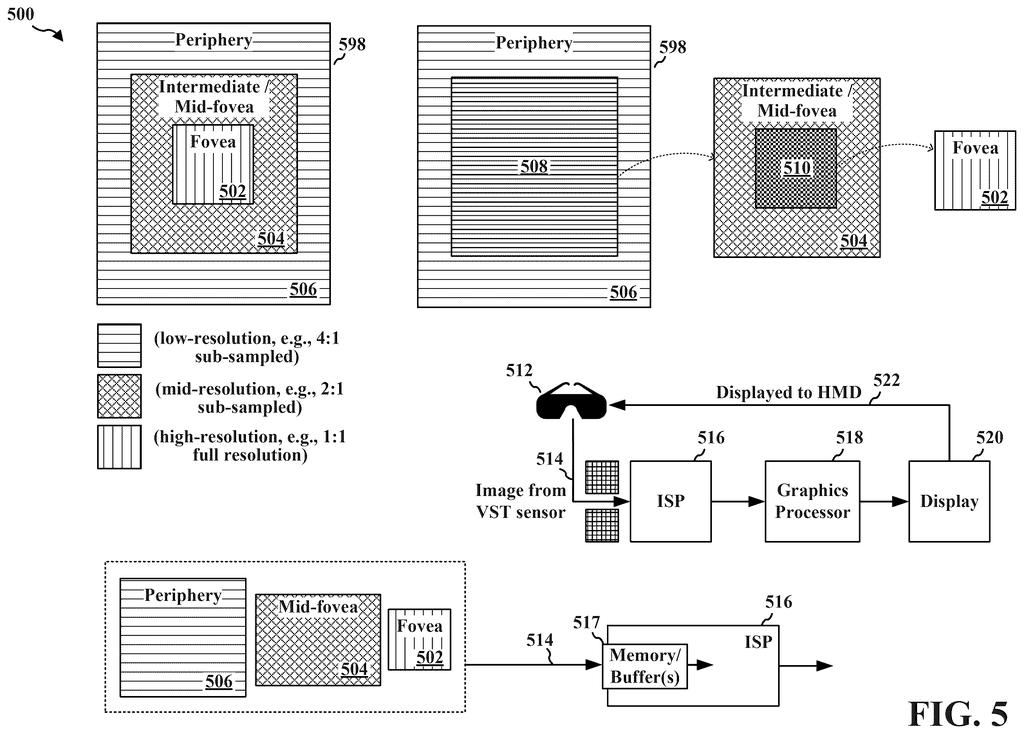
The setup is a headset with a foveated sensor (a camera that follows where you are looking and captures that spot in full detail, with less detail elsewhere). The filing's example uses three layers: a fovea layer at full resolution (1:1), a mid-fovea layer at half resolution (2:1), and a periphery layer at quarter resolution (4:1).
Normally every layer is stored in full, even though the wide periphery layer covers the area where the middle layer sits, and the middle layer covers the area where the fovea sits. The claims describe storing rows of pixel data (called data lines) for the wide layer while leaving out the overlapping part, then doing the same for the middle layer. Each layer gets its own buffer (a holding area) inside one contiguous block of memory.
A row is not released right away. Image processing often uses a small window, called a kernel, that looks at neighboring rows. A 5×5 kernel needs 2 rows above and 2 below. So the memory checks that enough earlier and later rows have arrived, then sends the row on to an image signal processor, a graphics processor, a display processor or the display. At the top or bottom edge of a layer, the missing rows are filled with mirrored copies or default values such as zeros or ones.
The buffers can be sized on the fly, with a small margin of extra rows to cover rows from the different layers arriving at slightly staggered times.
The second FOV includes an overlap of, and is surrounded on at least two sides by, the first FOV. Pixel data associated with the overlap is outside the data lines.
Translation: The inner display area shares space with the outer view, so the system avoids duplicating that shared pixel data.
Why a leaner video buffer matters on your face
The filing says that storing duplicate video adds overhead in power, processing time and memory area. Cutting the buffers is a direct way to trim all three in a headset that shows you a live camera view of the room, which the filing calls video see-through.
For you, the benefit is indirect. The picture should look the same, while the chip behind it needs less memory and draws less power. The extra margin rows give a little of that saving back, but the filing says the buffers still end up smaller than they would without skipping the overlap.
Qualcomm's 58th filing we've tracked since July in the AR glasses race builds on shrinking 3D video before sending and offloading video to a phone.
If this works as described, you will never see it. The picture in your headset looks the same, and the savings land in places like power draw and chip size, which could show up as a headset that runs longer or fits in a slimmer body, depending on what the maker does with the room.
The benefit is modest and the filing says so with numbers: in its own example the stored width drops by a third, and the margin rows win a bit of that back. A third less memory on the path from camera to screen still adds up on a chip, and it asks nothing of you.
The risk would show up at the edges of the sharp area, where skipped pixels have to line up with the layers around them. The padding rules and margin rows exist to protect image quality, and only real headsets will show whether they hold up.
Get our take in your Top Stories
Liked this breakdown? Add Patentlyze as a preferred source on Google, and our plain-English take shows up more often in your Top Stories the next time Qualcomm patent news breaks.
There are more where this came from
We read every patent application Big Tech publishes and send you the ones worth knowing. Plain English, free, every week.
The drawings
15 drawing sheets from US 2026/0330589 A1 · click any drawing to enlarge


Show the other 7 sheets


Want this weekly breakdown for a company we don't cover? Patentlyze Pro →
Be the first to weigh in