
Qualcomm Patents a System That Detects When You Grab the Wheel
When your car is steering itself and you decide to take over, the handoff isn't always smooth. Qualcomm has filed a patent for a system that detects the pressure of your hands on the wheel and blends control back to you in a way that doesn't feel like a tug-of-war.
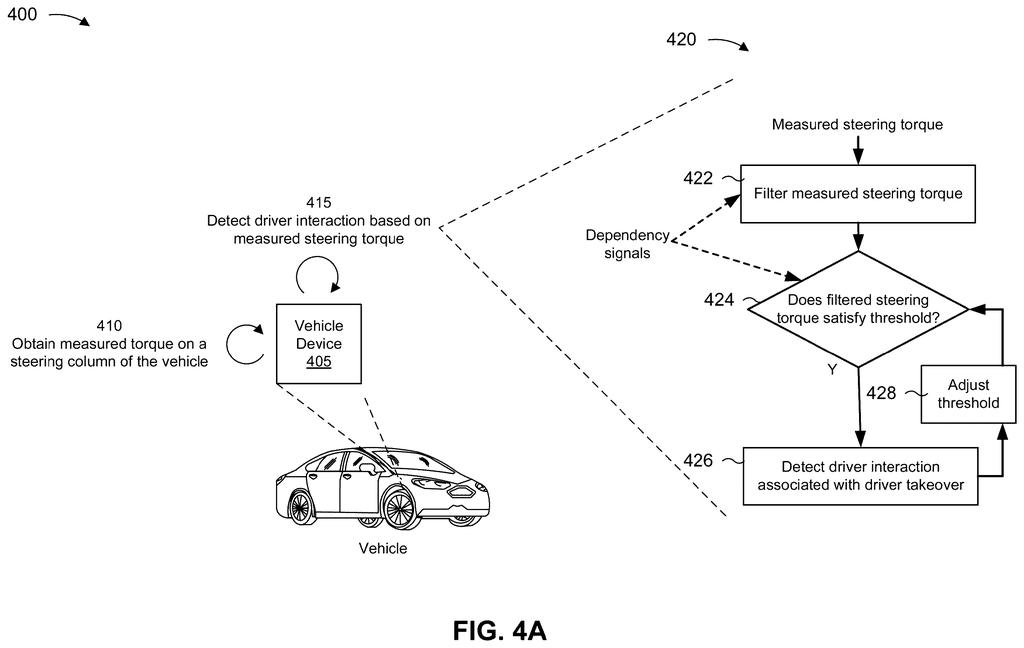
What Qualcomm's steering handoff system actually does
Ever grabbed a steering wheel while the car was in lane-assist mode and felt the car fighting you? That jerky, unsettling moment is exactly what this patent is trying to fix.
Qualcomm's idea is to measure the physical force (torque) you apply to the steering column the moment you touch the wheel. When the car's driver-assistance system senses that force, it doesn't immediately dump control back to you all at once. Instead, it gradually shifts the steering signal from what the car's computer wants to do to what your hands are asking for.
The result is a handoff that feels natural rather than sudden. You're not wrestling the car; it's cooperating with you. This kind of smooth transition matters most in everyday situations like merging onto a highway, avoiding a pothole, or just deciding you'd rather drive yourself for a while.
detect a driver interaction based on measured torque on a steering column of the vehicle; and transition, in connection with detecting the driver interaction, control of the vehicle from an advanced driver assistance system (ADAS) feature to a driver …
Translation: The system senses hands on the wheel and hands driving back to the human.
How torque sensing triggers the control switch
The patent describes a processor-based device installed in a vehicle that sits between the car's ADAS (Advanced Driver Assistance System) features, things like lane-keeping or adaptive steering, and the actual steering mechanism.
Here is what happens step by step:
- Sensors on the steering column measure torque (the rotational force your hands apply when you turn or grip the wheel).
- When that torque crosses a threshold, the device treats it as a driver interaction, a signal that you want control.
- Instead of an abrupt mode switch, the device outputs a blended steering request that transitions gradually from the ADAS system's steering commands to the driver's steering commands.
The key engineering idea is that the output signal to the steering system is a smooth interpolation (a continuous blend) rather than a hard cut. This prevents the steering wheel from lurching or the car from behaving erratically during the transition. The patent also implies the reverse is possible: a similarly managed handoff back to the ADAS feature.
The device may transition, in connection with detecting the driver interaction, control of the vehicle from an advanced driver assistance system (ADAS) feature to a driver by outputting a steering request that transitions from a feature steering request associated with the ADAS feature to a driver steering request.
Translation: It hands steering control back to the person as soon as they grab the wheel.
What this means for the future of assisted driving
Driver-assistance systems are already in millions of cars, from basic lane-keep assist to more sophisticated highway autopilot modes. One persistent complaint about all of them is the moment of takeover. An abrupt handoff can startle a driver, cause overcorrection, or, in the worst case, contribute to an accident. A patent that addresses the smoothness of that transition targets a real safety problem, not just a comfort one.
Qualcomm's interest in vehicle autonomy and ADAS extends well beyond chips, and a filing like this shows the company working at the software and control layer, the part of the system that decides who is in charge of the car at any given moment. For consumers, smoother handoffs could eventually mean driver-assist systems that are easier to trust and less disorienting to use.
Qualcomm's 41st filing we've tracked since July in our self-driving sensing race watch adds to earlier work on autopilot shutoff before complex routes and aligning camera and depth data.
Claim 1 covers any device that detects a driver grabbing the wheel by measuring torque on the steering column, then hands control back by blending the car's automated steering with the driver's input. No specific algorithm is required, no particular blending method is required, and no numbers are specified. That is a broad description of a general approach.
In practice, that breadth means any automaker or supplier building a takeover system that uses steering-column torque and produces a blended steering signal could fall inside this claim. Nearly every new vehicle with lane-keeping or automated steering handles exactly that moment when a driver reaches for the wheel.
Whether this coverage holds depends on what prior research and existing systems the patent office finds during examination. The claim is written to matter commercially, and if it survives, it covers a lot of ground.
There are more where this came from
We read every patent application Big Tech publishes and send you the ones worth knowing. Plain English, free, every week.
The drawings
8 drawing sheets from US 2026/0285401 A1 · click any drawing to enlarge


Want this weekly breakdown for a company we don't cover? Patentlyze Pro →
Be the first to weigh in