
Qualcomm Files Patent to Squeeze the Blurry Edges of VR Images to Save Memory
VR headset lenses are sharpest in the middle and blurriest at the edges, so Qualcomm's filing spends fewer pixels at the edges and keeps the middle at full detail.
What Qualcomm's edge-squeezing VR patent does
A VR headset draws a separate picture for each of your eyes, and every pixel of it has to travel from the chip to the screen in front of you. As screens get sharper, that traffic eats memory, power and battery life.
Qualcomm's filing describes a way to shrink the picture before it travels. The middle of the image, where the lens is clearest and your eyes do their best work, stays at full detail. The outer edges get squeezed into less space, with a smooth slope between the two so you don't see a seam.
A matching step near the screen stretches the edges back out. In one example, the squeezed picture needs about 56% fewer pixels, and the filing says the results keep the same quality as the full-size version.
… perform a non-linear foveated compression process on the at least one image, wherein the non-linear foveated compression process corresponds to a continuous non-linear compression for a portion of the at least one image; …
Translation: It squeezes the outer parts of the picture, where the headset lens is least sharp, to cut the data the chip has to handle.
How the center stays sharp as edges shrink
The claims cover two halves of one idea. On the sending side, a graphics chip (GPU) takes an image and applies a continuous non-linear compression to part of it, or all of it. In plain terms, the squeeze changes gradually with distance from the center, with no hard step where one zone ends and the next begins. On the receiving side, a display processor (DPU) or the display's own driver chip applies the matching stretch to restore the image.
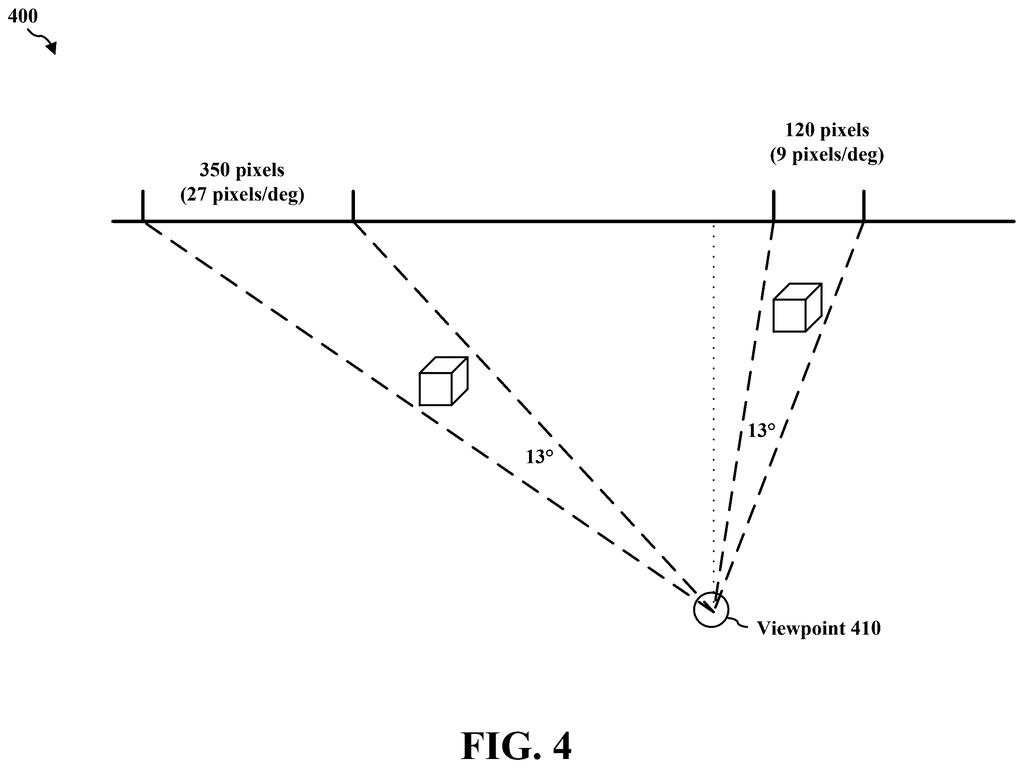
The filing's example uses a headset lens. The center 50% of the image keeps a 1:1 scale, while the 25% of pixels on each side get packed into just 12.5% of the output buffer. One example shrinks an image from 1832x1920 to 1221x1280 pixels, a 2.25x cut in the workload of time warp (a late step that adjusts the frame before it goes to the screen). The squeeze can happen in the same pass that already corrects the lens's distortion.
The filing also describes extra pieces:
- Filtering before shrinking, to reduce jagged, shimmering artifacts (claimed as less aliasing).
- Mipmaps (pre-shrunk copies of an image) with trilinear or anisotropic filtering, to cut flicker.
- Encoding before sending and decoding on arrival, with the stretch-back done at the DPU or at the panel itself.
Doing the stretch at the panel could lower the data rate between the main chip and the screen. The design also keeps everything in a single layer, which avoids juggling overlapping layers and blended seams.
Aspects presented herein relate to methods and devices for graphics processing including an apparatus, e.g., a GPU or a DPU.
Translation: This patent describes hardware technology designed to handle complex visual data efficiently.
Why VR headsets could use less memory and power
Headsets built on phone-class chips live under tight power and memory limits, and higher-resolution screens push against both. Sending fewer pixels at the edges, where the lens is least sharp anyway, could mean less heat, less battery drain and room to spend detail where it counts. The filing says the approach lowers both the rendering workload and the traffic between chips.
There is no product attached to this filing, and it is a patent application, not a granted patent. The examiner's first review rejected the claims as filed, which is routine and usually followed by amendments. Treat it as a look at how one chipmaker thinks about the cost of sharper VR screens.
This is the 60th Qualcomm filing we've tracked in the AR glasses race since July, adding to work like one on bandwidth signals and one on duplicate pixel cuts.
The cost of this design is detail at the edges, and the filing relies on the headset lens to hide it. Lenses already blur the outer region, so spending fewer pixels there costs little. Small text or fine detail placed near the edge of your view is where the squeeze could show.
The second price is coordination. The chip that squeezes and the chip that stretches back must agree on the exact curve, so the display side needs matching hardware. A mismatch or a rough transition would appear as a visible seam or shimmer, which explains why the filing spends so much effort on smoothing and filtering.
On balance the trade looks worth it, since the center stays at full detail and the savings land on memory and power, the scarce resources in a headset. The claims are broad, so the open question is how much of that breadth survives the examiner's pushback.
Get our take in your Top Stories
Liked this breakdown? Add Patentlyze as a preferred source on Google, and our plain-English take shows up more often in your Top Stories the next time Qualcomm patent news breaks.
There are more where this came from
We read every patent application Big Tech publishes and send you the ones worth knowing. Plain English, free, every week.
The drawings
15 drawing sheets from US 2026/0340763 A1 · click any drawing to enlarge


Show the other 7 sheets


Want this weekly breakdown for a company we don't cover? Patentlyze Pro →
Be the first to weigh in