
Qualcomm Patents a Phone Map Showing Where People Stood in a Restaurant
Qualcomm's patent describes a phone map that shows where people are standing inside a restaurant or store right now, and where they stood hours ago. It builds the map from the venue's own Wi-Fi.
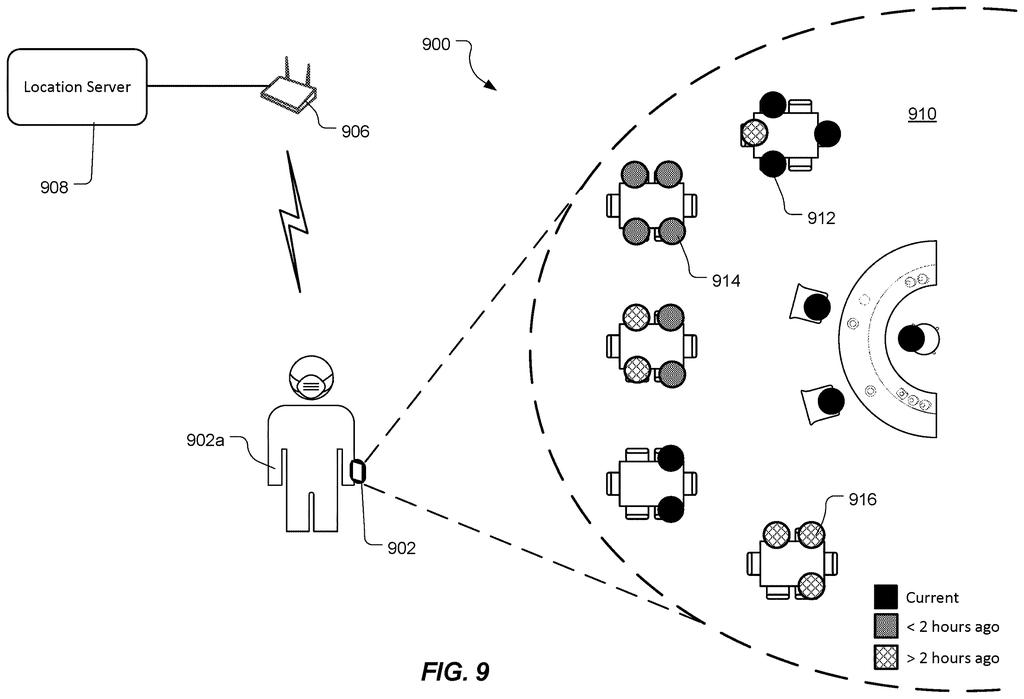
What Qualcomm's Wi-Fi contact history map shows
You're standing outside a crowded restaurant on a Saturday night, wondering whether it's packed inside or just loud. Qualcomm's patent describes a phone app that could show you, on a floor map, where people are sitting right now and where they sat earlier.
The restaurant's own Wi-Fi does the work. Its access points (the boxes that give you Wi-Fi) measure how far each phone is from them, and a server turns that into a contact history map. Current guests might show up in one color, people who left in the last two hours in another, and older visitors in a third.
You choose the rules. You can set how close counts as too close (6 feet is the example default) and how long two people must stay that close. The filing says the map can show positions alone, with no names or personal details attached.
… displaying a contact history map on a user equipment, comprising: activating a contact tracing application on the user equipment; providing one or more contact tracing configuration options to a contact tracing network …
Translation: Your phone runs a tracing app to share your setup preferences with a tracking network.
How your settings shape the contact history map
The claims cover the phone side of a Wi-Fi contact tracing system. Your phone (the filing calls it user equipment) opens a contact tracing app and sends configuration options to a contact tracing network, meaning a venue's Wi-Fi access points plus a location server (a computer that works out where devices are).
The options can go through a Wi-Fi station you've joined, or over the cellular network. In return, the phone receives contact history information and draws a map. The options named in the claims include:
- Social distance threshold: how close counts as contact.
- Contact time threshold: how long two devices must stay that close.
- Cluster range and cluster time: how near in space and time separate incidents must be to be grouped into one marked area.
The history can cover devices detected right now and earlier ones. It can also include social distancing violation objects: marked zones on the map with a count of incidents in each. A validation code tied to the network can be required before the phone receives any of it.
The wider description says the server builds this from timing measurements (how long signals take to travel between phones and access points), laid over the venue's floor plan.
The contact tracing may be Wi-Fi positioning based. An example method for reporting signal measurements to a contact tracing network includes activating a contact tracing application on a user equipment based on a proximity to the contact tracing network …
Translation: The system uses local Wi-Fi signals to automatically trigger the tracing app when you get close enough.
What a Wi-Fi crowd map means for dining out
If an app like this existed, the pitch would be simple: look before you go in. You could check how full a restaurant is, steer away from tables where people just left, or skip a crowded store. Venue managers could also see where close contacts pile up and rearrange seating or foot traffic.
The filing presents Wi-Fi as an answer to two problems with earlier contact tracing: Bluetooth can lose accuracy indoors, and location tracking worries some users. It describes position reports that carry no personal details. Whether venues would pay to run such a network is a separate question the patent does not answer.
Qualcomm's 573rd filing in our Qualcomm coverage since May adds to a network-safety thread that includes vehicle coverage checks and fake connection detection.
The design gives up reach to gain accuracy. Bluetooth works between any two phones, but the filing says it struggles indoors. Wi-Fi ranging only works where the venue has set up the network and agreed to run it, so your map exists only for participating restaurants, stores and arenas.
The second cost is trust. Even if the map shows dots and no names, a server somewhere keeps a record of where every phone stood and when. The filing adds a validation code and anonymous position reports, which helps, but you are still relying on the venue to handle that data well.
The trade looks worth it for a place you visit often, or if you are at higher risk from illness. Demand has shrunk since the pandemic peak, though, and a feature people only want during an outbreak is hard to keep alive in an app.
Get our take in your Top Stories
Liked this breakdown? Add Patentlyze as a preferred source on Google, and our plain-English take shows up more often in your Top Stories the next time Qualcomm patent news breaks.
There are more where this came from
We read every patent application Big Tech publishes and send you the ones worth knowing. Plain English, free, every week.
The drawings
22 drawing sheets from US 2026/0353038 A1 · click any drawing to enlarge


Show the other 14 sheets


Want this weekly breakdown for a company we don't cover? Patentlyze Pro →
Be the first to weigh in