
Qualcomm Files Patent to Stop Your Store Map Dot From Jumping Aisles
Your phone can tell roughly where you are in a store, but the dot on the map often hops across the aisle or lands in the wrong one. Qualcomm's fix is to do the math with beacon locations that have been deliberately shifted.
What Qualcomm's shifted-beacon idea does
Indoor positioning in a store usually works by listening to small radio transmitters and guessing where you are from how strong each signal is. The results can be jumpy: your dot may flip from one side of an aisle to the other, or place you in the wrong aisle entirely. Smoothing the dots after the fact helps a little, but it adds lag.
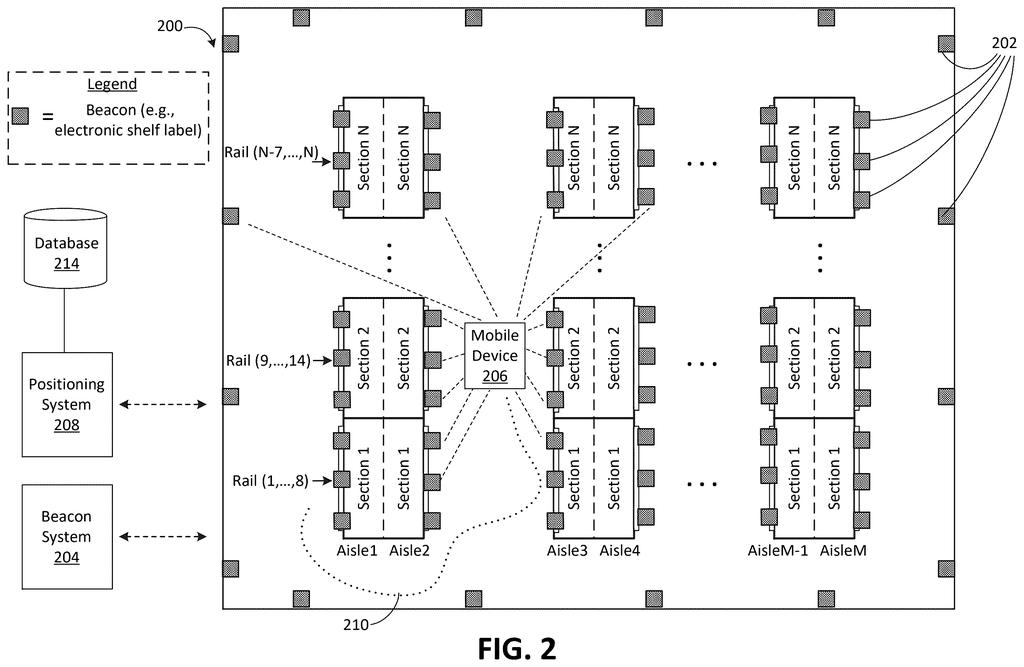
Qualcomm's patent application takes a different route. Instead of doing the math with each transmitter's true spot, the system uses a translated spot, a phantom position that differs from where the transmitter physically sits. Many of these transmitters are built into electronic shelf labels, the little screens that show prices. Their phantom positions get pulled toward the middle of the aisle.
The aim is a dot that moves smoothly and stays in the right aisle.
… obtaining translated coordinates for at least one beacon in the plurality of beacons deployed in the indoor environment, wherein the translated coordinates of the at least one beacon are different from physical coordinates associated with the at least one beacon; …
Translation: The system uses fake map coordinates for a beacon instead of where it actually sits in the building.
How shelf labels get a phantom position
Your phone listens to short radio broadcasts from beacons spread around a store, many of them built into electronic shelf labels (the small price screens clipped to shelves). It measures how strong each signal is, then averages the beacons' known locations, giving louder signals more weight, to guess where you are standing. This is called a weighted centroid calculation.
The patent's twist is to use translated coordinates in that average. These are phantom locations that differ from where each beacon physically hangs. The filing describes several ways to pick them:
- Push a shelf-edge beacon toward the center of the aisle it faces, using its facing direction and the aisle width from the floor plan.
- Draw a Voronoi diagram (a map that carves the store into one zone per beacon) and use each zone's center point.
- Decide which beacons to shift based on how crowded beacons are in that area, which ones are expected to be transmitting at that moment, and expected interference.
- Account for the phone's situation, such as your body blocking a signal when the phone is in a back pocket, or the device being smart glasses.
A store server can work out the shifted coordinates and send them to phones in an assistance message, or the phone can calculate them itself. Beacons without a shifted position keep their real one.
… determining an estimated position of the mobile device based at least in part on the translated coordinates of the at least one beacon.
Translation: Your phone figures out where you are by relying on those altered map coordinates.
Why store maps could stop jumping aisles
If you have ever watched a map dot wander around a store, this targets that annoyance. A calmer dot makes it easier to find an item, follow directions to a shelf, or get an alert when you walk near something of interest, which the filing's background lists as uses of store positioning.
For retailers, the appeal is that it works with beacons built into shelf labels, and the filing says the same approach could apply in warehouses or on factory floors. It also avoids the lag the filing says comes from smoothing out position estimates after the fact. The patent gives no accuracy numbers, so how much better the dot gets is unknown.
That makes this Qualcomm's 544th filing in our Qualcomm coverage since May, building on multi-task camera AI and faster camera AI math.
The shortest path to shipping this is a software update. A store that already has beacons in its shelf labels, a floor plan on file, and an app that shows a dot would only need to change the coordinates fed into one calculation. No new phone hardware is required.
What has to exist first is the store side: working beacons, a server holding each beacon's location and facing direction, and a shopping or staff app. That takes a lot of retailer buy-in, so rollout would hinge on store owners as much as on Qualcomm.
The filing offers no accuracy numbers, so the size of the gain is unknown. Still, the idea is simple and cheap to try, and it targets a complaint anyone who has watched a map dot wander will recognize.
Get our take in your Top Stories
Liked this breakdown? Add Patentlyze as a preferred source on Google, and our plain-English take shows up more often in your Top Stories the next time Qualcomm patent news breaks.
There are more where this came from
We read every patent application Big Tech publishes and send you the ones worth knowing. Plain English, free, every week.
The drawings
8 drawing sheets from US 2026/0343477 A1 · click any drawing to enlarge


Want this weekly breakdown for a company we don't cover? Patentlyze Pro →
Be the first to weigh in