
Sony Patents a System That Cross-Checks Your Car's Sensors Against Other Vehicles
What if your car could quietly ask a nearby vehicle, 'Hey, how far away am I from you?' — and use that answer to check whether its own sensors are lying? That's the core idea in this Sony patent.
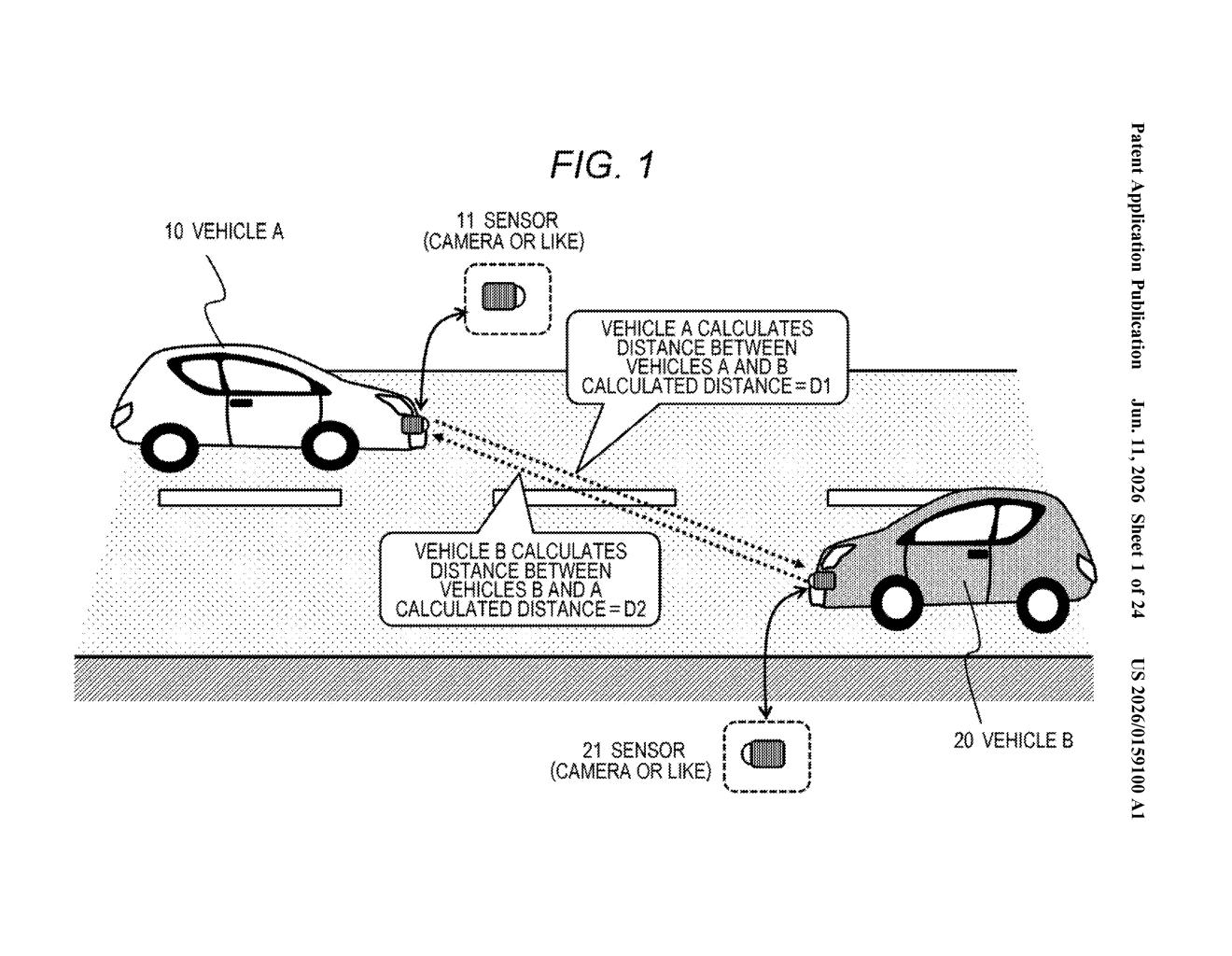
What Sony's vehicle sensor cross-check actually does
Imagine your car's cameras or radar are slowly going out of calibration — maybe after a fender-bender, a hard wash, or just gradual drift. Right now, your car probably has no way to know something is wrong until a technician runs a diagnostic. Sony's patent describes a smarter way to catch that problem while you're actually driving.
The idea is straightforward: your car measures the distance to another vehicle or a roadside sensor tower, and that other device does the same measurement independently. The two results get compared. If your car thinks it's 30 meters away but the other vehicle calculates 18 meters, something is off — and the system flags it for recalibration or flags a potential sensor failure.
This cross-check can happen frequently and automatically, without needing a workshop visit. Think of it like two people independently pacing out the same distance and comparing notes — if the answers match, great; if they don't, you know at least one of you made a mistake.
How two distance readings get compared in real time
The patent describes a sensor verification device that lives inside a vehicle and performs three core jobs:
- Distance calculation: It uses the car's onboard sensor — for example, a stereo camera or radar — to compute the distance between itself and another vehicle or a piece of roadside infrastructure (like a smart traffic pole).
- Data exchange: Over a wireless link, it receives the same distance measurement as calculated by that external device — the other car or the infrastructure unit.
- Comparison and verdict: It compares its own figure (called D1) against the externally sourced figure (called D2). If they diverge beyond an acceptable threshold, the system concludes the sensor may be miscalibrated or failing.
When a mismatch is detected, the system can trigger either a recalibration process — essentially nudging the sensor back into alignment using software — or a failure detection process that alerts the driver or a higher-level safety system that something is genuinely broken.
The key engineering insight is that the external device acts as a ground-truth reference. Because both sides are measuring the same physical gap from opposite ends, the comparison is inherently more reliable than any single-sensor self-test. The patent covers both vehicle-to-vehicle and vehicle-to-infrastructure verification scenarios.
What this means for self-driving car safety on the road
Autonomous and semi-autonomous vehicles depend entirely on sensors measuring the physical world accurately. A camera or lidar unit that's even slightly miscalibrated can cause a lane-keeping system to drift or an automatic braking system to react too late. Today, most calibration happens in a workshop on a schedule — not continuously while the car is in use. Sony's approach would make verification a routine background task, catching degradation before it becomes dangerous.
For Sony Semiconductor Solutions, which supplies image sensors to many of the world's largest automakers, owning this kind of verification technology could also be a way to sell not just the sensor hardware but the surrounding safety intelligence. It positions the company further up the automotive value chain, beyond silicon and into systems.
This is genuinely useful infrastructure work for the autonomous-vehicle era — not flashy, but exactly the kind of background-safety problem that tends to get solved late and quietly. The vehicle-to-infrastructure angle is particularly interesting because it suggests Sony sees roadside sensor networks as part of the calibration ecosystem, not just as passive data sources. Worth watching as ADAS regulations tighten globally.
There are more where this came from
We read every patent application Big Tech publishes and send you the ones worth knowing. Plain English, free, every week.
Want this weekly breakdown for a company we don't cover? Patentlyze Pro →