Qualcomm
Qualcomm · AI / ML · Filed Feb 24, 2025 · USPTO published Aug 27, 2026 · Aug 27 release
Qualcomm Patents an AI Processing System That Rates Its Own Accuracy Per Task
Most AI systems give you an answer. Qualcomm's new patent describes one that also tells you how sure it is about that answer, for every task it's running at the same time.
- Publication number
- US 2026/0253408 A1(US20260253408A1)
- Applicant
- QUALCOMM Incorporated
- Filed · Published
- Feb 24, 2025 · Aug 27, 2026
- Inventors
- Upal MAHBUB, Gokce DANE
- Status when we published
- Waiting for an examiner
- Document
- 20 claims
- US classification
- 382/157
- Examiner
- SOFRONIOU, MICHAEL MARIO (Art Unit 2661)
How Qualcomm's self-rating AI chip handles multiple jobs
Today's AI chips often run several recognition jobs at once, such as identifying objects, reading text, and tracking motion, but they typically hand back results without any signal about which ones they actually trust. Qualcomm wants to change that by attaching a confidence score to each individual result.
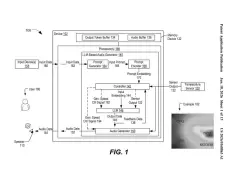
The idea works like a shared notepad. The chip looks at an image (or audio clip, or any input) together with some extra context, writes down a common summary of what it sees, then passes that summary to several specialized mini-analyzers. Each mini-analyzer produces its answer and a percentage-style rating saying how reliable that answer is.
For you, that means a device could automatically skip, double-check, or flag low-confidence results instead of acting on guesses. A phone deciding whether to unlock, a car camera deciding whether to brake, or a voice assistant deciding whether it heard you correctly could all use this kind of honesty about its own limits.
… apply a first task-specific output head to the shared feature representation to generate a first task-specific output corresponding to a first task and a first confidence measure indicating an accuracy of the first task-specific output …
Translation: The system uses a specialized component to perform a task and then calculates a score to show how likely it is to be correct.
How the shared feature layer feeds separate task heads
The patent centers on a multitask perception architecture, meaning a single AI model that handles several recognition or classification jobs at the same time rather than running a separate model for each.
Here is how the pipeline works:
- The system takes an input (say, a camera frame) plus contextual information (such as sensor readings, location data, or prior frames) and fuses them into a shared feature representation, essentially a compact mathematical summary of everything relevant in the scene.
- That shared summary is then handed to multiple task-specific output heads, each one a small specialized layer trained to answer a different question ("Is this a pedestrian?" vs. "What is the lighting condition?").
- Each head outputs both its answer and a confidence measure, a numeric indicator of how accurate that particular answer is likely to be.
The confidence scores are generated alongside the task outputs rather than as a separate post-processing step, which means the system can produce them with minimal added compute. This matters on mobile or automotive chips where power and processing headroom are tight.
The patent is written at the hardware-processor level ("an apparatus, comprising a processing system"), meaning Qualcomm intends this to run on-device rather than in a cloud server.
Certain aspects of the present disclosure provide techniques for performing multitask perception tasks, including receiving an input; receiving contextual information associated with the input; generating a shared feature representation based on the input and the contextual information …
Translation: The technology processes data by combining raw input with background information to create a unified digital understanding.
What self-rated confidence means for devices doing AI locally
On-device AI has a trust problem: when a chip is doing five things at once, a single wrong answer can cascade. A self-driving assistance system that incorrectly classifies a road sign and has no way to flag its own uncertainty will act on that bad call. Confidence scores give the broader software stack a way to decide when to ask for a second opinion, slow down, or simply abstain.
For Qualcomm specifically, this fits neatly into the company's push to make its Snapdragon chips the preferred platform for running AI at the edge (meaning on a phone, headset, or car rather than in a data center). Big Tech patent news in the on-device AI chip space increasingly circles around exactly this question of reliability, and this filing is Qualcomm's answer to it.
This is the fourth Qualcomm filing we've tracked in our AI guardrails watchlist since July, adding to earlier work on 5G AI error reporting and network AI fault reporting.
Source: US 2026/0253408 A1 at the USPTO (PDF). Full patent text and figures are in the official publication.
Get our take in your Top Stories
Liked this breakdown? Add Patentlyze as a preferred source on Google, and our plain-English take shows up more often in your Top Stories the next time Qualcomm patent news breaks.
Add Patentlyze on Google
One click.
There are more where this came from
We read the new patents from Big Tech, carmakers and more and send you the ones worth knowing. Plain English, free, every week.
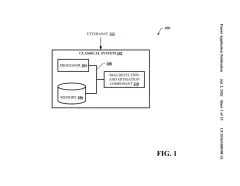
The drawings · 9 sheets
9 drawing sheets from US 2026/0253408 A1 · click any drawing to enlarge


Show sheet 9

More from Qualcomm
All 637 Qualcomm patents →
More in AI / ML
All 2,745 AI / ML patents →
IBM
IBM Patents a Way to Catch When Its AI Language Tools Stop Making Sense
IBM
IBM Patents an AI That Checks Its Own Confidence Before Answering Without a Full Team
IBM
IBM Patents a System That Tests Its Own AI for Bias and Picks the Fix
Google