
Salesforce Patents a Quantum-Assisted System for Blocking Malicious Web Traffic
Salesforce is exploring whether quantum computing techniques can make network security better at catching malicious traffic that slips past today's filters. The approach runs a classical security model on a quantum-derived foundation, aiming to spot threats that traditional pattern-matching misses.
How Salesforce's quantum traffic filter actually works
You're sending a request to a Salesforce app, something routine like loading a dashboard or submitting a form. Behind the scenes, a security system is checking whether that request looks like it came from a real user or from an attacker probing for weaknesses.
That check usually relies on pattern-matching rules that humans wrote ahead of time. Salesforce's new patent describes a different approach: a classifier trained using techniques borrowed from quantum computing. The idea is that quantum math can find patterns in attack signatures that are too subtle for conventional methods to detect.
In practice, the system takes a "fingerprint" of each incoming web request and runs it through a classifier to decide, in real time, whether to let it through or block it. The quantum side handles the hard math during training; the regular software handles the live blocking. You'd never see any of this, but if it works as described, fewer attacks would reach the app at all.
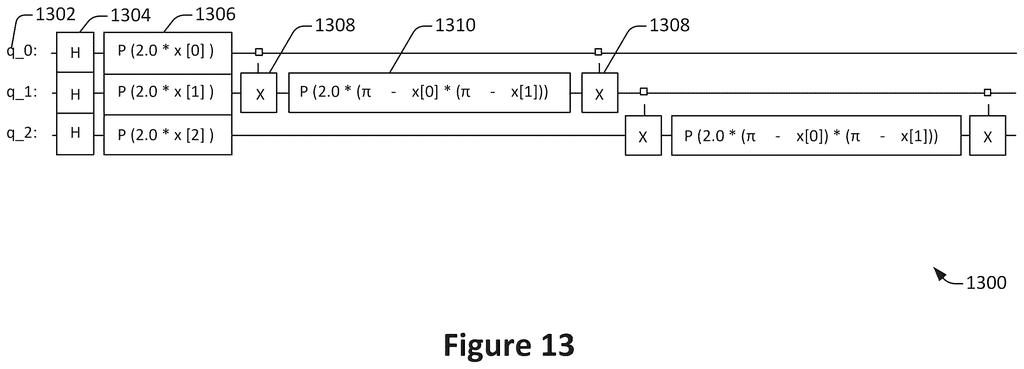
… determining a classical support vector machine based on a quantum kernel, the quantum kernel being determined based on a quantum feature map and a plurality of quantum states …
Translation: It builds a standard machine learning model using quantum math to analyze traffic patterns.
How the quantum kernel trains the threat classifier
The patent describes a two-stage pipeline for blocking malicious web requests at an application gateway (the entry point where traffic arrives at a cloud service).
First, during training, the system analyzes a large set of past web requests that have already been labeled as either malicious or legitimate. It extracts a fingerprint value from each one, a compact numerical summary of the request's content. Those fingerprints are then fed into a quantum feature map, which encodes the data into a form that quantum math can process. This produces a quantum kernel, a mathematical function that measures how similar two requests are in a high-dimensional space that classical computers struggle to compute directly.
That kernel is used to train a classical support vector machine (SVM), a well-established category of classifier that draws a boundary between "malicious" and "legitimate" examples. The quantum kernel is what makes this SVM potentially stronger: it can draw more complex boundaries than a standard kernel allows.
- Training phase: quantum kernel computed from labeled traffic data
- Inference phase: new requests fingerprinted and scored by the classical SVM
- Blocking: requests that fall on the malicious side are dropped at the gateway before reaching any application or database
The system runs entirely on classical hardware at inference time; the quantum computation is used offline during model training.
A device may determine a fingerprint value for an application-layer request message received at an application gateway within the computing system.
Translation: The system calculates a unique identifier for every incoming web request it receives.
What this means for cloud security and CRM platforms
For Salesforce customers, the practical promise is better protection for the applications that run their sales, support, and marketing workflows. Attacks on cloud platforms often exploit subtle patterns that rule-based firewalls miss, and a more accurate classifier means fewer breaches and fewer false alarms that block legitimate users.
The harder question is how far this is from shipping. Quantum computing hardware capable of running the kernel training step at production scale is still limited and expensive, and the patent does not specify any particular quantum hardware. The shortest path to a real product probably involves using quantum-inspired classical algorithms rather than actual quantum processors, which is a common practical compromise. Security engineers following the latest Big Tech patents in the quantum security space will find this filing representative of a broader push to apply quantum math to threat detection, even before true quantum hardware is ready.
The filing sits at a tricky midpoint: the classical SVM side is fully shippable today, but the quantum kernel training step that gives the whole approach its claimed advantage depends on hardware that is not yet practical at enterprise scale. The shortest path to a product is to precompute the kernel on quantum simulators or cloud quantum services and ship only the trained model, which is plausible within a few years. That makes this less a near-term product announcement and more a research stake in the ground, signaling that Salesforce is positioning its security stack to benefit from quantum processors as they mature.
There are more where this came from
We read every patent application Big Tech publishes and send you the ones worth knowing. Plain English, free, every week.
The drawings
13 drawing sheets from US 2026/0238656 A1 · click any drawing to enlarge


Want this weekly breakdown for a company we don't cover? Patentlyze Pro →
Be the first to weigh in