
Samsung Files Patent for a Before-and-After Slider That Shows What Its Photo Fix Changed
Samsung's patent application turns a photo-enhance button into something you can check for yourself: a draggable divider shows the original and the fixed version in one picture. Little markers flag the spots that improved the most.
What Samsung's before-and-after photo slider does
Every time you tap an enhance button on a photo, you're mostly taking the app's word that the picture got better. The old and new versions look close enough that it's hard to tell what actually changed.
Samsung's patent application tries to fix that. After you tap a button that recommends enhancement, your phone builds a corrected copy and shows you one picture split down the middle: the original on one side, the fixed version on the other. Drag the dividing line and you sweep back and forth between the two, so you can judge the before and after yourself.
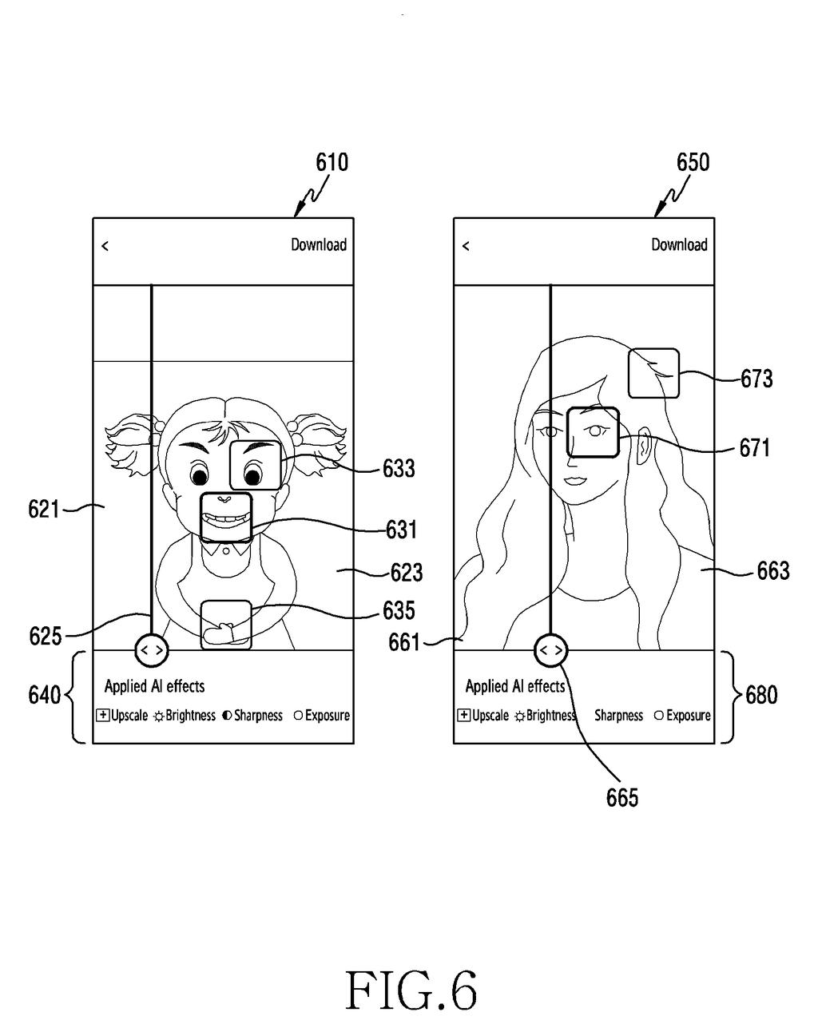
The phone can also mark the spots that improved most, such as a mouth, an eye or a hand, and it keeps the divider from sitting on top of those spots. Tap one and you get a zoomed-in comparison.
… display, through the display, a second screen including a third image including at least a first partial image from the first image, a second partial image from the second image, and a visual element …
Translation: It shows a split screen combining the original photo, the fixed photo, and a slider line.
How the slider and markers show what changed
The core claim is a two-screen flow. On the first screen, you see a photo from the camera and a button for recommending enhancement. Tapping it makes the phone correct the photo and produce a second image. A second screen then shows one combined picture: part of the original and part of the corrected version, joined at a draggable visual element (a divider handle). Slide it one way and more of the original appears. Slide it the other way and the corrected side grows.
The filing describes several add-ons around that core:
- Markers on the biggest improvements. The phone compares matching parts (an eye, a mouth, a hand) in both versions, scores the difference using things like sharpness, brightness and noise, and flags parts that pass a threshold.
- Per-fix switches. Buttons for upscaling (adding pixels to a small image), brightness, sharpness and exposure can each be turned on or off to update the corrected image.
- Linked zoom. Pinching to zoom on one version zooms the other by the same amount.
- Repeat fixes. A three-way view compares the original, an upscaled copy and a re-upscaled copy.
Which fixes get recommended can come from a trained AI model that analyzes the photo. The description says the goal is to improve the whole image, and it criticizes apps that redraw only the face, which it says can change expressions unnaturally.
What this means for trusting automatic photo fixes
Automatic photo fixes ask for your trust, and this filing is about earning it. Instead of swapping your picture for a new one, your phone would let you slide between the original and the fixed version, see which parts got better, and switch off any single fix, such as brightness, that went too far. The description also says the original is stored alongside the corrected copy.
The situations the filing names are everyday ones: a photo shot too dark or blurry, or a picture that arrived blurry through a messaging app. It is a patent application, so nothing here says Samsung will ship it, and it continues an application first filed in 2023. It does show the company thinking about how to present an automatic edit as well as how to make one.
Samsung's 29th filing we've tracked since July in the AI photo editing race builds on earlier applications like restoring deleted originals and turning people into stickers.
A before-and-after slider is a familiar idea, so the interesting part is the markers. They carry a cost: a phone that flags its own best work is grading itself, and its score for a good fix may not match what you care about. A threshold on pixel differences could highlight a sharper patch of brick wall and skip your friend's slightly soft eye.
The slider has its own price. While you drag, you see half of each version and never the whole finished photo, so you have to let go to judge the result. Markers also sit on top of the very picture you are trying to inspect, and the filing tries to limit that by keeping the divider off the flagged spots.
Overall the trade looks worth it. A few extra taps and overlays are a small price for seeing what an automatic fix did before you save it, and the on/off switch for each fix gives you a way out when the phone overdoes it.
Get our take in your Top Stories
Liked this breakdown? Add Patentlyze as a preferred source on Google, and our plain-English take shows up more often in your Top Stories the next time Samsung patent news breaks.
There are more where this came from
We read every patent application Big Tech publishes and send you the ones worth knowing. Plain English, free, every week.
The drawings
19 drawing sheets from US 2026/0320866 A1 · click any drawing to enlarge


Show the other 11 sheets


Want this weekly breakdown for a company we don't cover? Patentlyze Pro →
Be the first to weigh in