
Samsung Files Patent for a Blood Pressure Watch That Asks You to Warm Your Wrist
A cold wrist can make a watch's blood pressure reading fail, and Samsung's patent application describes a watch that notices the chill and tells you to warm up.
What Samsung's cold-wrist blood pressure fix does
You're sitting at your desk on a chilly morning, you tap your watch for a blood pressure reading, and it comes back with an error. Nothing is wrong with you. Your wrist is cold, and cold makes the tiny blood vessels there clamp down, which muddies the signal the watch depends on.
Samsung's patent application describes a watch that works out why the reading failed. If the signal is poor, it first checks whether you're holding still and wearing the watch properly. If that looks fine, it checks the temperature of the skin under the sensor.
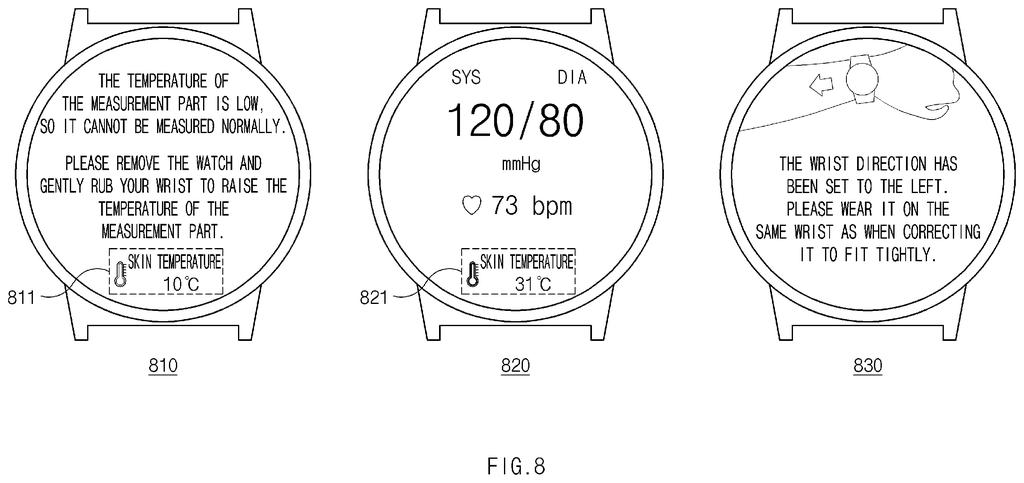
Then it gives you one specific tip instead of a generic error. The filing's example for a chilly wrist is a message asking you to rub the area to warm it up, and the watch can show you the current temperature while you do.
… obtain, based on the third information, a second result indicating whether the temperature of the measurement area corresponds to a designated reference temperature; and selectively provide a first guide related to the posture of the electronic device or a second guide related to the temperature of the measurement area, based on the first result and the second result.
Translation: The watch checks if your skin is warm enough and tells you to adjust your posture or temperature if the reading is bad.
How the watch decides: posture first, then chill
The device in the filing is a watch-style wearable with three sensors. A light sensor shines red and infrared light into the wrist and reads what bounces back, producing a pulse-wave signal called a PPG (photoplethysmogram, a waveform of blood flow). A motion and position sensor tracks how the device is sitting and moving. A temperature sensor reads the skin under the watch.
The watch first scores the signal quality. In the description, that means checking whether the peaks are tall enough and whether the repeating pulses look similar to one another. If quality is good, it estimates blood pressure. If quality is low, it runs through a set order of checks:
- Posture first: if the position, wearing state or movement is off, it shows a guide such as wearing the watch on your wrist or holding still.
- Temperature second: if posture is fine but the skin is below a reference temperature, it shows a warming guide, optionally with the current temperature.
- Then a follow-up: once the temperature recovers, it gives a further guide for taking the measurement.
A second independent claim covers a separate idea: correcting the math. The watch estimates values such as cardiac output (how much blood the heart pumps) or total peripheral resistance (how strongly the vessels resist flow), then adjusts them by comparing today's skin temperature with one stored earlier. The description also covers telling you to try again later if the skin is below a limit temperature.
In response to determining the signal quality of a biometric signal represented by the first information is lower than a specified level, the electronic device acquires, on the basis of the second information and the third information, a first result indicating whether the orientation of the electronic device corresponds to a designated reference orientation …
Translation: If the sensor data is too messy, the device figures out if the watch is sitting correctly on your wrist.
Why a cold wrist matters for watch blood pressure
If you've ever had a wrist-worn health reading fail with no explanation, this is the fix on paper: a reason and a next step. Blood pressure from a wrist is an indirect estimate, so quality swings with things you can control, such as how you hold your arm and how warm your hands are. A watch that coaches you through that could mean fewer wasted attempts and fewer numbers you shouldn't trust.
The temperature correction is the more interesting piece for accuracy. Cold weather is a daily fact for much of the year, and a watch that adjusts for it could give steadier numbers in winter. The description also mentions the monthly recalibration against a real cuff and suggests it could be stretched out when your wrist temperature stays stable. The filing gives no accuracy figures, so how much any of this helps is unknown.
Samsung's 27th filing we've tracked since June in our wearables that read your body watchlist follows toothbrush coaching add-on and fingerprint-reading ring.
Claim 1 is wider than the headline suggests. It says nothing about wrists, watches or even blood pressure. As written, it covers any device with a biometric sensor, a position sensor and a temperature sensor that, once the reading looks poor, chooses between a posture guide and a temperature guide.
Blood pressure appears in the dependent claims and in claim 11, which is a separate and narrower idea: it adjusts a blood pressure estimate using the skin temperature now and a temperature stored earlier. Claim 4 adds the checking order, posture first and temperature second.
If granted, the broad claim would reach any wearable that judges its own reading quality and coaches you using those sensors. It is a sensible, modest idea with wide wording, and an examiner may well narrow it.
Get our take in your Top Stories
Liked this breakdown? Add Patentlyze as a preferred source on Google, and our plain-English take shows up more often in your Top Stories the next time Samsung patent news breaks.
There are more where this came from
We read every patent application Big Tech publishes and send you the ones worth knowing. Plain English, free, every week.
The drawings
16 drawing sheets from US 2026/0314943 A1 · click any drawing to enlarge


Show the other 8 sheets


Want this weekly breakdown for a company we don't cover? Patentlyze Pro →
Be the first to weigh in