
Samsung Files Patent for a Toothbrush Add-On That Coaches You Using Your Dental Records
Samsung describes a small wearable that clips onto your toothbrush, pulls your dental records onto your phone, and tells you which tooth you keep brushing wrong. The advice is built from your own mouth, including pulled teeth, braces and gum disease.
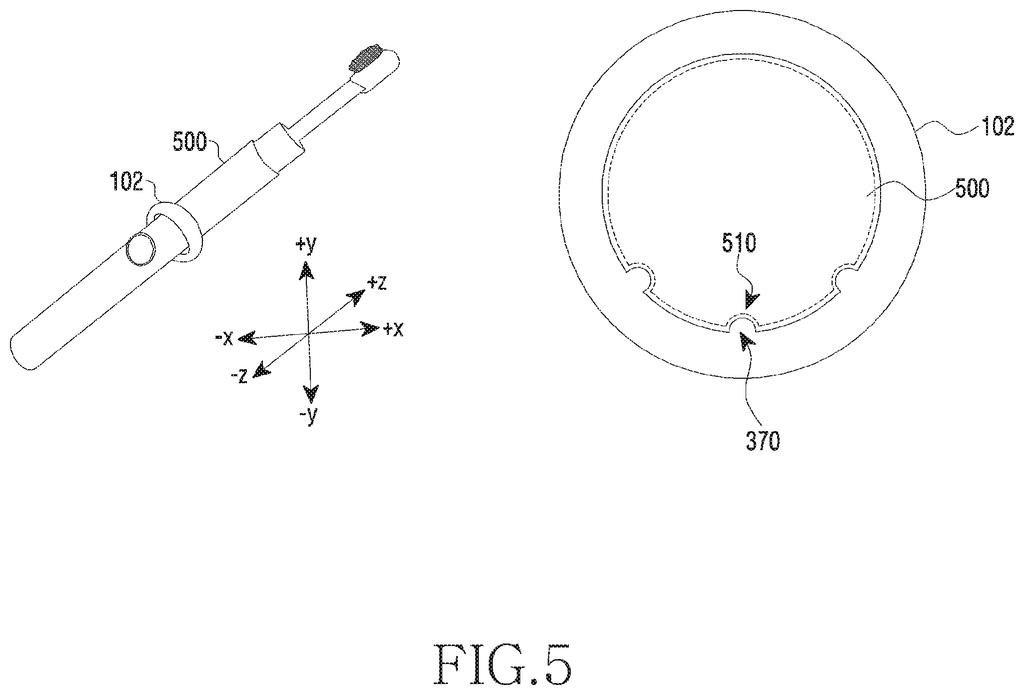
What Samsung's toothbrush-coaching wearable does
You're brushing before bed, half asleep, and your phone notices you've been skimming the inside of one back tooth. A tip pops up showing how to fix it.
Here's what Samsung is describing. A small wearable, the kind you'd normally wear on your finger, snaps onto your toothbrush. Your phone realizes it's on a toothbrush instead of your finger, then pulls your dental records: your age, which teeth have been pulled or treated, whether you have braces or gum disease. From that, it picks a brushing technique made for you.
While you brush, the wearable tracks how the brush tilts, twists and presses. If your motion on a tooth drifts too far from the recommended one, the app shows you how to correct it. There's even a child mode for parents brushing a kid's teeth.
identify first data related to an electronic medical record of a user, based on detecting a coupling between a first external electronic device and a first object related to a tooth brushing activity of the user; …
Translation: It pulls up your dental records the moment you attach a smart device to your toothbrush.
How your brushing gets matched to dental records
The system has three pieces: a phone running a health app (the filing names Samsung Health), a wearable with motion and pressure sensors, and a server that holds your dental record. The phone decides the wearable is on a toothbrush when its blood-flow sensor stops picking up a pulse (so it isn't on skin), or when you press a button that turns on a brushing mode.
The phone then fetches your record. The filing mentions a server built on FHIR (a standard format for sharing health records between systems). The record can include X-ray or CT images, a list of treated or extracted teeth, and notes from your dentist. A sample table in the filing maps age and condition to a technique:
- Ages 5 to 9 with normal teeth: Fones or scrubbing methods
- Age 10 and up with normal teeth: a rolling method
- Gum disease: the Bass method
- Braces or implants: the Charter's method
Each technique is modeled as a pattern for each tooth: how the brush's tilt, twist and pressure should change over time as you cover the outer, top or bottom, and inner surfaces. As you brush, the wearable streams its readings to the phone, which builds your actual pattern and scores how close it is to the target. If the score falls under a set threshold, the app displays corrective guidance, down to a specific surface of a specific tooth.
The screen shows a tooth image based on your records. Extracted teeth get a dotted outline, you tap where to start, and teeth change color step by step as you brush. The filing also describes a button to send the results to your dental office.
… determine the similarity between the first tooth brushing pattern and the second tooth brushing pattern; and display guide information based on the first tooth brushing pattern based on determining that the similarity is less than a threshold level.
Translation: It compares your actual brushing to your dental prescription and pops up corrections if you deviate.
Why your dentist's advice could follow you home
Most of us got brushing advice once, as kids, and never got it updated. A dentist might tell you at a checkup that you're missing the inside of your lower molars, but by Tuesday night you've forgotten. This patent puts that advice at the sink, tuned to your mouth, whether you have braces, an implant or a missing tooth.
It also shows Samsung treating the wearable as a general sensor you can reuse, since the same device goes from your finger to your toothbrush. Note that this is a patent application, not a product, and it only works if your dentist's records can be shared digitally with your phone. That is not a given in many clinics.
Samsung's latest application is the 26th we've tracked in our body-reading wearables watchlist since June, a list that already includes a fingerprint-reading ring and a finger-and-wrist blood pressure screen.
If this works as described, the benefit is easy to feel: you learn which tooth you keep missing and how to fix it, instead of staring at a generic two-minute timer. Dentists give advice once or twice a year, and this would deliver it at the sink every night.
The catch is the plumbing. It helps only if your dentist's records are digital and can reach your phone, and that varies a lot by clinic and country. A clip-on sensor also has to earn a spot on a bathroom counter where many people already have a power toothbrush with a built-in timer.
People with braces and parents of small children would notice it most, since their brushing rules are the strictest and the easiest to get wrong. For everyone else, it's a sensible idea that stands or falls on how easy setup is.
Get our take in your Top Stories
Liked this breakdown? Add Patentlyze as a preferred source on Google, and our plain-English take shows up more often in your Top Stories the next time Samsung patent news breaks.
There are more where this came from
We read every patent application Big Tech publishes and send you the ones worth knowing. Plain English, free, every week.
The drawings
18 drawing sheets from US 2026/0315202 A1 · click any drawing to enlarge


Show the other 10 sheets


Want this weekly breakdown for a company we don't cover? Patentlyze Pro →
Be the first to weigh in