
Samsung Patents a Chip That Cuts Its Own Power Draw Based on Your Activity
Your phone is constantly listening to its own sensors, even when the screen is off. Samsung is filing patents to make that background sensing far cheaper in battery terms, by teaching a small chip to dial its own power up or down based on what it sees.
How Samsung's context hub trades power for speed on the fly
Your phone runs a small army of sensors around the clock: accelerometers, gyroscopes, proximity detectors, and more. Even when you're not actively using the phone, a background processor called a context hub is always reading those sensors, looking for cues like whether you've picked up the device or started walking. All that background work burns battery and constantly.
Samsung's patent describes a way for the context hub to recognize patterns in that sensor data and then match its own power draw to the moment. If the data looks calm and routine, the chip runs slow and cheap. If it looks like something important is happening, the chip ramps up so it can respond quickly and then wake the main processor at the right time.
The technical term for this is dynamic voltage-frequency scaling, which just means adjusting how fast and how hard the chip works. Samsung wants the context hub to handle that adjustment automatically, without waiting for instructions from the main processor.
… a context hub configured to: receive the context data from the plurality of sensors; identify a pattern of the context data; read the context input pattern information from the context input pattern information circuit based on the identified pattern; and trigger the main processor based on the context input pattern information.
Translation: A dedicated chip watches your daily routines and wakes up the main processor only when necessary.
How the hub reads sensor patterns and sets clock speed
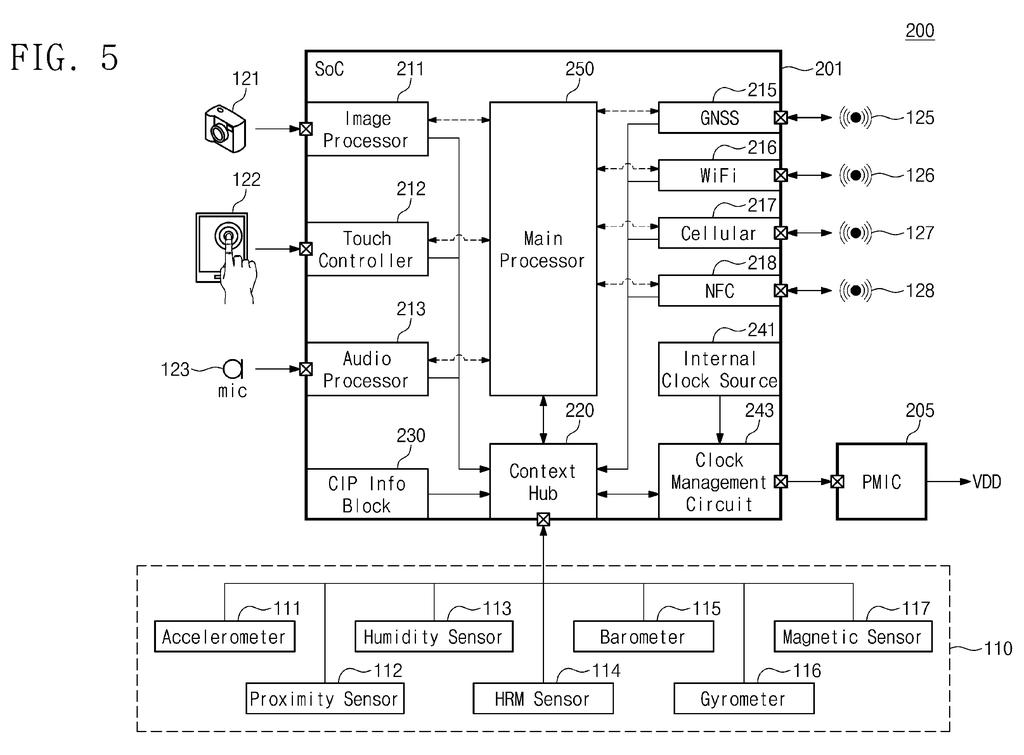
The system described in the patent has four main players:
- Sensors: a group of hardware monitors (motion, proximity, environmental, etc.) continuously generating what the patent calls context data.
- Context hub: a small, always-on processor dedicated to reading that sensor data so the main processor can sleep.
- Context input pattern information circuit: essentially a lookup table that stores known sensor-data patterns alongside the power settings appropriate for each.
- Main processor: the powerful central chip that stays dormant until the context hub decides something worth acting on has happened.
The core mechanism is pattern matching. The context hub watches the incoming sensor data, identifies which stored pattern it best matches, looks up the corresponding DVFS level (a combination of clock speed and voltage), and runs at that level. This is an important distinction from today's common approach, where power levels are often set by fixed schedules or by the main processor itself.
Once the hub has decided something notable is happening, it triggers the main processor. That trigger is mediated by the pattern information it already read, so the main chip wakes up with context rather than from a cold start.
The patent also covers the method itself, not just the hardware arrangement, which means the filing addresses both the circuit design and the software logic governing when and how power levels shift.
… determining a dynamic voltage-frequency scaling (DVFS) level corresponding to the identified pattern of the context data, and processing, at the context hub, the context data by using a clock signal or a driving voltage corresponding to the determined DVFS level.
Translation: The system adjusts its internal power levels and processing speed based on your current activity.
What this means for battery life on future Galaxy phones
Battery life remains one of the most complained-about aspects of modern smartphones, and always-on sensor processing is one of the least visible drains. If a context hub can genuinely match its power draw to what the sensors are actually reporting, rather than running at a fixed level all the time, the savings could add up across a full day of normal use, especially for features like step counting, sleep tracking, and fall detection that run continuously.
For you as a user, the practical outcome would be a phone that lasts longer without any change in the features you can use. Samsung's bet on always-on sensor intelligence suggests the company sees the context hub as increasingly central to how Galaxy devices handle health, location, and ambient awareness without waking the main chip.
Samsung's 259th filing in our cell phone patent coverage we've tracked since May follows cross-camera color consistency and sleep-mode screen color correction with yet another color-management idea.
The chip saves power by matching incoming sensor data against a pre-built library of known situations and adjusting its workload accordingly. What that design gives up is flexibility: any sensor event that falls outside the library gets handled at the wrong energy level, either burning battery on something routine or responding too slowly to something urgent.
Keeping that library accurate is harder than building it once. A pattern calibrated for one person's schedule may misfire for someone with irregular hours or an unusual routine, which turns accuracy into an ongoing maintenance problem rather than a solved one.
The trade still reads as worthwhile. Running the chip at full power constantly, or handing every decision to the main processor, both drain more than a well-matched system does. The fragility lives in the pattern library, and that is a real cost, but the underlying structure of matching effort to complexity is sound.
There are more where this came from
We read every patent application Big Tech publishes and send you the ones worth knowing. Plain English, free, every week.
The drawings
14 drawing sheets from US 2026/0299668 A1 · click any drawing to enlarge


Want this weekly breakdown for a company we don't cover? Patentlyze Pro →
Be the first to weigh in