
Samsung
Samsung · Software · Filed Mar 2, 2026 · USPTO published Aug 13, 2026 · Aug 13 release
Samsung Patents a Way to Tell a Paired Device Which Tasks Can't Wait
When your phone asks a paired device to do something, it usually doesn't explain how urgent that request is. Samsung's new patent wants to change that by attaching a priority label to every task sent across the connection.
- Publication number
- US 2026/0236297 A1(US20260236297A1)
- Applicant
- SAMSUNG ELECTRONICS CO., LTD.
- Filed · Published
- Mar 2, 2026 · Aug 13, 2026
- Inventors
- Kyungmin KANG, Gayong SONG, Jihun CHAE, Jaehyuk SHIM, Youngho CHOI, Taeyoung LEE, Chulmok LEE, Youngjin KIM
- Status when we published
- Waiting for an examiner
- Document
- 20 claims
- US classification
- 709/206
- Parent application
- Continuation of PCT/KR2026/002446 (filed Feb 10, 2026)(PCTKR2026002446)
How Samsung's priority signals work across paired devices
A smartwatch waits on instructions from a nearby phone, not knowing whether the app sending those instructions is running in the background or actively on screen in front of a user. That gap can slow things down at exactly the wrong moment, and you're the one who notices the lag.
Samsung's patent addresses this by having the phone check how important the app making a request actually is, using the CPU priority score the operating system already assigns to every running process. If that score is above a set threshold, the phone bundles a small "boost message" alongside the task request it sends to the paired device.
The paired device receives both pieces together: the task itself and the signal that this task comes from a high-priority process. It can then decide to move that work to the front of its own queue. The idea is that devices working together should share not just data but context about how urgently that data is needed.
… based on determining that a CPU priority of the first process is higher than a threshold level, generate, a boost message including CPU priority information of the first process; and transmit, through the communication circuit, the first task request and the boost message to the external device.
Translation: The device checks if a task is important enough to send a priority boost signal to another gadget.
How the boost message carries CPU priority to the external device
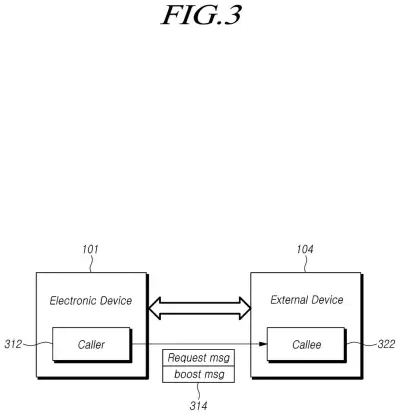
The patent describes a two-device system where an electronic device (think a smartphone or tablet) communicates with an external device (a smartwatch, wireless earbud hub, or similar companion gadget).
When a running application triggers a task request directed at the external device, the phone's processor checks the CPU priority of the process behind that request. CPU priority is a number the operating system assigns to every running process to decide which ones get processor time first; a foreground app a user is actively using typically carries a higher priority than a background sync job.
If the priority clears a configured threshold level, the phone generates a boost message containing that priority information and transmits it through the communication circuit alongside the original task request. The external device receives both:
- The task itself (whatever work needs doing)
- The boost message (the context that this task is time-sensitive)
The external device can use the boost message to raise how it schedules or handles that work, effectively letting the requesting device's urgency propagate across the wireless link rather than being lost at the boundary between the two devices.
The disclosure provides an electronic device interacting with an external device. According to an embodiment, the electronic device may identify that a first task request for an external device occurs in a first process according to execution of a first application …
Translation: This patent describes how a phone or computer tells a connected device that a specific app needs immediate attention.
What this means for Galaxy phones and companion gadgets
For Galaxy phone and Watch users, the practical payoff is that time-sensitive interactions, like a real-time health measurement triggered by an on-screen workout app, should get faster responses from the paired device than a background data sync that happens to be queued at the same time. The phone is no longer treating every outbound request as equally important, and neither is the watch.
The design is fairly narrow in scope, applying only when paired devices communicate over an existing link, so it won't help when devices aren't already connected. Still, as Samsung extends its Galaxy ecosystem across phones, watches, earbuds, and tablets, scheduling coordination between those devices is a real friction point. Patentlyze covers plain-English patent summaries across the device-coordination and chip-scheduling space, where Samsung has been filing a steady stream of incremental system-level patents like this one.
Source: US 2026/0236297 A1 at the USPTO (PDF). Full patent text and figures are in the official publication.
Get our take in your Top Stories
Liked this breakdown? Add Patentlyze as a preferred source on Google, and our plain-English take shows up more often in your Top Stories the next time Samsung patent news breaks.
Add Patentlyze on Google
One click.
There are more where this came from
We read the new patents from Big Tech, carmakers and more and send you the ones worth knowing. Plain English, free, every week.
The drawings · 10 sheets
10 drawing sheets from US 2026/0236297 A1 · click any drawing to enlarge


Show the other 2 sheets


More from Samsung
All 1,662 Samsung patents →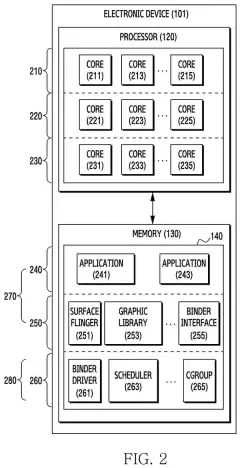
More in Software
All 816 Software patents →
Apple
Apple Patents a Grouped UI for Tracking Paired Accessories in Find My
Sony
Sony Patents a Paired-Rollback Storage System for Safe Software Updates
Samsung
Samsung Patents a System That Reads Your Screen to Control Connected Devices
Microsoft