
Samsung Patents a Way to Route Screen-Drawing Work to Its Fastest Chips Automatically
Samsung has filed a patent for a system that watches what your phone's apps are doing and automatically moves screen-drawing work to the fastest available processor cores, while leaving everything else where it is.
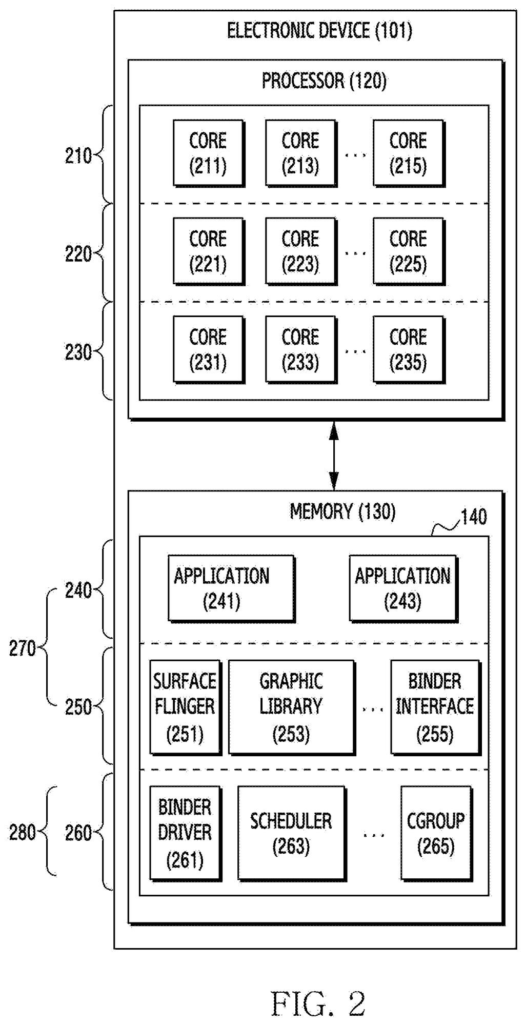
What Samsung's automatic core-switching actually does for your screen
You're scrolling through a photo gallery and the screen stutters slightly, even though your phone has plenty of processing power sitting idle. That happens because not all work gets handed to the right chip at the right time.
Samsung's patent describes a system that monitors what each piece of an app is doing and asks one question: is this task related to putting something on the screen? If yes, the phone shifts that task to a high-powered core. If not, the task stays wherever it already is, running on a lower-power core that sips less battery.
The goal is to make display work feel responsive without burning extra energy on tasks that don't affect what you see. Your phone already has different types of processor cores built in; this patent is about teaching the software to use that hardware more deliberately.
… allocate the first process to the first core for processing, and based on the process indicated by the request being related to a process other than a process for outputting an image to the display, maintain a core currently allocated to the first process as the core for processing the first process.
Translation: Screen drawing tasks go to the fast processor, while everything else stays wherever it is.
How the processor spots a rendering task and reroutes it
Modern smartphone processors contain two broad classes of cores: fast, high-frequency ones for demanding work and slower, low-frequency ones that conserve battery. Most task assignment happens at a coarse level, the operating system scheduler deciding priority without knowing much about whether a task actually touches the screen.
This patent describes a more targeted approach. When an application launches a process, the device identifies whether that process is connected to a rendering process (the specific task responsible for sending image frames to the display). If it is, the system moves it onto a first core running at a higher frequency range. If the process is unrelated to rendering, the system does nothing and leaves it on whatever core it was already using.
The key distinction is between processes that sit in the rendering pipeline and processes that do background work like fetching data, logging, or handling network responses. Only the former gets the upgrade.
- The device intercepts a process request from an application.
- It checks whether the requested process is linked to the display-output process.
- If linked, it reallocates to the faster core. If not, it maintains the current assignment.
What this means for phone smoothness and battery life
For everyday users, this is about frame consistency: the visual smoothness you notice when scrolling, switching apps, or playing a game. Dropping a single frame of animation is imperceptible in isolation, but the cause is almost always a rendering-related task that didn't get CPU headroom in time. A system that automatically prioritizes those tasks could reduce those micro-hiccups without the user adjusting any settings.
The patent also has a battery angle. By leaving non-rendering tasks on lower-power cores, the device avoids promoting everything indiscriminately to its most power-hungry chips. Samsung keeps filing on processor-level display optimization, and this filing fits a pattern of trying to squeeze more efficiency out of hardware that already exists in Galaxy devices rather than just increasing raw clock speeds.
Samsung's 253rd filing in our cell phone coverage since May adds to a run of antenna work, including one on keeping antennas active when folded and one on using the frame as an antenna.
Claim 1 covers one specific decision: when a task arrives, the device checks whether that task is connected to the job of putting images on screen, and if it is, the device moves that task to the faster processor. That relationship check, and nothing else, is what Samsung is protecting.
The claim is narrow in a meaningful way. It does not cover every method of steering tasks to faster processors, only this particular "is it linked to the image-output job?" test. A device running different logic to make the same routing decision would fall outside it entirely.
That boundary matters because the decision Samsung is patenting is invisible to the person holding the phone, yet it is the difference between a scroll that feels like glass and one that stutters. Samsung is treating that split-second assignment of the right computing power to the right task as precise enough to own, and the claim text backs that up.
There are more where this came from
We read every patent application Big Tech publishes and send you the ones worth knowing. Plain English, free, every week.
The drawings
11 drawing sheets from US 2026/0288535 A1 · click any drawing to enlarge


Want this weekly breakdown for a company we don't cover? Patentlyze Pro →
Be the first to weigh in