
Samsung Patents an Image Sensor That Splits Focusing and Color Into Separate Pixel Groups
Samsung has filed a patent for a camera sensor that handles autofocus and color capture in dedicated, electrically separated pixel groups on the same chip. The goal is cleaner data for each job, rather than asking every pixel to do both at once.
What Samsung's dual-job camera sensor actually does
Imagine you're taking a photo of a fast-moving subject and your phone's camera hunts around, struggling to lock focus before the moment is gone. That frustrating delay often comes down to how the image sensor collects two kinds of information at the same time: where to focus, and what color everything is.
Samsung's patent describes a sensor that assigns those two tasks to separate groups of pixels. One group gathers phase data, which tells the camera how far off focus it is and in which direction to correct. The other group captures color image data. A small electrical barrier between the groups keeps their signals from mixing.
Each group of four pixels also shares a single readout point at its center, and two small lenses sit over each group, one per pair of pixels. That arrangement is specific hardware, not a software trick, which means any improvement has to come baked into the chip itself.
output phase data based on at least a portion of phase signals received from the first pixel group; and output image data based on at least a portion of color signals received from the second pixel group, …
Translation: The sensor processes information separately for autofocusing and for capturing the actual picture.
How the pixel groups divide phase and color duties
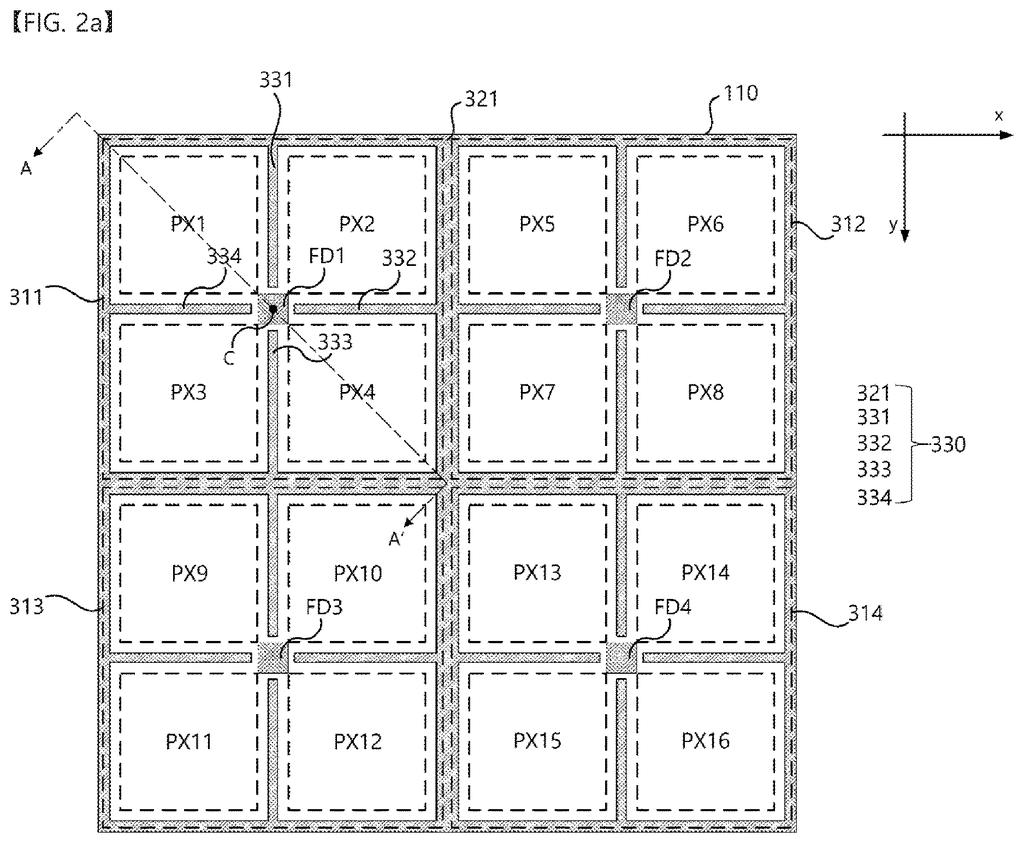
The patent describes an image sensor built from repeating units of eight pixels arranged in two side-by-side 2×2 grids.
The first pixel group (pixels one through four) is dedicated to phase detection autofocus (PDAF). Phase detection works by comparing two slightly offset views of the same scene to calculate how far and in what direction the lens needs to move to achieve focus. Two small lenses sit over this group, one covering the top two pixels and one covering the bottom two, creating that offset perspective. All four pixels in the group share a single floating diffusion node (a tiny charge-collection point) at the center, which is how their signals are combined before being read out.
The second pixel group (pixels five through eight) handles standard color image capture. A device isolation pattern, essentially an electrical wall etched into the silicon, runs between the two groups. Critically, that wall also extends between each individual pixel inside the first group, keeping their phase signals from leaking into each other.
The readout circuit then processes the two groups separately: phase data comes from the first group, image data from the second. By keeping the two signal types physically and electrically separated, the sensor avoids the crosstalk (unwanted signal mixing) that can degrade both autofocus accuracy and image color fidelity.
What this means for autofocus speed and image quality
For anyone who takes photos of moving subjects, better autofocus hardware is a direct quality-of-life improvement. When phase detection pixels share space with color pixels on the same sensor, the camera has to make compromises in how it reads each. A dedicated pixel group with its own electrical isolation removes some of those compromises at the hardware level.
Samsung's interest in image sensor architecture shows up across a long run of filings, which makes sense given that the company both makes sensors for its own Galaxy phones and sells them to other manufacturers. A sensor design like this, if it makes it into production, would affect cameras across a wide range of devices, not just Samsung's own flagship line.
Samsung's 139th filing we've tracked in our camera sensor push since May builds on ideas like the refrigerator camera and the dual-metal light filter.
Hardware changes like this one live on a much longer road to your hands than a software update does. Samsung would need a new fabrication process, tiny lens arrays positioned precisely over specific pixel pairs, and a circuit designed to juggle two separate data streams at once. None of that ships in a patch.
The level of detail in the claims suggests real engineering effort rather than a placeholder. Exact pixel arrangements, a shared collection node at the center of each group, a carefully spaced electrical barrier between groups: that specificity usually means someone has built or at least modeled the thing.
The most plausible route to a product is a future premium camera sensor where sharper, faster focusing is the headline selling point. How many generations away that is depends on manufacturing yield and cost, and the patent is silent on both.
There are more where this came from
We read every patent application Big Tech publishes and send you the ones worth knowing. Plain English, free, every week.
The drawings
17 drawing sheets from US 2026/0304972 A1 · click any drawing to enlarge


Want this weekly breakdown for a company we don't cover? Patentlyze Pro →
Be the first to weigh in