
Samsung
Samsung · AI / ML · Filed Feb 6, 2026 · USPTO published Aug 13, 2026 · Aug 13 release
Samsung Patents a Way to Tune AI Models Using Low-Resolution Images
Training an AI model from scratch is expensive and slow, largely because of the sheer size of the images involved. Samsung's new patent describes a shortcut: figure out the best training settings using small, low-resolution images first, then scale up.
- Publication number
- US 2026/0236789 A1(US20260236789A1)
- Applicant
- SAMSUNG ELECTRONICS CO., LTD.
- Filed · Published
- Feb 6, 2026 · Aug 13, 2026
- Inventors
- Kikyung KIM, Saehyun AHN, Chanho AHN, Seungju HAN, Sungjoo SUH
- Status when we published
- Waiting for an examiner
- Document
- 20 claims
- US classification
- 706/25
How Samsung speeds up AI training on the cheap
Ever tried to find the best seasoning for a big pot of soup by tasting the whole batch every time you adjust the recipe? You'd run through your ingredients fast. The smarter approach is to taste a small spoonful instead.
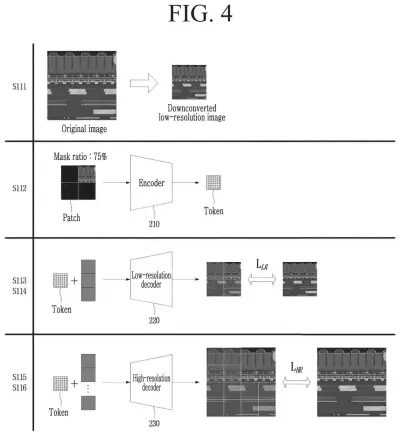
Samsung is applying the same logic to AI training. When building an image-processing AI, engineers have to dial in dozens of settings called hyperparameters (think of them as the recipe's ingredient ratios). Normally, testing each combination means running the model on full-size, high-resolution images, which takes a lot of time and computing power. Samsung's patent describes doing that search on low-resolution images instead, which are much cheaper to process, finding the winning settings there, and then using those settings when training on the real thing.
The practical payoff is that Samsung could train image AI faster and at lower cost, which matters whether the goal is a better camera algorithm, a photo-enhancement chip, or an on-device AI that improves your photos in real time.
performing first pre-trainings of the AI model using a first low-resolution image set according to sets of values of hyperparameters, each set of values comprising values respectively corresponding to the hyperparameters …
Translation: The system tests different model settings by training the AI on a set of low-quality images.
How the low-resolution pre-training pipeline works
The patent describes a two-phase process repeated at reduced image size to find the best hyperparameter values (the configuration dials, like learning rate or batch size, that shape how an AI learns) before committing to expensive full-resolution training.
- First pre-training: The AI model is trained multiple times from scratch on a set of low-resolution images, each run using a different combination of hyperparameter values. Low-resolution here means images smaller than what the finished model will actually process, so each run is faster and cheaper.
- First fine-tuning: Each pre-trained version of the model is then fine-tuned on a second low-resolution image set, still using its respective hyperparameter combination. Fine-tuning (adjusting a mostly-trained model on a more targeted dataset) is the step that usually polishes raw capability into real-world accuracy.
- Optimal value selection: After both phases, the system compares performance metrics across all the combinations and picks the hyperparameter values that produced the best results.
The key insight is that the relative ranking of hyperparameter combinations tends to be consistent whether you test on small or large images. So finding the winner at low resolution is a good proxy for the winner at full resolution, without paying the full computational bill.
… wherein the low-resolution image set includes first low-resolution images that are low-resolution relative to a resolution that the AI model is capable of performing inference on …
Translation: The images used for training are smaller and less detailed than the images the AI is designed to analyze.
What this means for Samsung's on-device AI ambitions
On-device AI, especially for camera processing and photo enhancement, is a competitive battleground for Samsung. Every efficiency gain in the training pipeline translates directly into the ability to ship more capable AI features, or to update them more frequently, without ballooning the compute costs. If this method works reliably across model types, it could also shrink the time between a new AI architecture being discovered and it being ready to deploy in a Galaxy device.
The latest Big Tech patents in AI model training show a clear trend toward efficiency tricks that reduce the cost of the experimentation phase, and Samsung's low-resolution proxy approach sits squarely in that current.
Source: US 2026/0236789 A1 at the USPTO (PDF). Full patent text and figures are in the official publication.
Get our take in your Top Stories
Liked this breakdown? Add Patentlyze as a preferred source on Google, and our plain-English take shows up more often in your Top Stories the next time Samsung patent news breaks.
Add Patentlyze on Google
One click.
There are more where this came from
We read every patent application Big Tech publishes and send you the ones worth knowing. Plain English, free, every week.
The drawings · 7 sheets
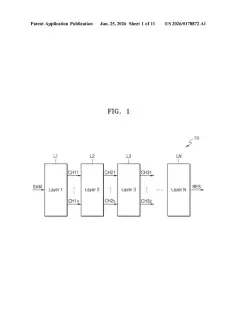
7 drawing sheets from US 2026/0236789 A1 · click any drawing to enlarge


More from Samsung
All 1,629 Samsung patents →
More in AI training & infrastructure
All 316 AI training & infrastructure patents →
Nvidia
Nvidia Patents an Automated Grading System for Robot-Controlling AI Models
Qualcomm
Qualcomm Patents a Method to Speed Up Image Data Processing for AI Training
X (Google)
Google Files Patent for AI System That Corrects Earthquake Sensor Timing Errors
IBM