
Samsung Patents a Glass-and-Plastic Cover for Foldable Phone Screens
Foldable phones need a screen cover that bends like plastic but feels and resists damage like glass. Samsung's answer is to stack both and put a hard coating on top.
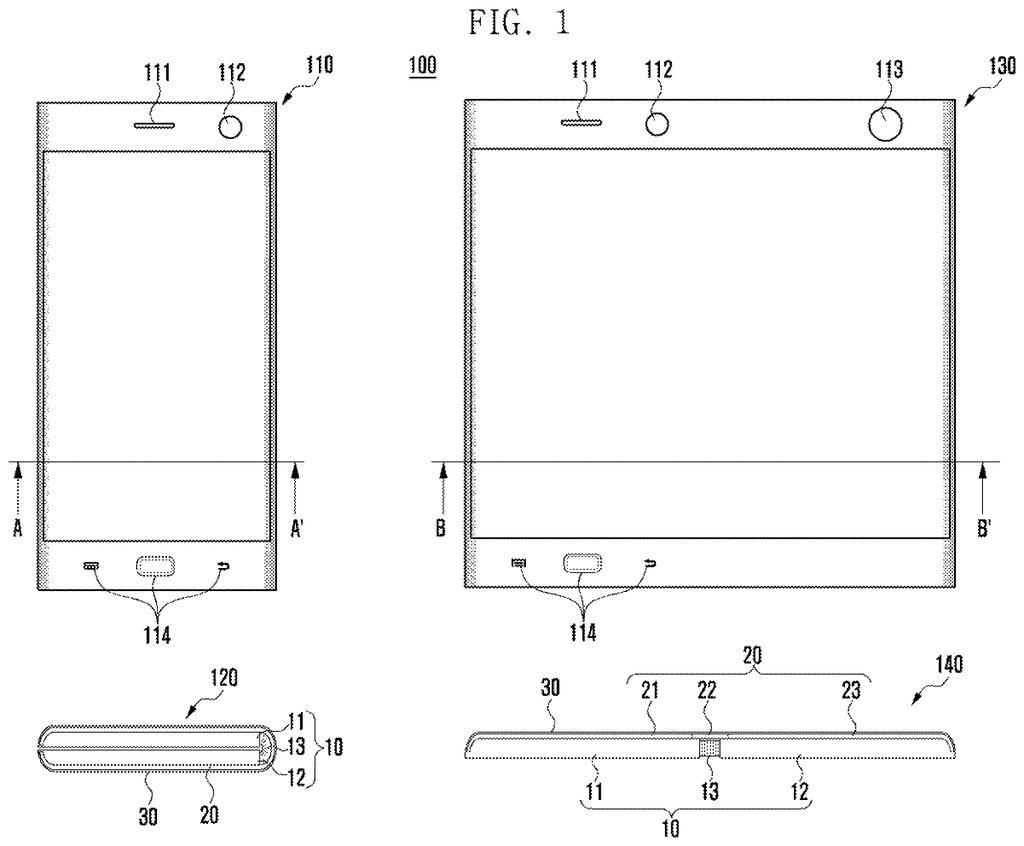
What Samsung's two-layer foldable cover actually is
Glass feels great under your finger, but glass thin enough to fold can snap. Plastic bends all day without complaint, but it scratches easily and a pen or a poke can dent it. That's the bind every foldable screen cover is stuck in, and it's the one Samsung's patent tries to get out of.
The idea is to use both. Samsung describes a cover with a thin sheet of glass and a sheet of plastic glued together, with a hard anti-scratch coating on top. The plastic and the glue beneath it soak up pokes, the glass gives you that smooth, solid touch, and the glue is soft enough to let the layers slide a little as the phone folds.
The filing also leaves a small gap between the screen and the phone's frame, so a hit is absorbed by the softer display underneath instead of slamming into a rigid edge.
… a glass layer having a first surface hardness, a polymer layer having a second surface hardness and attached to the glass layer via an adhesive layer located therebetween, and a coating layer formed on the polymer layer and having a third surface hardness higher than the second surface hardness.
Translation: The screen protector stacks glass, plastic, and adhesive together with a tough outer coating.
How the layers and the slippery glue fit together
The main claim describes a foldable device with two housing halves that open and close around a flexible display. Over the display sits an outer layer made of a glass layer and a polymer (plastic film) layer, bonded by an adhesive layer in between. A coating layer on the polymer is harder than the polymer itself, and a dependent claim calls it an anti-scratch layer.
The filing puts numbers on this. The glass is rated at about 2H, a rating on a surface-hardness scale. The description gives both the glass and the plastic a thickness of roughly 0.025 to 0.2 mm, and says the finished window can bend to a radius of 3 mm or less.
A few supporting details stand out:
- Slip-friendly adhesive: when the phone folds, the layers shift slightly against each other, so the glue has to let them slide instead of tearing.
- Zoned glue: the description splits the adhesive into sections, stiffer over the flat halves and softer over the fold. Stiffness is measured as Young's modulus: 200 KPa or more for flat parts, 10 to 100 KPa at the fold.
- Edge gap: the display sits slightly back from the frame, and the cover reaches past it toward the frame. The filing wants the unsupported strip kept to 0.25 mm or less, with an optional resin support underneath.
… a polymer layer, a glass layer interposed between the polymer layer and the screen, and an adhesive layer interposed between the polymer layer and the glass layer.
Translation: A thin layer of glass is sandwiched between a plastic top layer and the display screen.
Why a tougher fold-friendly cover matters to you
If you carry a foldable, this targets the two things that wear a cover down: scratches from daily life and cracks from folding. A harder coating on top and glass underneath is meant to give you the feel of a regular phone screen without glass's usual trouble with bending.
For Samsung, the pitch is durability, which matters for a product whose screen has to flex thousands of times. The filing also says the window can be replaced easily, which hints at repair as a goal. It is a continuation of earlier applications dating back to 2016. As always, a patent application describes an approach, not a shipping product.
Samsung's 96th filing we've tracked since May in our foldable phone patents watch follows work like reducing crease wiring and a triple-fold edge guard.
If you own a foldable, you already know the weak spot is the screen cover. You would notice a better one in small moments: keys sharing your pocket, a fingernail, a stylus pressed a little too hard.
The slip-friendly glue is the detail that matters most for how long the phone lasts. Folding hundreds or thousands of times is what splits stiff adhesive, and the filing answers that directly with a softer glue only where the phone bends.
Whether you ever feel the difference depends on thickness and price, and the filing settles neither. It still goes after a daily annoyance for foldable owners, and the fixes it describes are specific enough to test.
Get our take in your Top Stories
Liked this breakdown? Add Patentlyze as a preferred source on Google, and our plain-English take shows up more often in your Top Stories the next time Samsung patent news breaks.
There are more where this came from
We read every patent application Big Tech publishes and send you the ones worth knowing. Plain English, free, every week.
The drawings
9 drawing sheets from US 2026/0349475 A1 · click any drawing to enlarge


Show the other 1 sheets

Want this weekly breakdown for a company we don't cover? Patentlyze Pro →
Be the first to weigh in