
Samsung
Samsung · Software · Filed Jul 1, 2026 · USPTO published Nov 12, 2026 · This week's release
Samsung Patents a Group Chat Tool That Drafts a Different Reply for Each Person
Samsung's patent describes a group chat helper that reads the room, then drafts a different suggested reply for each person waiting on you. It can even work out that you're asleep and say so.
- Publication number
- US 2026/0361670 A1(US20260361670A1)
- Applicant
- Samsung Electronics Co., Ltd.
- Filed · Published
- Jul 1, 2026 · Nov 12, 2026
- Inventors
- Dongil SON, Hyeongseok KIM, Sungkweon PARK, Soonsang PARK, Jaeyung YEO, Yongjoon JEON
- Status when we published
- Waiting for an examiner
- Document
- 20 claims
- US classification
- 709/206
- Parent application
- Continuation of PCT/KR2024/017661 (filed Nov 8, 2024)(PCTKR2024017661)
What Samsung's per-person reply patent does
Ever opened a group chat after a busy afternoon and found three people waiting on three different answers from you? Your sister wants to know about dinner, a coworker dropped a link, and a friend posted a photo from a concert.
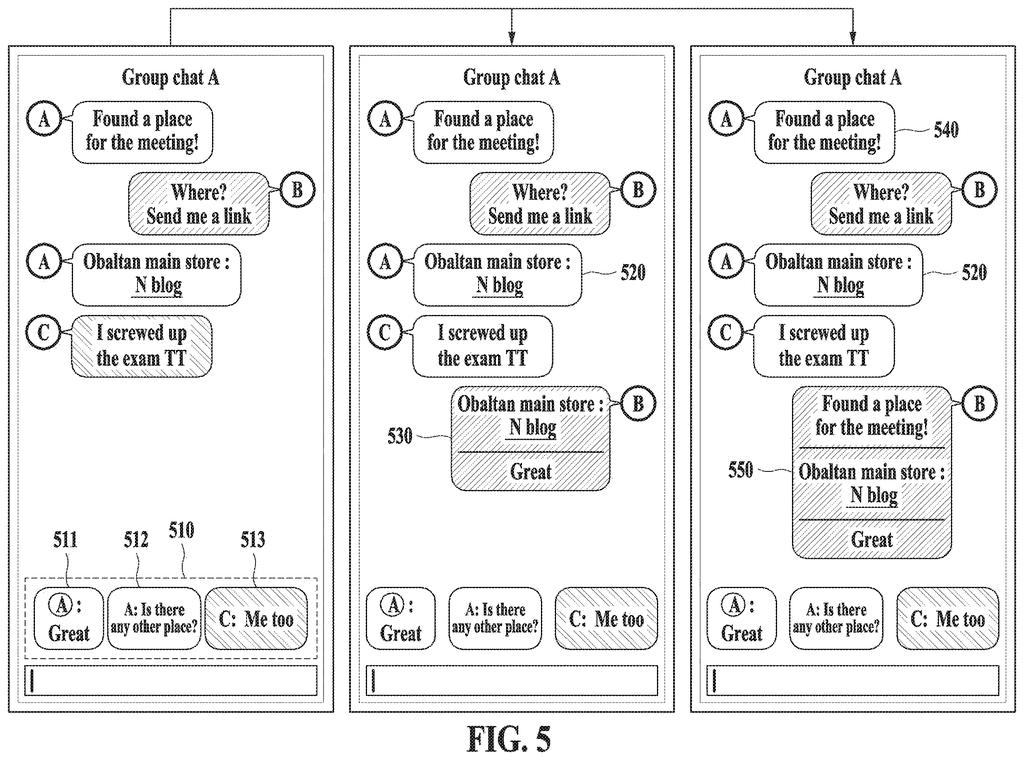
Samsung's patent describes a phone feature that reads the whole conversation, then reads each person's messages separately, and offers a suggested reply for each of them. Every suggestion comes tagged with that person's name, profile picture or bubble color, so you know who it's meant for. Tap one, and the app can show you the exact message it answers.
The filing also describes replies that change with the situation: a casual tone for family, a more polite one for colleagues, and a reply that mentions you're asleep if your phone's sensors suggest you are.
parse a chat of a plurality of participants joining a communication application (app), classify and analyze the parsed chat of the plurality of participants into an entire chat and a participant-wise individual chat …
Translation: The software reads a group conversation and breaks it down into both the full group chat and separate one-on-one histories.
How the phone sorts whole-chat and personal context
Claim 1 covers a device that parses a group chat (splits each message into small units of meaning), then sorts the chat into two views: the entire chat and each participant's individual chat. It writes a suggested reply for each participant and displays it together with participant information, such as a name, an ID, a profile picture or that person's bubble color.
The filing says a reply for one person can use only that person's messages, or those messages plus a summary of the whole chat so the suggestion stays on topic. The analysis can also favor a current topic (say, travel) or a time window the user sets, such as the last six months.
Beyond claim 1, the description and other claims add several extras:
- Reading a shared link or analyzing a shared photo or video before suggesting a reply.
- Searching your phone, for example your gallery, when someone asks for a family vacation photo.
- Picking a polite or casual tone based on how the participants relate to each other.
- Adding extra suggestions when someone deletes a message.
- Using sensor data to detect that you're sleeping or exercising.
Suggestions are ranked so that more recent and more urgent messages (phrases like "hurry") come first. Some of the analysis could run on an outside server instead of the phone.
… generate a recommended response for each of the plurality of participants, based on the analyzed entire chat and the analyzed individual chat …
Translation: It creates a custom suggested reply for every person in the group using the context of both the overall and individual chats.
Why group chat replies could get more personal
If you live in group chats, the pitch is simple: less typing and less scrolling back to remember who asked what. The filing describes answers ranked by how recent and urgent each message is, a reply that can pull a photo from your gallery without leaving the chat, and a tone that shifts between family and coworkers. It lists phones and wearables among the devices that could run it.
The catch is how much the feature has to read. To suggest replies per person, it studies your chat history with each participant, plus links, images and sensor data. The filing allows some of that analysis to run on an outside server, so how it handles your private conversations would matter as much as how clever the suggestions are.
Samsung's 1609th filing in our Samsung coverage since May follows work like a face-tracking 3D screen and a battery-aware photo cleaner.
Source: US 2026/0361670 A1 at the USPTO (PDF). Full patent text and figures are in the official publication.
Get our take in your Top Stories
Liked this breakdown? Add Patentlyze as a preferred source on Google, and our plain-English take shows up more often in your Top Stories the next time Samsung patent news breaks.
Add Patentlyze on Google
One click.
There are more where this came from
We read every patent application Big Tech publishes and send you the ones worth knowing. Plain English, free, every week.
The drawings · 18 sheets
18 drawing sheets from US 2026/0361670 A1 · click any drawing to enlarge


Show the other 10 sheets


More from Samsung
All 1,629 Samsung patents →
More in Software
All 753 Software patents →
Microsoft
Microsoft Patents a Hidden Chat Channel That Only Meeting Organizers Can See

Microsoft
Microsoft Patents a Shared Multi-User AI Chat Session for Copilot

Microsoft
Microsoft Patents a Way to Pull Your Pre-Meeting Chat Into the Meeting Itself

Apple
No comments yet