
Samsung
Samsung · Display · Filed Jun 25, 2026 · USPTO published Nov 12, 2026 · This week's release
Samsung Patents a 3D Screen That Tracks Which Way Your Face Is Turned
Samsung's patent for a 3D screen treats your shoulders as a clue to where your head is turned. It then follows just a handful of points instead of re-finding your eyes and nose in every frame.
- Publication number
- US 2026/0361842 A1(US20260361842A1)
- Applicant
- SAMSUNG ELECTRONICS CO., LTD.
- Filed · Published
- Jun 25, 2026 · Nov 12, 2026
- Inventors
- Daewon YOON
- Status when we published
- Waiting for an examiner
- Document
- 15 claims
- US classification
- 382/154
- Parent application
- Continuation of PCT/KR2024/096711 (filed Dec 11, 2024)(PCTKR2024096711)
What Samsung's 3D screen does with your face
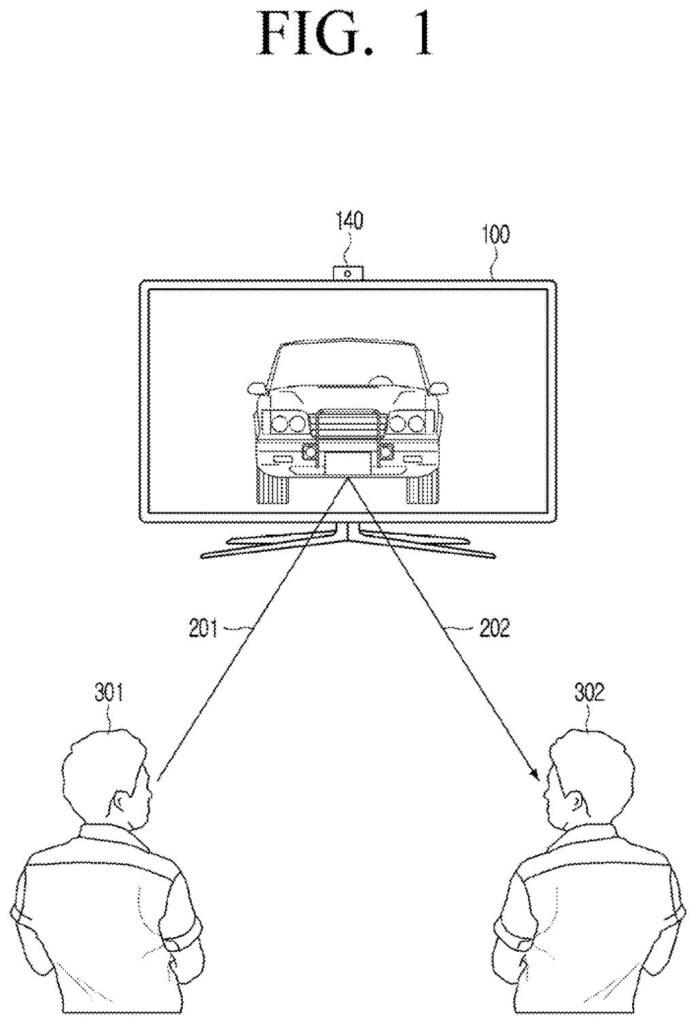
A 3D screen shows a car. The viewer standing on the right sees the front and right side of it, while the viewer on the left sees the front and left side. For that trick to work, the screen has to know where each person is and which way their face is pointing.
Samsung's patent describes a faster way to keep tabs on your face. The screen first grabs one clear, front-facing image of your face and shoulders and marks a few spots: the middle of your face, your jaw on both sides, and both shoulders. After that, it follows only those spots from frame to frame, instead of hunting for your eyes, nose and mouth all over again each time.
Your shoulders help because they show which way your upper body is turned, and your head usually stays within a limited range of that. The filing gives plus or minus 10 degrees as an example.
A display apparatus including a memory that stores information associated with a reference coordinate system defined with respect to an image and information associated with a plurality of reference points; a display; and at least one processor that controls the display to display a 3 D image corresponding to a direction of a face of a user.
Translation: The device uses stored visual data and a processor to adjust a three dimensional screen based on head position.
How five tracked points reveal your head turn
The claims cover a display with a memory and a processor that work from camera images. The memory holds a reference coordinate system (a set of invisible axes, like a map grid, anchored to your face) and a short list of reference points, including one at the center of your face and others at your shoulders.
Setup happens once, using a clear front-facing image. The system finds feature points (eyes, nose, lips, jawline, shoulder line) with standard detection methods. It then picks five reference points: face center, left and right jaw, left and right shoulder. The face center becomes the origin of the coordinate system.
After that, it follows only those five points. It watches how small patches of pixels move between frames (a technique called optical flow). The processor draws a circle for your face, with a fixed size and shape taken from the setup image, and checks where that circle sits in the reference system to get yaw, pitch and roll (turn, nod and tilt). Shoulder spacing shows your upper body direction: the closer your shoulders look, the more your torso is turned.
The filing also describes a neural network (software trained on examples) that turns the points into an angle. A reset rule is included too: if the points are lost for a set number of frames (60 is the example), or at regular intervals, the system deletes its setup and rebuilds it from a fresh image.
Why Samsung's face tracking reaches past screens
Glasses-free 3D screens only work if they know where you are and which way you face, and they have to keep up as you move. The filing says following a few points beats re-detecting your eyes, nose and mouth in every frame, and that using your shoulders makes the estimate more accurate. It gives no measured numbers to back that up.
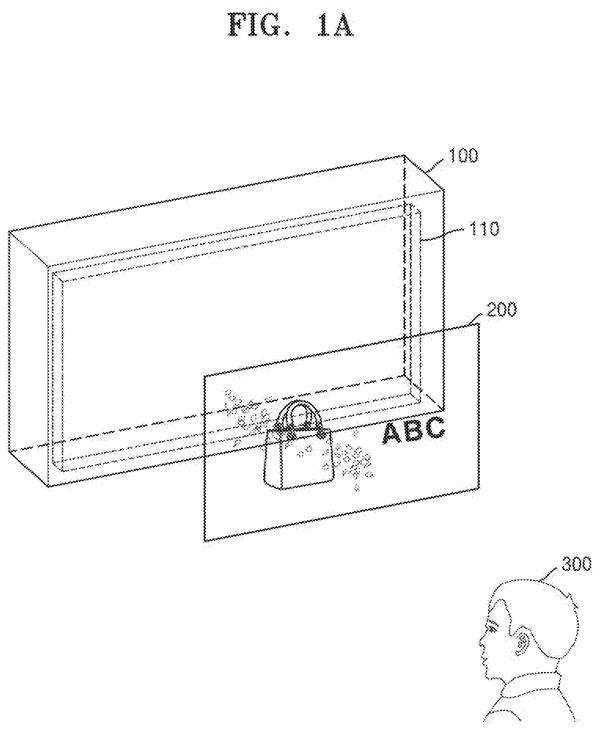
Samsung also describes the same method in a car head-up display (a driving display on the windshield) that adapts to the driver's face, a hologram projector, and a driver-monitoring system that beeps if your face stays pointed down. It mentions a robot that starts a conversation when you face it and a tool that logs how long you look at a book or screen. So the idea reaches well beyond 3D screens.
Samsung's 134th filing we've tracked in our display technology watchlist since May adds to a picture that includes a glow-behind messaging screen and a floating hand-tracking display.
Source: US 2026/0361842 A1 at the USPTO (PDF). Full patent text and figures are in the official publication.
Get our take in your Top Stories
Liked this breakdown? Add Patentlyze as a preferred source on Google, and our plain-English take shows up more often in your Top Stories the next time Samsung patent news breaks.
Add Patentlyze on Google
One click.
There are more where this came from
We read every patent application Big Tech publishes and send you the ones worth knowing. Plain English, free, every week.
The drawings · 9 sheets
9 drawing sheets from US 2026/0361842 A1 · click any drawing to enlarge


Show the other 1 sheets

More from Samsung
All 1,629 Samsung patents →
More in Display
All 730 Display patents →
Samsung
Samsung Files Patent for a Screen That Shows Flat and 3D Images at Once
Samsung
Samsung Patents a Way to Cut Always-On Display Power Without Dimming the Screen
Samsung
Samsung Patents a Display That Rolls Itself Into Position When You Add Another Screen
Samsung
No comments yet