
Samsung Files Patent for Floating Translated Captions on Calls in Third-Party Apps
Samsung describes a phone that subtitles your internet calls in real time, translating the other person's speech and floating the text over the call screen. It also works with calling apps Samsung didn't build.
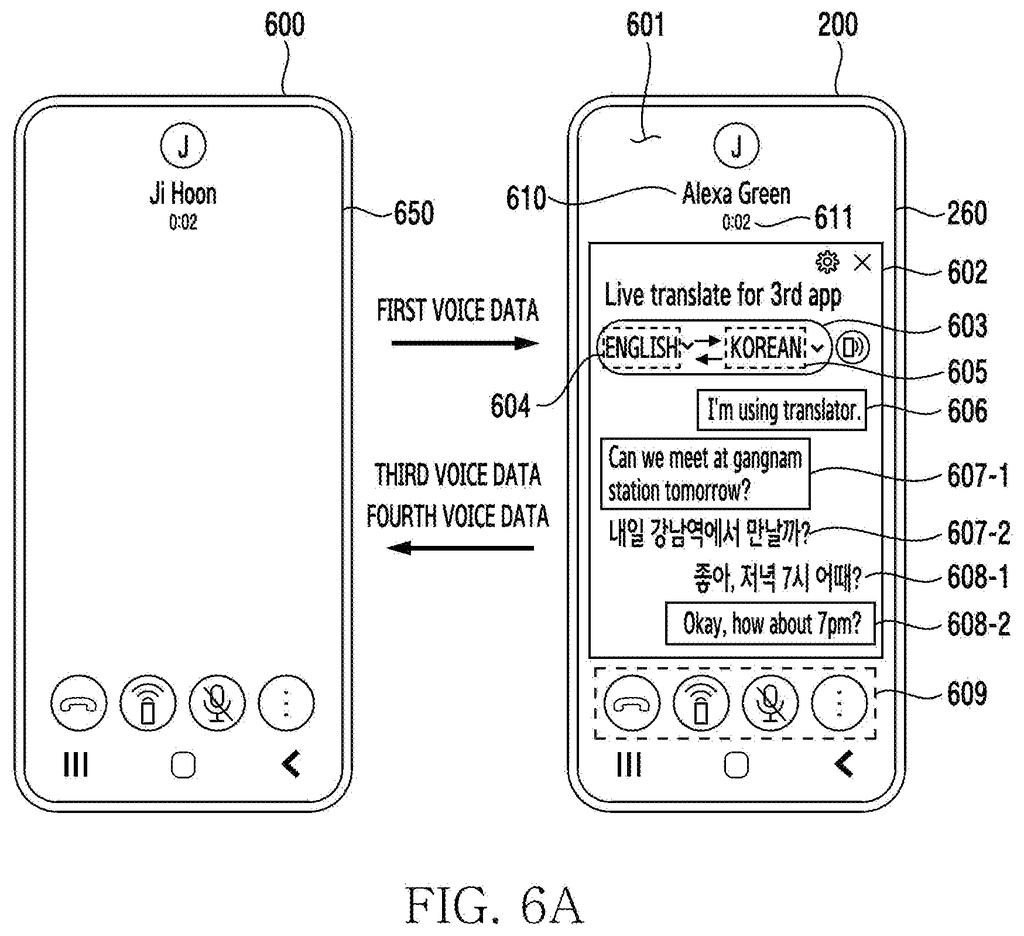
What Samsung's call-translation overlay does
You're on a video call with a supplier in another country, and every sentence she says is in a language you don't speak. You can't pause the call to paste her words into a translator.
Samsung's patent describes a phone that does the translating for you, live. As she talks, a semi-transparent box floats over the calling app and shows her words as written text, with your language right underneath. Your phone can also read the translation aloud, and when you reply in your own language, it can translate your words and send them to her as speech in hers.
The twist is that the calling app doesn't have to build any of this itself. The phone pulls the audio out of the app, so it works even if the person on the other end has no translation feature at all.
identify that a call connection with an external electronic device through an application related to a voice over internet protocol (VoIP) is established …
Translation: The phone detects when you start a voice call using an internet calling app.
How the phone pulls audio from other apps
Claim 1 covers the display piece. When a VoIP call (a call made over the internet through an app, rather than the regular phone network) is connected, the phone takes in speech in one language, turns it into text, translates that text into a second language, and shows both texts in an overlay on top of the calling app's screen.
The part that makes this work with outside apps is a voice data manager, a software component that pulls the call audio out of the app. Third-party calling apps don't normally hand their audio to other software, so the filing adds that path. From there the audio goes through speech recognition (software that turns speech into text, one sentence at a time), a translator, and text-to-speech (software that turns text back into a spoken voice). The description says the app may need to be authorized, and users can pick which apps get the feature in settings.
The description also covers these variations:
- The overlay can be semi-transparent and movable, with a slider to change how see-through it is.
- Original and translated text can differ in color or thickness so you can tell them apart.
- A handwriting area or keyboard lets you reply in text, which is translated and spoken to the other person.
- On a foldable phone, a half-folded screen can show the call on one half and the captions on the other. A fully closed phone can show them on the outer screen.
- In a group video call, only the person speaking a different language gets captions, shown over their video tile.
- The translation work can run on a server instead of the phone.
… displaying, through a display of the electronic device, a visual object including the first text and the second text, in an overlapping manner on a user interface for the application …
Translation: It shows the original and translated subtitles floating directly over the call screen.
Why this matters for calls across languages
If you talk with relatives, coworkers or customers in another language, your phone could act as the interpreter. The filing says it works whether or not the other person's device has any translation feature, and the calling app doesn't have to build the translation itself. You can read captions, hear the translation, or do both.
The details show Samsung thinking about real situations: a group video call where only one person speaks a different language, a half-folded phone with the call on one half and captions on the other, and a handwriting or typing box for replying without speaking. The phone also announces to the other person by voice that translation is on. Patent applications don't always become products, but this feature list is built around everyday use.
Samsung's 1447th filing we've tracked since May in our Samsung coverage extends the TV voice work seen in the privacy shutoff patent and the borrowed voice memory patent.
Claim 1 is short and wide. It asks for the parts every smartphone has (screen, speaker, microphone, memory, processor), then three steps: notice an internet call is live, turn the other person's speech into text in one language plus a translation in another, and show both texts floating over the calling app's screen.
Look at what claim 1 leaves out. The audio-grabbing software that makes this work with outside apps shows up only in claim 6, the spoken translation in claim 3, and the folding-phone layouts in claims 9 through 11. If granted as written, the core claim would reach any phone that lays original and translated captions over a call, however it gets the audio.
The one word that narrows it is 'superimposed.' A layout that puts captions beside the call instead of on top is handled separately, in the folding-phone claims. It is a broad, sensible claim on a feature plenty of people would use.
Get our take in your Top Stories
Liked this breakdown? Add Patentlyze as a preferred source on Google, and our plain-English take shows up more often in your Top Stories the next time Samsung patent news breaks.
There are more where this came from
We read every patent application Big Tech publishes and send you the ones worth knowing. Plain English, free, every week.
The drawings
16 drawing sheets from US 2026/0321261 A1 · click any drawing to enlarge


Show the other 8 sheets


Want this weekly breakdown for a company we don't cover? Patentlyze Pro →
Be the first to weigh in