
Qualcomm
Qualcomm · Chip · Filed Jun 10, 2025 · USPTO published Aug 20, 2026 · Aug 20 release
Qualcomm Patents Chip Technology That Stops Unauthorized Programs From Reading Sensitive Data
Every time a chip touches a block of memory, something has to decide whether that access is allowed. Qualcomm's new patent describes a way to make those checks faster and more flexible on the type of processors that power most phones and connected devices.
- Publication number
- US 2026/0244579 A1(US20260244579A1)
- Applicant
- QUALCOMM Incorporated
- Filed · Published
- Jun 10, 2025 · Aug 20, 2026
- Inventors
- Andrew DELLOW, Eckhard DELFS
- Status when we published
- Examiner raised objections; the company can respond
- Document
- 20 claims
- US classification
- 711/163
- Examiner
- MENDEL, JULIAN SCOTT (Art Unit 2133)
- Parent application
- Claims priority from a provisional application 63759825 (filed Feb 18, 2025)
How Qualcomm's memory permission lookup actually works
You're running several apps at once on your phone, and under the hood, each one is constantly reading and writing data in the chip's memory. The chip has to make sure none of those apps can snoop on memory that belongs to a different app or to the operating system itself. That gating process has to happen millions of times per second, so if it's slow or rigid, the whole device pays for it.
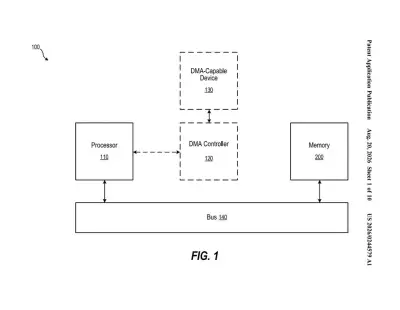
Qualcomm's patent describes a more flexible way to handle those checks. Instead of baking access rules directly into a big table (which wastes space and is hard to update), the system stores a small ID number in the table and then looks up the actual rules in a set of quick-access registers. Think of it like a coat-check ticket: the table just holds the ticket number, and the rules live somewhere much faster to reach.
This approach is aimed at RISC processors, the family of chip designs that underpins nearly every smartphone, tablet, and smart-home gadget. More flexible memory protection means it's easier to carve a chip into isolated zones, which is a building block for running sensitive code safely alongside everyday software.
performing, during physical memory access, a table walk to identify a leaf-node containing permissions for supervisor domains (SDs) corresponding to a physical memory address space; …
Translation: The chip checks memory permissions during a memory lookup to see what rules apply.
Inside the table-walk and programmable-register lookup
The patent centers on what chip engineers call a Memory Protection Table Extension (MPTE), a scheme for controlling which software components can read or write to which parts of physical memory on a RISC-based chip.
The process works in three steps:
- Table walk: When the chip needs to access a memory address, it traverses a tree-shaped data structure to find the relevant "leaf node," the entry that describes permissions for that address range. A leaf node is simply the final, most specific entry in the tree, like reaching the last folder in a nested file-system path.
- Read the ID field: Instead of storing the full permission rules inside the leaf node, the node contains a compact identification value. This keeps the table small and easy to cache.
- Register lookup: The chip takes that ID and looks up the actual access rules in a set of programmable registers (tiny, ultra-fast storage locations baked into the processor). The registers hold the concrete yes/no permissions for each supervisor domain, which are isolated software zones (think: the secure payment environment vs. The regular app environment).
By separating the address-to-ID mapping from the rules themselves, the design lets system software change permission policies for many memory regions at once simply by updating a register, without rewriting the entire table.
… performing a look-up to determine access permissions for the supervisor domains from a set of programmable registers according to an identification (ID) value from the access control permissions field of the leaf-node.
Translation: It consults a special register to verify if the program is allowed to read the requested data.
What this means for chip security on mobile and IoT devices
Memory isolation is one of the core building blocks of device security. If a malicious app can read memory it isn't supposed to touch, it can steal passwords, intercept messages, or tamper with other apps. On mobile and IoT chips, where dozens of processes run simultaneously, enforcing those boundaries efficiently matters a lot for both security and battery life.
Qualcomm's approach, if it works as described, could make it cheaper (in silicon area and in clock cycles) to support more supervisor domains on a single chip, which means more fine-grained isolation without a proportional cost. That's relevant for everything from flagship Android phones to the low-power RISC cores inside routers and wearables. Chip-level memory security is one of the faster-moving areas in Big Tech patent news, as companies race to harden processors against software-level attacks that hardware boundaries can stop cold.
Qualcomm's 317th filing we've tracked since May, part of our Qualcomm coverage, joins earlier work like a chip task-priority application and a sound-wave object locator.
Source: US 2026/0244579 A1 at the USPTO (PDF). Full patent text and figures are in the official publication.
Get our take in your Top Stories
Liked this breakdown? Add Patentlyze as a preferred source on Google, and our plain-English take shows up more often in your Top Stories the next time Qualcomm patent news breaks.
Add Patentlyze on Google
One click.
There are more where this came from
We read the new patents from Big Tech, carmakers and more and send you the ones worth knowing. Plain English, free, every week.
The drawings · 10 sheets
10 drawing sheets from US 2026/0244579 A1 · click any drawing to enlarge


Show the other 2 sheets


More from Qualcomm
All 637 Qualcomm patents →
More in Cell phone
All 496 Cell phone patents →
Samsung
Samsung Patents a Chip That Loads the Next Filter While the Current Image Renders
Apple
Apple Patents a Chip That Frees Stuck Memory Automatically When Apps Stall
Samsung
Samsung Patents Technology That Catches Data Errors Inside Storage Chips Automatically
Google