
Samsung Files Patent for Headset Lenses That Bounce Light to Stay Slim
Samsung has described a headset lens that folds the path of light back on itself, so the optics can stay short while the picture stays wide and sharp.
What Samsung's folded-light headset lens does
Ever worn a VR headset for an hour and felt like you were balancing a brick on your nose? A big reason is the lenses. They have to sit a certain distance from the screen to make the picture look sharp and wide.
Samsung's patent application describes a way to shorten that distance. Instead of letting light travel straight from the screen to your eye, the lens stack bounces it back and forth inside itself, so the light covers a long path in a small space. It works like a hallway lined with mirrors: the trip is long even though the hallway is short.
The filing pairs this with at least three plastic lenses and a coating that acts as a half-mirror, aiming for a view of 100 degrees or more. The stated goal is good image quality in a lighter, smaller package that tires you out less.
… the beam splitter of the polarization assembly may include a reflective aspheric surface without an inflection point …
Translation: The internal mirror is shaped in a smooth, continuous curve to manage how light bounces around.
How light bounces twice inside Samsung's lenses
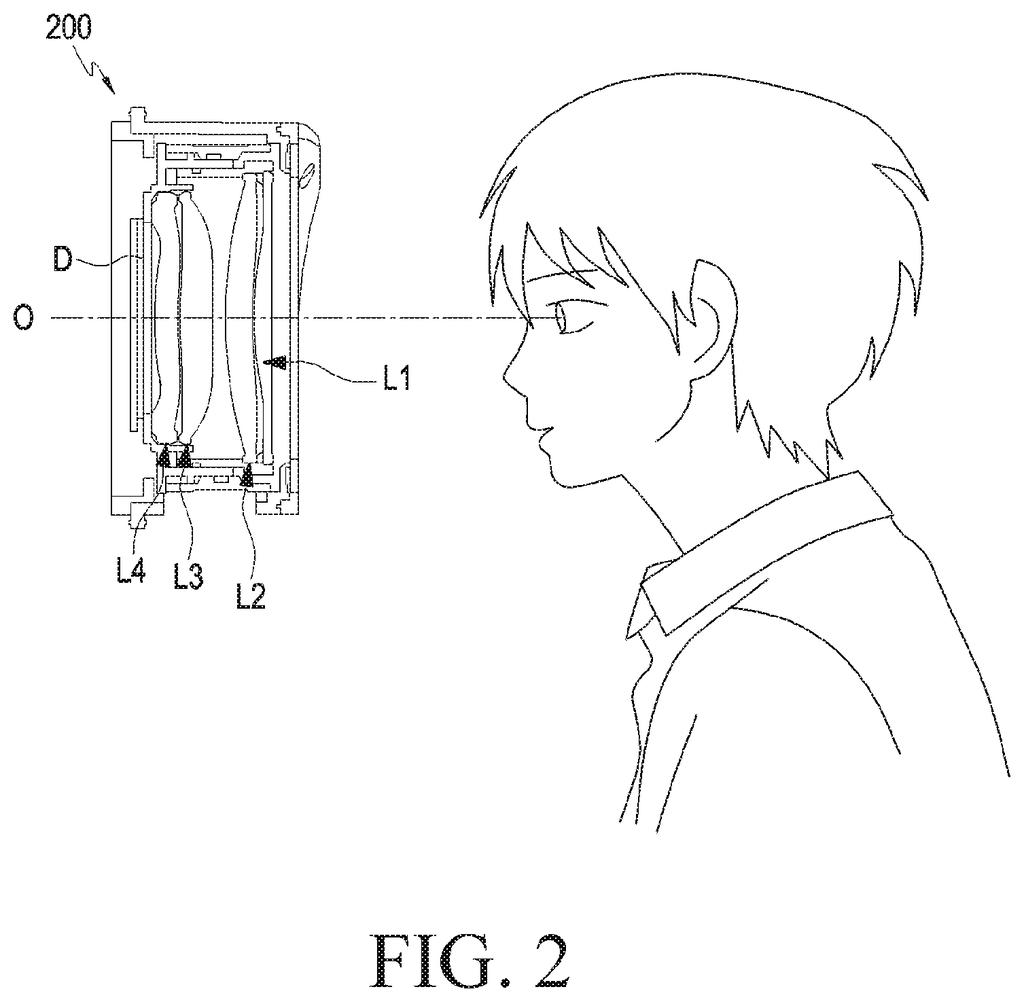
The invention is a lens system for a head-worn display, the optics that sit between a small screen and your eye in AR and VR headsets. It lines up at least three plastic lenses along one axis and builds in a polarization assembly (a set of light-filtering films). From your eye toward the screen, the assembly has a first film group, a beam splitter (a coating that passes about half the light and reflects the rest, like a half-silvered mirror), and a second film group.
Light leaves the screen and passes through the second films, which set its polarization (the orientation of the light waves). Quarter wave plates (thin films that rotate that orientation) let a reflective film send the light back, and the beam splitter reflects it again toward your eye. So the light is reflected at least twice, giving it a path much longer than the physical stack.
The claims add specific design rules:
- At least one lens has an Abbe number of 40 or less (a measure of how much a lens splits colors) and negative power, which the filing says helps control color fringing.
- The beam splitter's curved surface has no inflection point, meaning it never switches from curving one way to the other.
- The screen's height divided by the whole system's focal length must fall between 1 and 3.
One worked example has a 108 degree view, a 15.12 mm focal length and a 24.72 mm screen height, a ratio of about 1.63. The filing also shows other layouts, with the films on different lens surfaces and views from 100 to 108 degrees.
Why slimmer headsets matter for your face
If you have ever finished a long headset session with a sore neck or red marks on your face, this is the problem Samsung is aiming at. The filing says head-worn displays are used for gaming, industrial, medical and military work, and all of them need good image quality in a lighter, smaller body. Shorter optics could mean a slimmer front end and less pull on your head.
For Samsung, the design is a building block for any wearable that puts a screen close to your eye. The patent doesn't name a product, and a lens layout on paper says nothing about cost or manufacturing yield. It does show where the optical effort is going: wide views of 100 degrees or more in a shrinking package.
Samsung's 82nd filing we've tracked since May adds to a picture that includes faster object tracking and the folding camera idea, all part of the broader AR glasses race.
Headset weight is a real problem. Anyone who has worn one through a long session knows the front-heavy tug on the neck and the pressure on the cheeks, and it is a big reason people take the thing off.
The approach matches the problem well. Folding the light path is a common way to shrink lenses, and the filing goes after the side effect that comes with it: stray light and color fuzz that blur the picture. Fewer lens surfaces between the two reflective layers, plus a lens that cancels color fringes, target exactly that.
The filing is an optics blueprint full of lens curves, and it gives no figure for how much weight or thickness it saves. The size of the win hangs on numbers we can't see here, so call it a sensible, modest step on a problem that deserves more attention.
Get our take in your Top Stories
Liked this breakdown? Add Patentlyze as a preferred source on Google, and our plain-English take shows up more often in your Top Stories the next time Samsung patent news breaks.
There are more where this came from
We read every patent application Big Tech publishes and send you the ones worth knowing. Plain English, free, every week.
The drawings
13 drawing sheets from US 2026/0349262 A1 · click any drawing to enlarge


Show the other 5 sheets


Want this weekly breakdown for a company we don't cover? Patentlyze Pro →
Be the first to weigh in