
Samsung Files Patent to Brighten Dim Rooms in Headset Camera Views
Put on a headset that shows you the real world through its cameras, walk into a dim room, and everything turns murky. Samsung's patent application describes a way to brighten that video one pixel at a time, frame by frame.
What Samsung's low-light passthrough fix does
Today, a headset that shows you the world through its cameras struggles when the lights go down. The video comes out dark and flat, which makes it harder to see where you're walking and can leave you feeling uncomfortable. The camera is doing its best, but it captures only so much light.
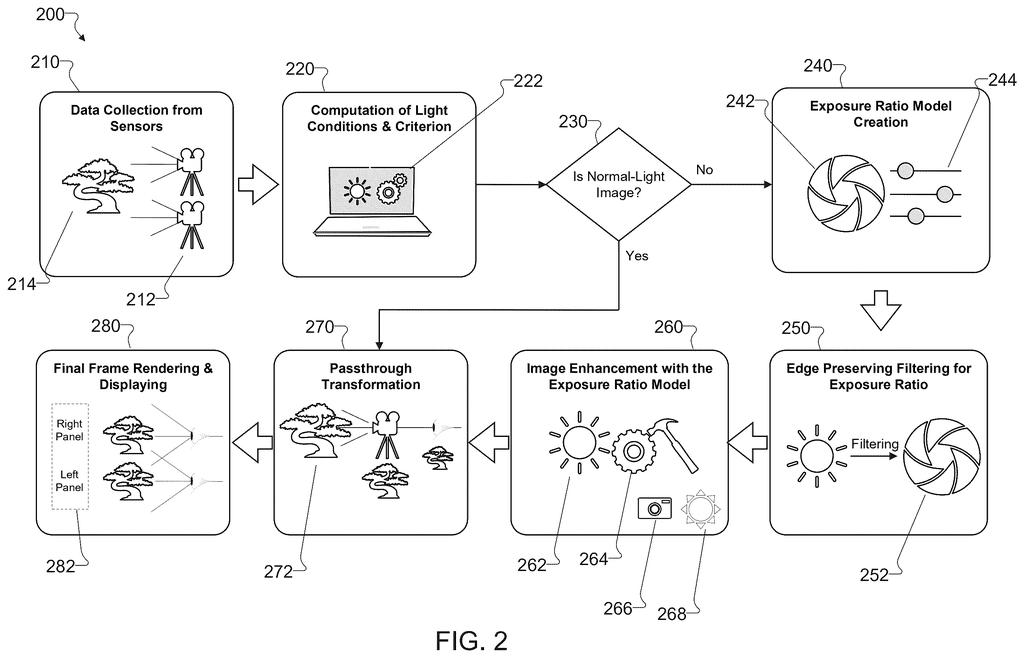
Samsung's patent application describes a fix that runs on every frame of that video. The headset first checks how bright the scene is, how much contrast it has, and how much grain (noise) is in the picture. If the frame looks fine, it passes straight through. If it's too dim, the headset works out how much light each pixel got and lifts the dark spots accordingly.
The goal is a brighter, clearer picture of your surroundings before it ever reaches your eyes.
… creating, using the at least one processing device, an exposure ratio model based on the image data and the scene lighting condition; creating, using the at least one processing device, an image enhancement model using the exposure ratio model; …
Translation: The system calculates lighting levels to build a model that fixes dim video.
How Samsung scores the light in every pixel
The filing covers a way to improve the quality of camera video in a video see-through headset (a headset that shows you the real world through its cameras instead of letting you look through clear glass). The system first measures the lighting of each frame: its brightness, its contrast, and its signal-to-noise ratio (how much useful picture there is compared with random speckle).
If the frame is too dim, the device builds an exposure ratio model. It starts with an illumination map, a rough estimate of how much light reaches each part of the scene, and turns it into an exposure ratio map: one number per pixel describing how much that pixel needs to be boosted.
To keep the boost from smearing edges, the map goes through edge-preserving filtering. This smooths flat areas but keeps the outlines of objects sharp. The filtering works on small overlapping patches of the image and averages the results.
The exposure ratio model is then combined with two others:
- A camera response model, built from the camera's factory calibration, which describes how the sensor turns light into brightness.
- A brightness transform model, which describes how to raise brightness without losing color accuracy.
The combined model raises brightness and contrast, and the result goes through the headset's usual passthrough corrections before it is shown on the displays.
Why dark rooms are a problem for XR headsets
If you wear a passthrough headset in a living room with the lamps off, or in any dim space, the quality of the camera feed decides whether the experience feels usable or annoying. The filing says dark, low-contrast frames make it harder to perceive your surroundings and can leave you uncomfortable. A fix aimed at that problem matters most for headsets meant to be worn around the real world.
The filing frames the idea mostly around Samsung-style XR headsets and smart glasses, but it also says the same approach could apply to general image processing on other devices. It is a patent application, so it shows what Samsung has worked out on paper, not a feature you can turn on today.
This is the 73rd Samsung filing we've tracked since May in our AR glasses race watch, adding to work like tinting glare and billboards and blocking mirror reflections.
The cost of this design is that it works on every frame, and a headset has very little time to spare. The picture has to reach your eyes almost instantly, and per-pixel brightness math on top of the other corrections adds work to that clock. The filing never gives timing or power numbers, so the price is unknown.
The second risk is noise. Lifting dark pixels also lifts the grain hiding in them, and the filing admits this with its mention of spatial smoothing to hold back noise amplification and optional smoothing to reduce halos around bright objects. Those halos are the usual giveaway of brightening done badly.
The trade still reads as worth making. A headset that is blurry and murky in a dim room fails at its basic job, and checking each frame first means well-lit scenes skip the extra work. It is a sensible, modest fix, and the real test is how it looks and how long the battery lasts, which a patent can't show.
Get our take in your Top Stories
Liked this breakdown? Add Patentlyze as a preferred source on Google, and our plain-English take shows up more often in your Top Stories the next time Samsung patent news breaks.
There are more where this came from
We read every patent application Big Tech publishes and send you the ones worth knowing. Plain English, free, every week.
The drawings
7 drawing sheets from US 2026/0343102 A1 · click any drawing to enlarge


Want this weekly breakdown for a company we don't cover? Patentlyze Pro →
Be the first to weigh in