
Sony Files Patent for Games That Dim Your Lights and Turn On Your Fan
Sony's patent describes a game that could warm your living room when your character walks into a desert, then cool the air and dim the lights when you step into a cave. The twist in the claims is a check that stops two gadgets from doing the same job.
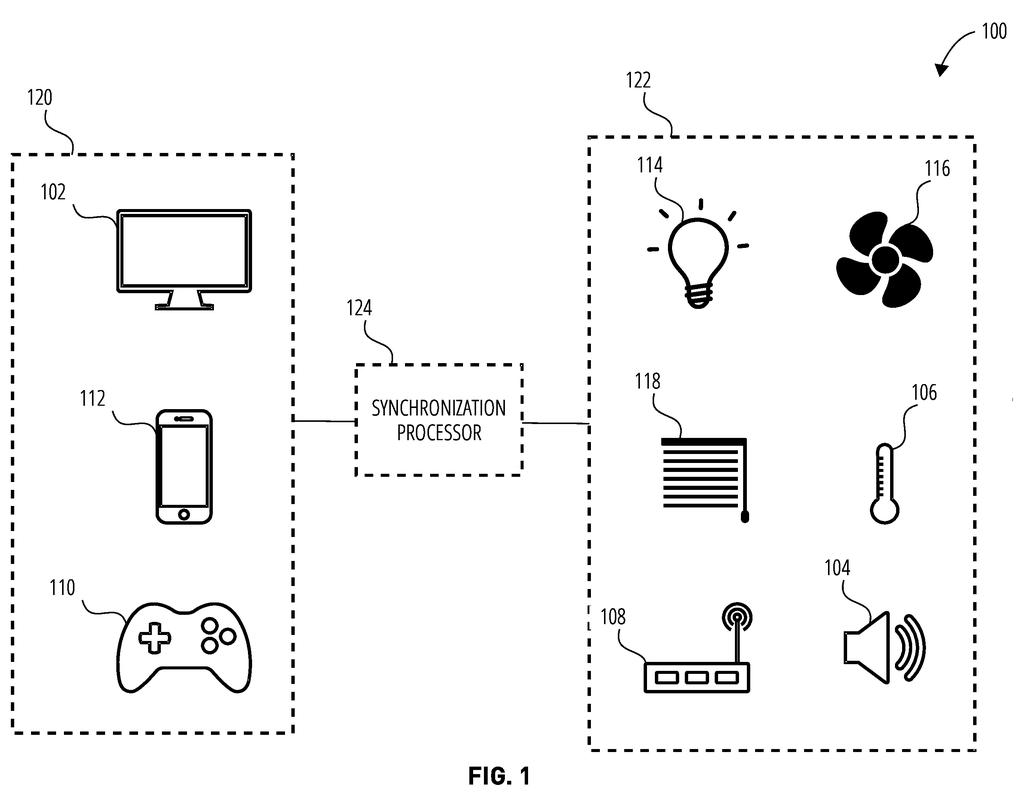
What Sony's game-synced room effects do
Every time a game drops you into a dark cave, the change happens only on your screen and through your speakers. The room around you stays exactly the same.
Sony's patent describes a way to change that using gadgets you may already own: smart lights, fans, thermostats, blinds and speakers. In the filing's example, walking into a desert could warm your room and shift your lamps to a hotter color. Stepping into a cave could cool things down, dim the lights and turn on a humidifier.
The part the claims focus on is a check for overlap. Before the system sends a second command, it asks whether that change would just repeat what another device is already doing. If it would, it can skip the extra command.
… generating, based at least in part on the one or more gameplay features, a first state change instruction to change a first physical state for a first remote device in a physical environment that comprises the electronic device …
Translation: The system figures out how to adjust a gadget in the room based on what happens in the game.
How the system skips duplicate commands
The system starts with gameplay input data: the game's audio, video, vibration signals and context details such as the level you're on. Machine learning models (software trained on examples) pull out gameplay features from that stream, anything from the objects in a scene to measurements of the sound that a person couldn't easily describe.
A second model turns those features into a state vector for each device, which is just a target setting. A lamp might get on or off, a brightness from 0 to 100 and a color. A fan might get on or off. The claims center on the next step: after creating a first instruction for one device, the system checks whether a second device's instruction is redundant, meaning it adds nothing beyond what the first change already does. The claims name lighting changes as one example.
- If the two target states differ, both devices change.
- If they match, only the first device changes and the second is left alone.
- A third device can be checked against the first two the same way.
The description adds extras. The system can predict what's coming and act early, so a fan with a three-second delay starts spinning before your character reaches a windy area. It can also account for where each device sits relative to you, and if you own no lights it may open the blinds instead.
… generating, based at least in part on the first state change instruction, a determination of whether a second state change instruction to change a second physical state for a second remote device is redundant …
Translation: The software checks whether commanding a second device would duplicate the action of the first.
Why your existing smart home could matter
If you already own a few smart bulbs or a smart fan, this idea would put them to work during games without a headset. The filing says outright that VR and AR headsets rely on gear many players don't have or don't want to use, while most people play on a TV or monitor with speakers. The redundancy check gives the system a way to avoid sending several gadgets the same job.
The patent says a console, PC, phone or cloud server could do the processing, so in principle the gaming side needs no new hardware. You would still need compatible home devices, and the filing relies on feedback surveys to learn which effects players actually enjoy.
Sony's 623rd filing we've tracked since May adds to a run that includes cutting wireless lag and placing game characters in your room.
Of all the ideas in the document, this one sits unusually close to something you could ship. It needs no new hardware. The filing relies on bulbs, fans and speakers people already own, and on a console, PC or phone that already sees the game's picture and sound.
The shortest route is a software feature that watches the screen, guesses the mood and sends commands to lights over a home network. Games that share extra details such as the level or story progress give it more to work with, and the filing treats those details as optional.
What has to exist first is the messy part: reliable links to many brands of smart device, and a way to learn what players enjoy. Heat and airflow also lag behind the action, which is why the patent bothers with prediction. The claims center on the duplicate-command check, a modest piece of housekeeping. Whether anyone wants their living room to heat up for a desert level is the real test.
Get our take in your Top Stories
Liked this breakdown? Add Patentlyze as a preferred source on Google, and our plain-English take shows up more often in your Top Stories the next time Sony patent news breaks.
There are more where this came from
We read every patent application Big Tech publishes and send you the ones worth knowing. Plain English, free, every week.
The drawings
9 drawing sheets from US 2026/0315914 A1 · click any drawing to enlarge


Show the other 1 sheets

Want this weekly breakdown for a company we don't cover? Patentlyze Pro →
Be the first to weigh in