
Samsung
Samsung · Security · Filed Apr 16, 2026 · USPTO published Nov 12, 2026 · This week's release
Samsung Patents a System That Keeps AI Programs From Misusing Your Phone's Data
Phones are filling up with AI helpers that can open your photos, your banking app and the internet, and many will come from third parties. Samsung's patent application describes a supervisor AI whose only job is to keep the others in line.
- Publication number
- US 2026/0359474 A1(US20260359474A1)
- Applicant
- Samsung Electronics Co., Ltd.
- Filed · Published
- Apr 16, 2026 · Nov 12, 2026
- Inventors
- Sagar Mahesh MALIYE, Nikhil SAHNI, Renju Chirakarotu NAIR, Shashidhara RAMACHANDRAPPA, Sreevatsa Dwaraka BHAMIDIPATI, Aarif ZAFAR, Harsh Bhushan TALELE
- Status when we published
- Waiting for an examiner
- Document
- 20 claims
- US classification
- 726/26
- Parent application
- Continuation of PCT/IB2026/051638 (filed Feb 20, 2026)(PCTIB2026051638)
What Samsung's phone AI watchdog actually does
Imagine you ask your phone's AI helper to make a photo collage. Meanwhile, an add-on agent from some app decides to grab your private pictures and upload them to a website you have never heard of. Samsung's filing says there is currently no effective way to stop that kind of over-reach.
Samsung's answer is a privacy and security agent that sits above all the other AI helpers on the device. Before a helper gets going, it has to prove it is the real thing. Each step it takes is checked against what it is supposed to be doing, and anything containing personal details is screened before it leaves your phone.
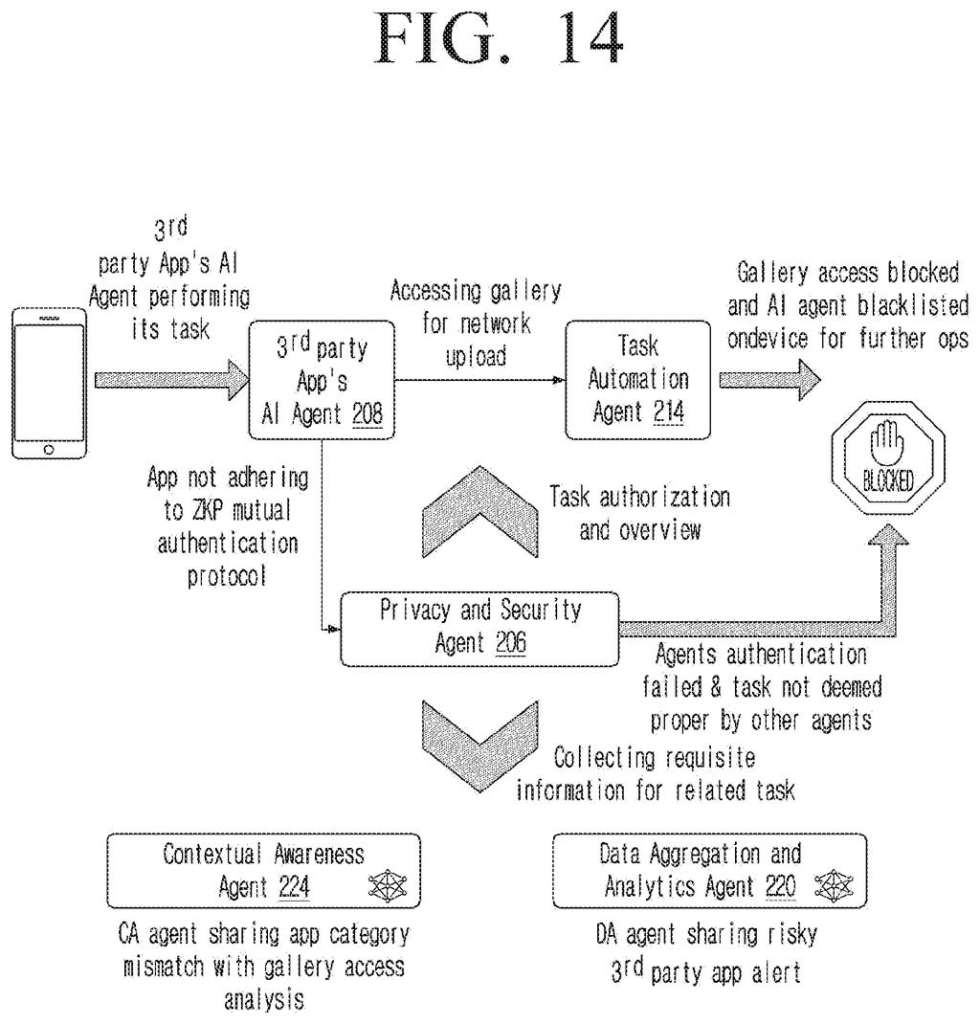
If something gets blocked, the system tells you what was stopped and why. In one example, an unverified app's agent tries to send your gallery pictures over the network. It is shut out and blacklisted on the device.
… allocating, by the agent monitoring module, one or more tasks to a plurality of agents based on at least one of the collected at least one of context and data, and the at least one monitored task being performed by the at least one agent …
Translation: The system assigns jobs to different AI helpers based on your current device activity.
How the watchdog vets each AI helper's every step
The filing describes an agent monitoring module that watches what your phone and connected devices are doing (permissions, app behavior, network use) and hands tasks to different AI agents. An agent here is a small AI program that handles one kind of job, such as saving battery, automating chores or tracking health.
Agents are sorted into four levels. Third-party add-ons and customizable agents sit at level 1. Helpers for battery, task automation and health sit at level 2. Agents that handle voice and touch, connected gadgets and context sit at level 3. A single privacy and security agent sits alone at level 4 with the highest privilege.
That top agent runs a series of checks:
- Identity: each agent proves who it is with a zero-knowledge proof (a way to prove you know a secret without showing it). The filing describes a version that needs no special trusted setup, and the proof gets lighter or heavier depending on the agent's security level.
- Task: when an agent splits a job into sub-tasks, each one is checked by comparing its goal with the data and tools it wants.
- Clearance: low-level agents are blocked from critical data, like your gallery.
- Personal info: every sub-task output is scanned before it leaves the phone.
- Judgment: a reasoning model weighs ethics and sensitivity, and an on-device knowledge graph (a stored web of facts about known vulnerabilities and past misuse) double-checks the result.
If any check fails, the system explains the failure to you.
… agents authentication via a zero-knowledge proof (ZKP), and a task based authentication, and providing user explainability in case of actions related to blocked agentic access …
Translation: It uses cryptographic proofs to verify AI programs and explains to you why any action was blocked.
Why add-on AI helpers raise the stakes on phones
If AI helpers become the way you get things done on a phone, they will also hold the keys to your photos, payments and accounts. Add-on agents from other companies make that riskier, since you cannot easily see what each one is doing behind the scenes. A built-in gatekeeper that vets every helper could keep a bad one from sending your data somewhere it should not go.
The filing says the idea could fit smartphones, tablets, smartwatches and TVs, and even PCs, cars and factories. The explanation to you when an action is blocked matters too. It lets you restart a task another way, such as an automated payment, instead of wondering why nothing happened.
Samsung's 14th filing we've tracked since June in the AI guardrails race follows earlier applications like one blocking AI photo hallucinations and one checking car safety alerts.
Source: US 2026/0359474 A1 at the USPTO (PDF). Full patent text and figures are in the official publication.
Get our take in your Top Stories
Liked this breakdown? Add Patentlyze as a preferred source on Google, and our plain-English take shows up more often in your Top Stories the next time Samsung patent news breaks.
Add Patentlyze on Google
One click.
There are more where this came from
We read every patent application Big Tech publishes and send you the ones worth knowing. Plain English, free, every week.
The drawings · 15 sheets
15 drawing sheets from US 2026/0359474 A1 · click any drawing to enlarge


Show the other 7 sheets


More from Samsung
All 1,629 Samsung patents →
More in Security
All 341 Security patents →
Nvidia
Nvidia Patents a Risk Score for AI Models Downloaded From Untrusted Sources
Google
Google Patents Vibrations That Tell You How Sure Its AI Is
OpenAI
OpenAI Files Patent for AI That Hunts Security Holes in Finished Software
OpenAI
No comments yet