
Samsung Patents a Projector That Automatically Moves Itself Into Position
Setting up a projector usually means a frustrating ritual of nudging it forward, backward, and sideways until the image lands right. Samsung's new patent describes a device that skips all of that by moving itself.
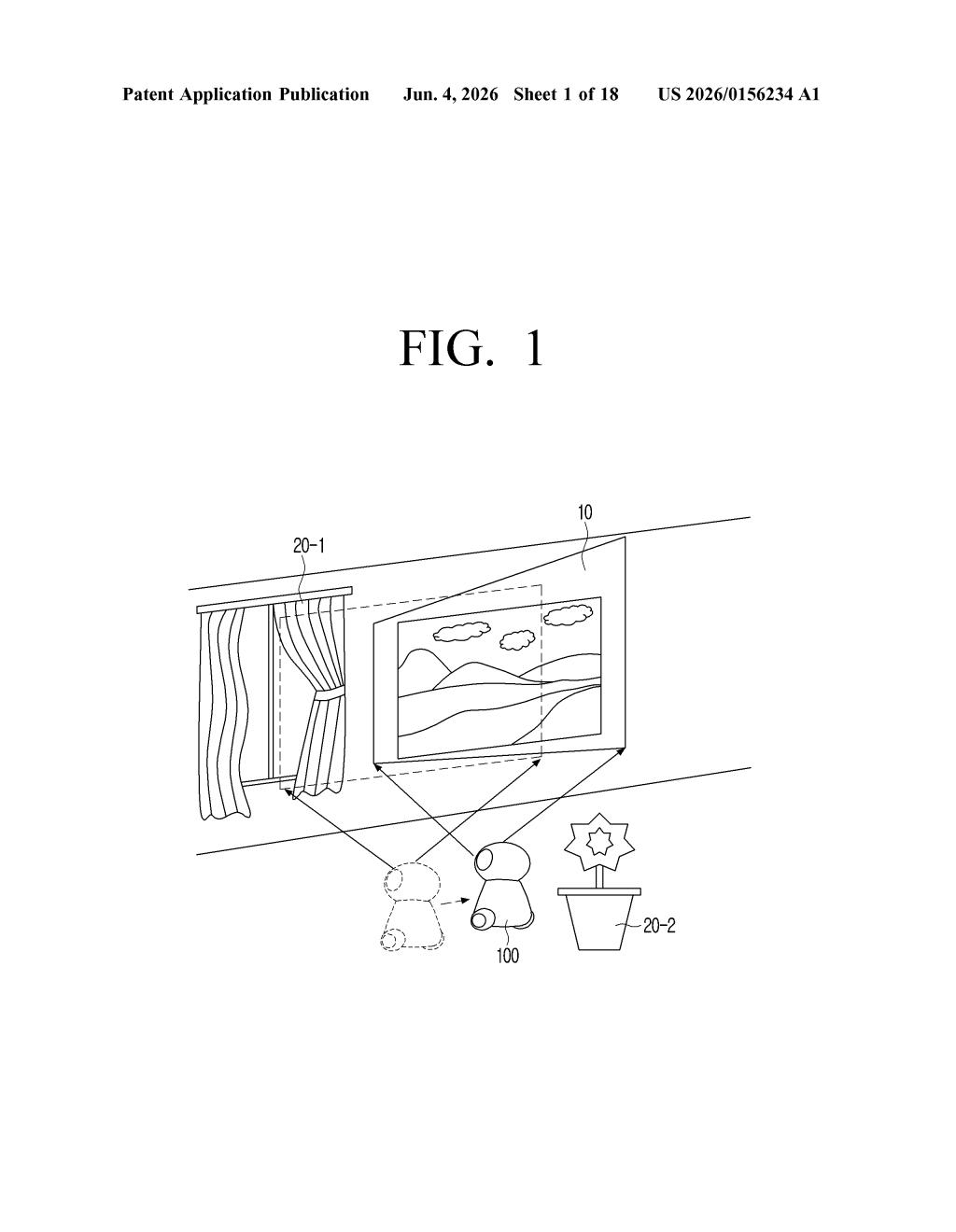
What Samsung's self-positioning projector actually does
Imagine you pull out a portable projector, point it roughly toward a wall, and instead of manually adjusting its position to get a clean picture, the projector just… scoots itself into the right spot automatically. That's the core idea here.
Samsung's patent describes a projector with a built-in sensor that detects the surface you want to project onto. Once it identifies that surface, it calculates how far away it is, what angle it's sitting at relative to the wall, and how far it needs to physically move to hit the ideal projection position. Then a built-in motor — the "driver" — moves the device accordingly.
The result is a projector that requires little to no manual placement fussing. You trigger a projection event (turn it on, tap a button, whatever the interface ends up being), and the device handles the geometric math and physical repositioning on its own.
How the sensor calculates distance, angle, and movement
The patent describes an electronic apparatus — almost certainly a projector — equipped with three key components working in concert:
- A sensor that scans the environment to identify the projection surface (e.g., a wall, a screen, or a flat ceiling).
- A processor that calculates the optimal projection position using three variables: projection distance (how far the surface is), projection angle (the geometric angle between the device and the surface), and movement distance (how far the device itself needs to travel to reach the correct spot).
- A driver — motorized circuitry — that physically moves the apparatus to that calculated position.
The trigger is described as an "event corresponding to an image projection" — meaning the auto-positioning kicks off whenever a projection is initiated, not as a separate setup step.
The patent's claim is hardware-agnostic about how the sensor works (it could be infrared, ultrasonic, camera-based depth sensing, or LiDAR) and how the driver moves (wheels, a linear actuator, a motorized base). The invention is primarily in the control logic that ties sensor data to physical movement.
What this means for portable and smart-home projectors
Portable and "smart" projectors have been a growing product category, but setup friction has always been a barrier — especially for devices meant to be moved room to room or used casually. A projector that can reposition itself based on real-time surface detection would meaningfully reduce that friction, making the category more accessible to non-technical users.
For Samsung specifically, this fits squarely into the positioning of products like The Freestyle, its portable lifestyle projector. Auto-positioning would be a genuine differentiator in that segment. It also has implications for ceiling-mounted or furniture-integrated projectors where precise placement is critical but physically adjusting the unit is inconvenient.
This is a practical, user-experience-focused patent rather than a deep-tech one — the core idea is straightforward, and the novelty is in automating something people currently do by hand. That said, it's exactly the kind of polish that separates a good portable projector from a great one, and Samsung has a clear product line (The Freestyle) where this would be a natural fit.
There are more where this came from
We read every patent application Big Tech publishes and send you the ones worth knowing. Plain English, free, every week.
Want this weekly breakdown for a company we don't cover? Patentlyze Pro →