
Skydio
Skydio · Robotics · Filed Mar 26, 2026 · USPTO published Nov 19, 2026 · This week's release
Skydio Files Patent for a Drone Camera Mount That Adjusts Itself to Each Camera
Swap the camera on a drone's stabilizer and you change how heavy and how hard to turn the whole load is. Skydio's filing has the stabilizer notice the swap and load the right motor settings on its own.
- Publication number
- US 2026/0370944 A1(US20260370944A1)
- Applicant
- Skydio, Inc.
- Filed · Published
- Mar 26, 2026 · Nov 19, 2026
- Inventors
- Noriaki Saika, Christopher Bramley Fruhauf, Daniel Francis Kennedy
- Status when we published
- Waiting for an examiner
- Document
- 20 claims
- US classification
- 244/118.1
- Parent application
- Continuation of 18/600,021 (filed Mar 8, 2024)(18600021)
What Skydio's self-tuning camera mount does
You're clipping a lighter camera onto your drone, and the first clip comes out twitchy. The motorized stabilizer underneath was tuned for the old, heavier camera, so it overcorrects.
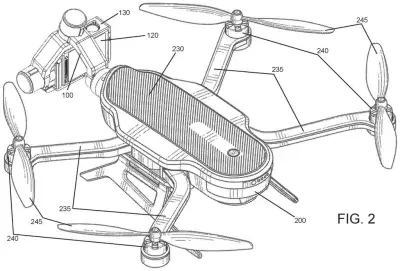
Skydio's filing has the stabilizer work out what it is carrying. When you plug in a camera or its detachable frame, that part can send an ID number or a weight and balance profile through the connection. The stabilizer then looks up the matching motor settings, or calculates them, and gets to work. It can also tell what it is mounted on, whether a drone, a handheld grip or a car, and adjust for that too.
If it meets a camera it has never seen, it runs a quick self-test: it moves the camera to a few set angles, times the movement, and nudges its settings until the motion matches what it expects. The filing also describes a spring-and-damper sleeve that lets the stabilizer float inside the drone's body to soak up vibration.
… a memory storing a plurality of sets of motor-control parameters, the plurality of sets being associated with different camera-assembly configurations, different mount-platform configurations, or both …
Translation: The drone saves different sets of motor settings for various camera and mount setups.
How the gimbal picks the right motor settings
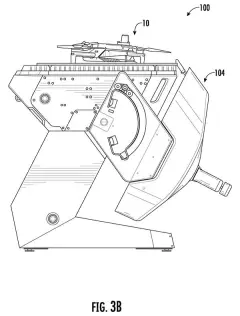
The claims in this filing cover the control side of a camera stabilizer, called a gimbal (a motorized mount that rotates a camera to cancel out shake). The gimbal stores several sets of motor-control parameters (the settings that tell each motor how hard and how fast to push), each tied to a different camera setup, a different mount, or both.
When something is attached, the processor gets an indication of the current setup, picks the matching set and runs the motors with it. That indication can be:
- An identifier sent from the camera or its detachable frame through the electrical connection when you plug it in.
- A mass profile: the weight and moment of inertia (how hard the camera is to start and stop rotating), from which settings can be calculated.
- The mount type, detected from an electrical signal or from motion data, such as whether the movement looks like a drone or a handheld grip.
A set can specify motor acceleration, top and bottom speeds, torque, current and voltage, or the weights of a PID loop (a common feedback recipe that corrects errors using the present error, past error and trend). Mount-specific sets can also cap rotation speed and limit how far the camera may turn on each axis.
For an unrecognized setup, an auto-calibration routine moves the camera to preset angles, measures its speed, compares it with the expected speed and adjusts the motor settings. The description also covers a floating gimbal sleeve held by springs and dampers inside the drone body, which is what the title and abstract describe.
a tube structured to couple with a gimbal connector of the gimbal, and an attachment mechanism configured to couple the tube to the chassis …
Translation: A specialized tube and latch system connects the camera gimbal securely to the drone body.
What this means for swapping drone cameras
If you fly a drone with different cameras, or move the same stabilizer between a drone and a handheld grip, retuning by hand is a chore most people will skip. Automatic matching could mean you plug in, wait a moment and get steady footage without touching a setting.
The description says a stabilizer used with cameras of different weights can perform poorly, and it names several fixes. One is a camera frame built to match a standard weight. The claimed approach changes the settings to fit the camera instead. That lets one stabilizer support more cameras and more mounts, and the vibration-damping sleeve described alongside it works on the physical side of the same problem: footage that is shaky or noisy from the drone's vibration.
Source: US 2026/0370944 A1 at the USPTO (PDF). Full patent text and figures are in the official publication.
Get our take in your Top Stories
Liked this breakdown? Add Patentlyze as a preferred source on Google, and our plain-English take shows up more often in your Top Stories the next time Skydio patent news breaks.
Add Patentlyze on Google
One click.
There are more where this came from
We read the new patents from Big Tech, carmakers and more and send you the ones worth knowing. Plain English, free, every week.
The drawings · 16 sheets
16 drawing sheets from US 2026/0370944 A1 · click any drawing to enlarge


Show the other 8 sheets


More from Skydio
All 2 Skydio patents →More in Camera
All 278 Camera patents →
Toyota
Toyota Patents a Fix for Robot Cameras That Stop Agreeing on Where Things Are
Sony
Sony Patents a Drone Camera You Aim by Tilting Your Hand
Sony
Sony Files Patent for a Drone Microphone That Hides From the Camera
Wing (Google)
No comments yet