
Toyota
Toyota · Robotics · Filed Sep 4, 2025 · USPTO published Nov 19, 2026 · This week's release
Toyota Patents a Fix for Robot Cameras That Stop Agreeing on Where Things Are
A robot's two cameras can drift out of agreement after a small bump, and that is enough to make it miss a bottle. Toyota's research arm describes a way for the robot to catch the mismatch and correct it in the middle of a job.
- Publication number
- US 2026/0364802 A1(US20260364802A1)
- Applicant
- TOYOTA RESEARCH INSTITUTE, INC.
- Filed · Published
- Sep 4, 2025 · Nov 19, 2026
- Inventors
- Isabella HUANG
- Status when we published
- Examiner raised objections; the company can respond
- Document
- 20 claims
- US classification
- 700/251
- Examiner
- OSTROW, ALAN LINDSAY (Art Unit 3657)
- Parent application
- Claims priority from a provisional application 63805403 (filed May 14, 2025)
What Toyota's two-camera robot fix actually does
Ever closed one eye, then the other, and watched a nearby object seem to jump sideways? Now say a robot has to reach for a bottle using both of those views at once, and the views don't quite agree.
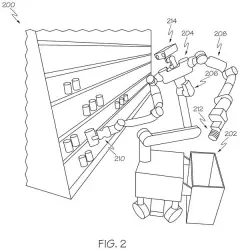
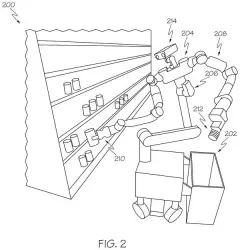
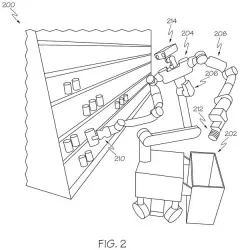
That is the situation Toyota Research Institute describes. Its robot has one camera in its torso and another in its head. The torso camera spots the item you asked for, such as a bottle on a grocery shelf, while the head camera watches the robot's hand. If a bump or a slightly off setup shifts one view, the robot's idea of where the bottle is and where its hand is can drift apart.
The patent's fix is to check the two views against each other while the robot works, measure how far off they are, and correct for it, so the hand lands where the item actually is.
detecting a misalignment between a point cloud captured by a chassis camera a point cloud captured by a head camera of the robot …
Translation: The robot figures out when its body camera and head camera no longer agree on what they see.
How the robot lines up its torso and head views
The robot in the filing has two cameras. One sits in its torso (the chassis) and stays put. The other sits in its head, which moves and watches the robot's gripper (the manipulator tool). Each camera builds a point cloud, a 3D map made of thousands of tiny dots that trace the surfaces it sees.
Because of imperfect calibration or an accidental collision, the two maps can fail to line up. The method runs in three steps:
- Detect the mismatch. The system notices that the chassis map and the head map disagree.
- Compute a correction. It performs a registration (matching the two dot maps to each other) and works out a relative transformation, a set of shifts and rotations describing the offset between them. Dependent claims name iterative closest point, or ICP, a standard method that repeatedly nudges one map toward the other until the dots overlap.
- Realign. The cameras are realigned using that correction, in real time according to the description.
The claims go further. The chassis camera's map is used to find the 3D position of the item to grab, the head camera's map is used to find the gripper's position, and each gets adjusted by its own correction. The robot then plans the grasp, picks up the item, pulls it out and places it in a basket. The description's example setting is a grocery store, with items like a bottle that need accuracy under a centimeter.
… realigning the chassis camera and the head camera according to the relative transformation …
Translation: The system automatically adjusts the cameras so they map the world correctly together again.
Why camera drift matters for grocery-picking robots
If robots are going to fetch things in homes and stores, an engineer can't re-calibrate them every time someone bumps into one. Toyota Research Institute's filing describes the robot checking itself on the job. That matters most for fiddly grabs, like holding a bottle by its neck, where the filing says accuracy under a centimeter is needed for success.
You won't see this as a feature on a product box. It is behind-the-scenes plumbing that helps decide whether a grocery-picking or shelf-stocking robot works reliably in the real world, a setting the filing says many lab demos gloss over. The application is early: an examiner rejected the claims as filed in a first review, which is routine and usually followed by amendments.
Toyota files its sixth robotics patent we've tracked since November, adding to earlier work on lifting items over shelf lips and gripping grocery items.
Source: US 2026/0364802 A1 at the USPTO (PDF). Full patent text and figures are in the official publication.
Get our take in your Top Stories
Liked this breakdown? Add Patentlyze as a preferred source on Google, and our plain-English take shows up more often in your Top Stories the next time Toyota patent news breaks.
Add Patentlyze on Google
One click.
There are more where this came from
We read the new patents from Big Tech, carmakers and more and send you the ones worth knowing. Plain English, free, every week.
The drawings · 7 sheets
7 drawing sheets from US 2026/0364802 A1 · click any drawing to enlarge


More from Toyota
All 16 Toyota patents →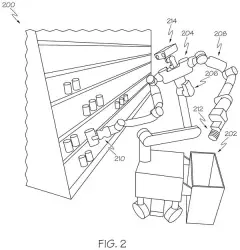
More in Camera
All 278 Camera patents →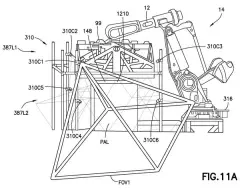
Symbotic
Symbotic Patents a Camera System That Helps Robots Remove Warehouse Boxes One Row at a Time
Sony
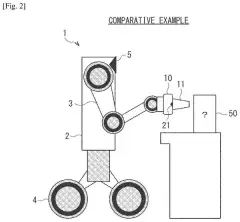
Sony Patents a Robot That Uses Touch and Distance Sensing Together to Understand Objects
Samsung
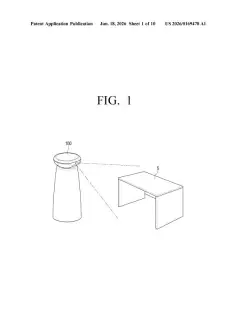
Samsung Patents a Robot That Chooses Its Own Best Vantage Point to Map a Room
Samsung
No comments yet