
Skydio
Skydio · Robotics · Filed Jul 22, 2026 · USPTO published Nov 19, 2026 · This week's release
Skydio Patents a Charging Station That Repositions Landed Drones Automatically
Most drone docks demand a precise landing. Skydio's filing lets the drone land loosely, then uses sliding bars to shove it into the exact spot where its battery meets the charger.
- Publication number
- US 2026/0365345 A1(US20260365345A1)
- Applicant
- Skydio, Inc.
- Filed · Published
- Jul 22, 2026 · Nov 19, 2026
- Inventors
- Patrick Allen Lowe, Christopher C. Berthelet, Maximilian Joseph Halper Krogius, Divyanshu Pachisia, Philipp Foehn, Benjamin Scott Thompson, Yee Shan Woo, Joseph Tankeh, Andrew Xu
- Status when we published
- Waiting for an examiner
- Document
- 20 claims
- US classification
- 244/114B
- Parent application
- Continuation of 19/090,837 (filed Mar 26, 2025)(19090837)
What Skydio's self-centering drone dock does
A drone settles onto a landing pad and comes to rest a few inches off center. If you run a drone that lives in a box between flights, that small miss can mean a battery that never touches its charger, or a lid that comes down on the aircraft.
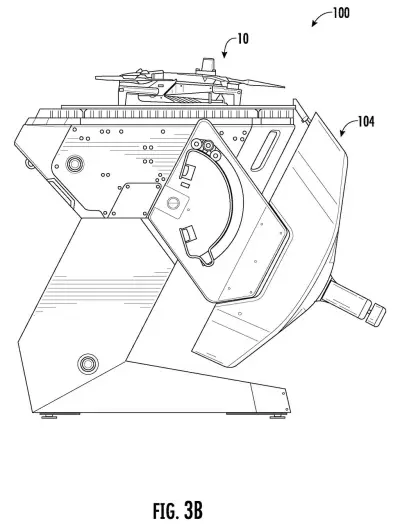
Skydio's patent application describes a dock that fixes the miss after the fact. Once the drone lands, two bars on either side of the pad slide inward, push on the drone's legs, and shuffle it to the middle. That lines up the battery on the drone's belly with a charging connector underneath.
The connector stays hidden below the pad while the drone is coming in, so the drone gets a bigger target to land on. Only after the drone is centered does the connector rise up through a slot and plug in. When charging ends, the bars let go, the drone flies off and the lid closes.
… reconfiguring the landing platform from a first configuration into a second configuration to generally align a power source on the UAV with a charging hub of the base station …
Translation: The landing pad shifts shape to line up the drone's battery with the charger.
How the dock slides a drone onto its charger
The filing describes a base station (a weatherproof box that stores and charges a drone) with a flat landing platform on top. The platform stays in a fixed spot during landing, which the filing says makes wind and propeller wash easier to predict. Before the drone arrives, the roof opens and the drone is guided in by fiducials (printed patterns the drone's camera can recognize), some of which can be backlit.
The claims cover a docking sequence that runs like this:
- The drone lands with its legs in round dips in the platform, and a landing check confirms it. If a leg misses, the drone lifts off and tries again.
- Two alignment members (sliding bars) retract inward toward each other. Their angled tips push the drone's legs toward the center of the platform.
- The charging hub, hidden below the platform, rises through a window and connects to the battery on the drone's underside.
A motor moves a belt, and the belt moves the bars. Spring-loaded pulleys and an adjustable screw keep the belt tight, and plastic guards shield the sliding parts from water and debris. Much of the filing is about this hardware, while the claims focus on the docking steps themselves, in three separate versions of varying detail.
… repositioning the charging hub in relation to the landing platform from a first position into a second position.
Translation: The charging connector moves into place to dock with the landed drone.
Why a sloppy landing matters for drone docks
For anyone who wants a drone to fly jobs without a person standing nearby, landing and charging have to work every time. The filing says hiding the charger under the pad widens the usable landing area, so the drone does not need to be precise. Centering the drone afterward also keeps the roof from touching it as the box closes.
A filing is not a product, and this one is a continuation of an application from March 2025, so it adds to an existing line of work. Expect it to matter mostly to people who run automated drone sites, where one failed landing can mean a trip out to reset the equipment.
Skydio's second filing in our robotics coverage since November follows a self-adjusting drone camera mount, the two applications we've tracked showing the company exploring how drones handle cameras.
Source: US 2026/0365345 A1 at the USPTO (PDF). Full patent text and figures are in the official publication.
Get our take in your Top Stories
Liked this breakdown? Add Patentlyze as a preferred source on Google, and our plain-English take shows up more often in your Top Stories the next time Skydio patent news breaks.
Add Patentlyze on Google
One click.
There are more where this came from
We read the new patents from Big Tech, carmakers and more and send you the ones worth knowing. Plain English, free, every week.
The drawings · 24 sheets
24 drawing sheets from US 2026/0365345 A1 · click any drawing to enlarge


Show the other 16 sheets


More from Skydio
All 2 Skydio patents →More in Energy
All 147 Energy patents →
Wing (Google)
Wing Files Patent for Delivery Drones That Work Out Which Charging Pad They're On
IBM
IBM Patents a System for Drones to Share Battery Power Mid-Flight
Samsung
Samsung Patents a Robot Charging Dock That Extends Its Own Contacts on Impact
Samsung
No comments yet