
Sony Files Patent for Displays That Put More Light Directly Into Your Eyes
AR glasses lose a lot of light out the edges of the lens. Sony's patent application gives that border a second job: sending some of the escaping light to your eye.
What Sony's light-recycling AR lens edge does
Imagine you're wearing AR glasses on a sunny street. The image floats in front of you, but it looks faint, because a lot of the light the glasses make never reaches your eye. Some of it leaks off the edges of the lens and gets lost.
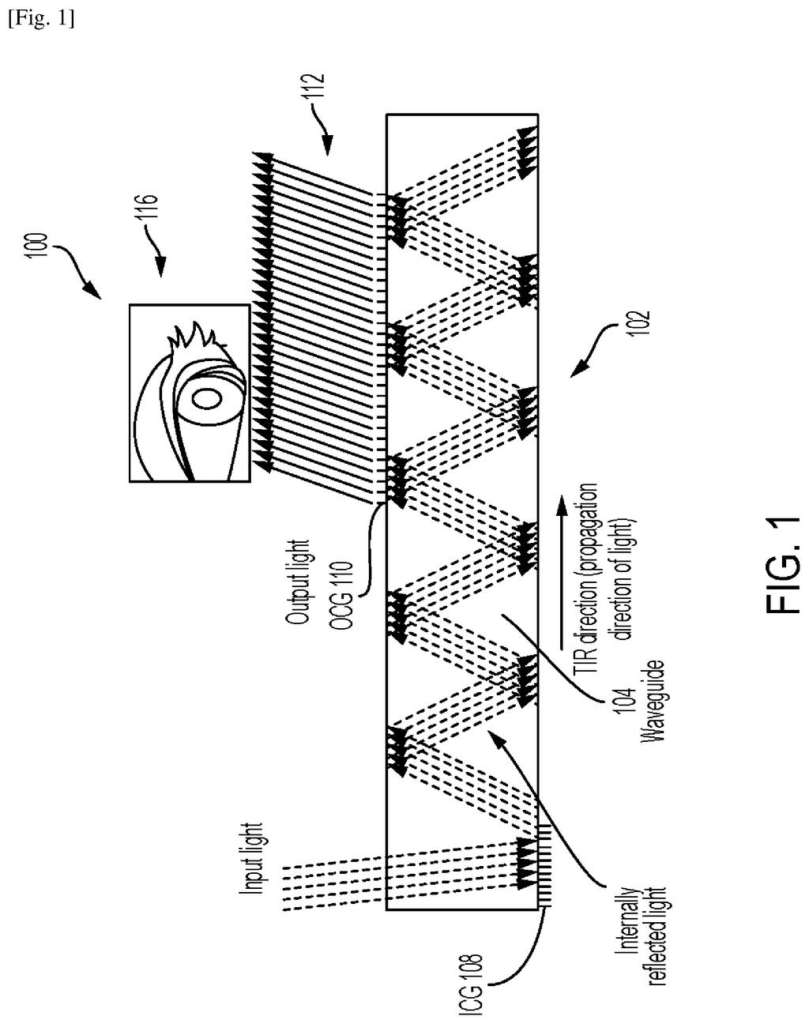
Sony's filing goes after that waste. Glasses like these send light through a thin piece of glass or plastic, and a patch of microscopic bumps pushes it out toward your eye. Usually a separate border of bumps catches the escaping light and bounces it back. Sony's version gives that border a second job: while it bounces light back, it also sends some straight to your eye, so the border helps paint the image too.
The border is made of tiny repeating tiles, and the bump layout changes from one area to the next. That lets the balance between bouncing light back and sending it out shift across the lens.
1 . A recycler grating for a waveguide-based display, comprising: a base substrate; and a plurality of photonic structures arranged into groups of unit cells on the base substrate …
Translation: Sony's patent centers on a specialized grating built on a base to better manage light inside the display.
How the tiny cells split light three ways
The filing covers a recycler grating (a patterned surface that redirects light) for a waveguide display (a thin transparent plate that carries an image from a tiny projector to your eye by bouncing light inside it). Normally an output coupling grating (the patch that lets light out toward your eye) shows the image, and recyclers around its edges only send stray light back. The description says ordinary recyclers make the waveguide bigger, add manufacturing steps, and do not directly add to the image you see.
Sony's recycler is built from unit cells, tiny repeating tiles. Each tile holds at least two separate raised structures (pillars or holes), divided by imaginary "cut lines." A single tile can diffract light in up to eight directions, so it can reflect light back, redirect it within the waveguide, and send it out toward the eye.
The design details include:
- Tiles are grouped into regions, and the shape, size or orientation of the structures can differ from one region to the next.
- The share of light sent to the eye is tuned by position. The description gives a range from 0.001% to 90%, set higher near the main output patch.
- In one example tile, about 8% of incoming light is recycled while 90% passes through.
The recycler can surround at least three sides of the main output patch. The claims also cover a full waveguide and a head mounted display built this way.
… each unit cell comprises at least two photonic structures that are spaced apart from one another in at least one section along a first cut line that extends in one of the first to fourth directions.
Translation: The tiny light-routing patterns are carefully spaced out along specific geometric paths.
What this means for brighter AR glasses
If you have tried AR glasses, you know the weak spot: the image can look washed out in bright places, and turning it up costs battery and heat. A lens border that sends escaping light back and also to your eye could squeeze more brightness out of the same light source. The filing says its aim is better brightness and more even coverage across what you see.
It could also help with size. The description says traditional recyclers enlarge the waveguide and add fabrication steps. Giving the border a second job could mean a lens that wastes less space. The claims name a head mounted display but no specific product, so treat this as groundwork for future glasses.
That makes this Sony's 44th filing we've tracked in our AR glasses race watch since July, adding to work like the wall-proximity VR safety one and the display-evening microstructures one.
Shipping this means changing the physical lens, so it would only reach you in a new pair of glasses. No software update can add it. The shortest route is to swap the border pattern on a waveguide design a company already has, using the nanoimprint printing the filing names.
What has to exist first is the hard part. The tiles are a few hundred nanometers wide (far thinner than a human hair), and each region of the border needs its own tuned pattern. The filing gives light-split numbers for single tiles but no figure for how much brighter a whole display gets.
That makes this a sensible fix for a familiar annoyance, still well short of something you could buy. If prototypes show a clear whole-lens brightness gain, it becomes a real selling point for thinner, brighter glasses.
Get our take in your Top Stories
Liked this breakdown? Add Patentlyze as a preferred source on Google, and our plain-English take shows up more often in your Top Stories the next time Sony patent news breaks.
There are more where this came from
We read every patent application Big Tech publishes and send you the ones worth knowing. Plain English, free, every week.
The drawings
10 drawing sheets from US 2026/0339099 A1 · click any drawing to enlarge


Show the other 2 sheets


Want this weekly breakdown for a company we don't cover? Patentlyze Pro →
Be the first to weigh in