
Sony Files Patent to Keep Bluetooth Distance Readings Accurate While You Move
Measuring distance with radio waves goes wrong when you move during the measurement. Sony's answer is to run it up and then down, so the two errors cancel.
What Sony's distance-by-radio patent actually does
Imagine you're walking across a room while your phone tries to work out how far away another Bluetooth device is. The usual radio trick takes a quick series of measurements, each on a slightly different frequency, and reads the distance from how the signal's timing shifts across them. The catch: if you move during that series, your movement gets mixed into the answer.
Sony's filing fixes this by sweeping the frequencies both ways. If you're moving away, the upward sweep makes the distance look too big and the downward sweep makes it look too small. Average the two and the mistake mostly cancels. The claims also cover a version that hops through frequencies in a random order, repeats that several times, and uses every result.
How bad is the problem? In Sony's own test, a device moving at about 1 km/h was off by roughly 1 meter, compared with about 20 centimeters when standing still.
An object of the present invention is to improve distance measurement accuracy in a case where there is a change in distance between communication devices in a case where distance measurement is performed by a phase based method.
Translation: Sony wants to keep distance measurements precise even when devices are moving.
How Sony sweeps frequencies up, down and at random
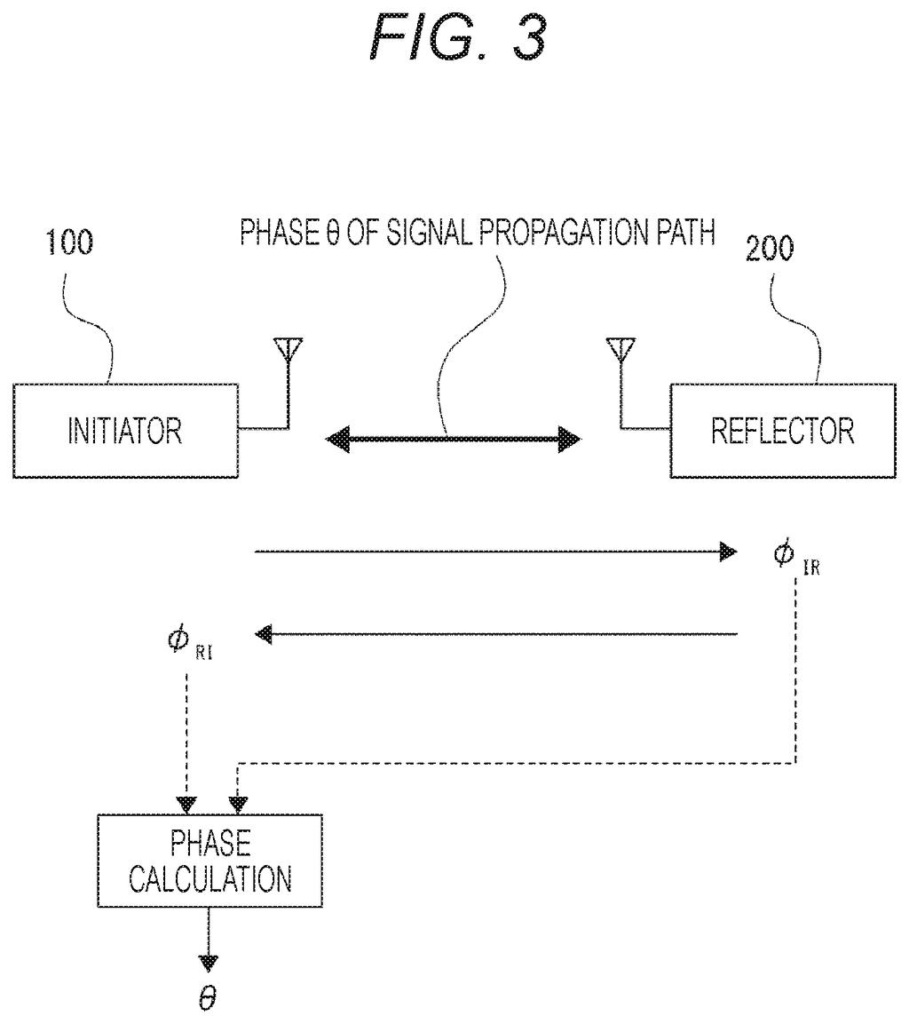
Two devices (the filing calls them an initiator and a reflector) pass a test signal back and forth at many frequencies in the 2.4 GHz band that Bluetooth Low Energy uses. At each frequency the receiver splits the signal into an in-phase and a quadrature component (two copies offset by a quarter wave) and takes the inverse tangent of their ratio. That gives the signal's phase, meaning where it sits in its wave cycle.
Plot phase against frequency and you get a slanted line. The steeper the slope, the farther apart the devices are. The device turns the slope into a delay and multiplies by the speed of light to get a distance. The problem is movement mid-sweep: the filing figures a device at 10 km/h moves about 2.8 cm during a 10 millisecond sweep, enough to twist the phase by around 80 degrees.
The claims cover the fix. The device changes frequency in a pattern with both upward and downward steps, runs a random-order version several times, and calculates distance from each result. Added claim details include:
- Fitting a straight line through the readings with least squares (a standard best-fit method), then averaging the slopes or the distances.
- Using a lookup table to do the inverse tangent quickly.
- Optionally converting the readings into a time waveform with an inverse fast Fourier transform.
The description also mentions a motion sensor option that uses the two-way sweep only above a set speed, saving time when nothing is moving.
… calculating the phase characteristic based on an inverse tangent of a ratio of the quadrature signal component to the in-phase signal component …
Translation: The device measures wave angles using trigonometry to figure out how far apart the gadgets are.
Why Bluetooth distance stops drifting when you walk
Many Bluetooth distance features today rely on signal strength, which the filing says gets thrown off by reflected signals and by the angle of the antenna. The phase method this patent application builds on avoids those problems, and this filing goes after its biggest weakness: movement. If it works as described, indoor positioning, where GPS can't reach, would stay accurate while people actually walk around.
The claims describe ordinary radio parts: a switch between sending and receiving, a frequency generator, and a lookup table for the math. That makes the idea easy to picture inside a small, low-power Bluetooth chip. It is also a continuation of an earlier application filed in 2023, with a 2021 Japanese priority date, so the idea has been in development for a while.
This is the 659th Sony filing in our Sony coverage since May, adding to work like a display aimed at your eyes and deduplicating AI training data.
If you've ever watched a distance reading jump around while you walked toward something, you've seen the problem Sony is working on. The fix is easy to picture: measure once while motion pushes the number up, again while it pushes the number down, then average. You would notice it as a reading that holds still when you do not.
The filing's own numbers show why this matters. At about 1 km/h, a slow shuffle, the error grew to roughly 1 meter, which is far too loose for anything meant to tell you something is within arm's reach. The motion-sensor option also skips the extra sweep when you're standing still, so stationary use costs you nothing.
Expect no new feature from this. Expect fewer moments where a distance reading jumps for no reason. That is useful polish, and a patent application is no promise it ships.
Get our take in your Top Stories
Liked this breakdown? Add Patentlyze as a preferred source on Google, and our plain-English take shows up more often in your Top Stories the next time Sony patent news breaks.
There are more where this came from
We read every patent application Big Tech publishes and send you the ones worth knowing. Plain English, free, every week.
The drawings
16 drawing sheets from US 2026/0338935 A1 · click any drawing to enlarge


Show the other 8 sheets


Want this weekly breakdown for a company we don't cover? Patentlyze Pro →
Be the first to weigh in