
Sony
Sony · Biotech · Filed Aug 11, 2025 · USPTO published Nov 19, 2026 · This week's release
Sony Patents a Camera System That Keeps Watching a Patient's Breathing After They Move
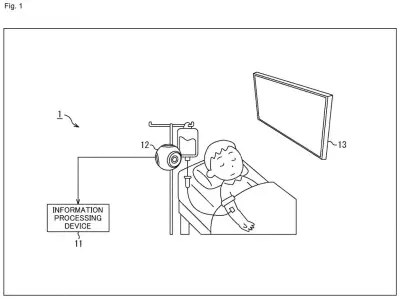
Sony has filed a patent for a hospital camera that watches a patient breathe and, when the patient rolls over or a nurse steps into the shot, finds a new spot on the body to watch by itself.
- Publication number
- US 2026/0363553 A1(US20260363553A1)
- Applicant
- SONY GROUP CORPORATION
- Filed · Published
- Aug 11, 2025 · Nov 19, 2026
- Inventors
- TAKANORI FUKAZAWA, NANA KAWAMURA, HIROYASU BABA
- Status when we published
- Examiner raised objections; the company can respond
- Document
- 16 claims
- US classification
- 600/476
- Examiner
- ROY, BAISAKHI (Art Unit 3797)
- Parent application
- National Stage Entry of PCT/JP2024/004782 (filed Feb 13, 2024)(PCTJP2024004782)
What Sony's breathing-monitor camera does
You're a nurse in an ICU, and the camera watching your patient's breathing has just lost track. Someone leaned in to adjust a line, or the patient rolled onto their side, and the little box on the screen that follows the chest is now pointing at nothing.
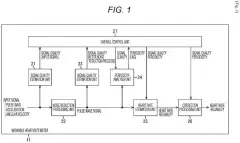
Sony's patent describes a way for the system to fix that on its own. A camera that records both ordinary color video and a distance map follows a spot on the patient's chest or belly using the color video. When that tracking fails, the system switches to the distance map, cuts the picture into small squares, and looks for the squares where the body is rising and falling in a regular rhythm.
It then picks the square with the strongest breathing signal and carries on, with nobody needing to re-aim anything.
… tracks, based on the RGB image, a measurement region set in a respiration region of the patient, and, when a tracking error of the measurement region occurs, resets the measurement region, based on the Depth image.
Translation: It follows the patient's breathing area using a standard camera and switches to depth data if it loses track.
How the camera finds a new spot to watch
The system is built around an RGB-D camera: one sensor records normal color video, and a second records a depth map, where every pixel says how far away that point is. The filing names a Time of Flight sensor (which times how long light takes to bounce back) as an example of the depth sensor.
A nurse first marks a measurement region, a box on the chest or abdomen. The system follows that box from frame to frame in the color video, using optical flow (estimating how points move between frames). It decides tracking has failed when the match to the surroundings drops below a threshold, for example when the patient moves a lot, someone walks in front of the camera, or a blanket covers the box.
That is when the depth map takes over. The system:
- Splits the depth image into a grid of candidate boxes;
- Throws out boxes with too many pixels that returned no valid distance, boxes outside a set distance range (the filing gives 10 cm to 200 cm as an example), and boxes where distances jump around, which usually means the edge of the body;
- Runs an FFT (math that finds repeating rhythms in a signal) on each remaining box and keeps those with a clear breathing peak;
- Ranks them by breathing strength and sets the strongest as the new box.
The description also covers using infrared instead of color video in dark rooms, and showing the breathing waveform and rate on a monitor.
… acquires an RGB image obtained by capturing an image of a patient and a Depth image indicating Depth values relative to certain locations on the patient; tracks, based on the RGB image, a measurement region set in a respiration region of the patient …
Translation: The system combines regular video and depth sensing to monitor how a patient is breathing.
Why hospitals could care about hands-free re-aiming
Hospitals have long relied on sensors that touch the patient, and those can give false readings when contact slips. A camera avoids that, but a camera that loses its target after one rolled-over patient or one passing nurse is only useful if someone notices and re-aims it. This patent targets exactly that weak spot, so the monitor could keep reading for the people caring for the patient.
The filing also describes a battery-powered camera and a cloud version that sends only breathing waveform data, so images of the patient stay inside the hospital. The examiner's first review rejected the claims as filed, which is routine at this stage and usually followed by amendments.
This is the 13th Sony filing we've tracked since July in our wearables that read your body watchlist, following applications like one on needle-free glucose and one on brain-reading headphones.
Source: US 2026/0363553 A1 at the USPTO (PDF). Full patent text and figures are in the official publication.
Get our take in your Top Stories
Liked this breakdown? Add Patentlyze as a preferred source on Google, and our plain-English take shows up more often in your Top Stories the next time Sony patent news breaks.
Add Patentlyze on Google
One click.
There are more where this came from
We read every patent application Big Tech publishes and send you the ones worth knowing. Plain English, free, every week.
The drawings · 23 sheets
23 drawing sheets from US 2026/0363553 A1 · click any drawing to enlarge


Show the other 15 sheets


More from Sony
All 722 Sony patents →
More in Biotech
All 27 Biotech patents →
IBM
IBM Files Patent for Pain Treatment Matched to Sleep, Mood and Activity Patterns
IBM
IBM Patents a Dimpled Chip Surface That Helps Sensors Spot Proteins in Blood
Verily (Google)
Alphabet Spinout Verily Patents a Blood-Sugar Sensor That Sits Under Your Eyelid
Google
No comments yet