
Sony Patents a Drone That Refuses to Fly on Mismatched Batteries
Sony has filed a patent for a drone that tells you how much charge its batteries hold the moment you click one in, with the drone still switched off. It can also refuse to fly if the two packs are too far apart in charge.
What Sony's two-battery drone check actually does
You're standing in a field with your drone and you've just swapped in a fresh battery. Is it actually full? In the older approach the filing describes, you have to power the whole machine up and wait to find out. Sony's patent says the drone should simply tell you the instant you attach or remove a battery.
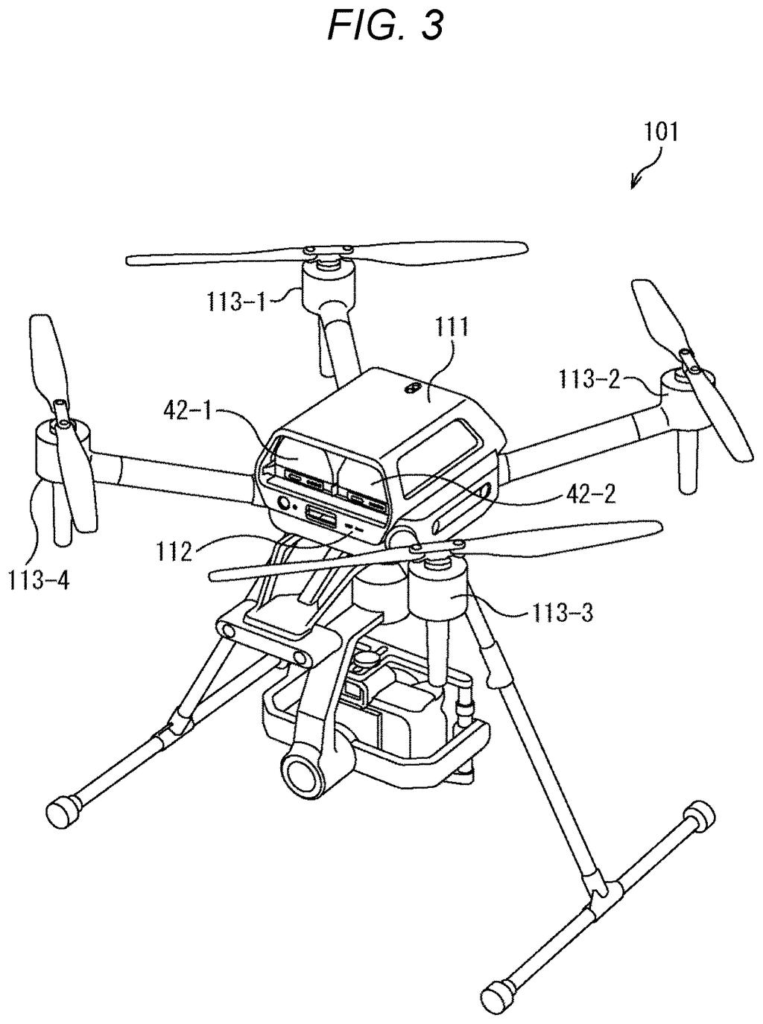
The drone in the filing has two battery slots. When a pack goes in or comes out, a row of four small lights on the back shows how much charge is left, for about 10 seconds, even though the drone is off. If a slot is empty, the lights stay dark, which is a handy hint that you forgot the second battery.
The filing goes further. If one battery is much more drained than the other, the drone can refuse to take off, slow its motors, or land itself. It's a pre-flight check built into the machine.
… circuitry configured to detect a remaining capacity and a voltage of each of the two or more batteries attached to the attachment portion, control an operation of the mobile body, and control the operation of the mobile body in accordance with a difference between remaining capacities of the two or more batteries.
Translation: Internal computer chips check the power levels and voltages of all attached batteries to decide how the drone operates.
How the drone compares its battery packs
The filing describes a drone (or another battery-powered machine, such as a robot) with two or more removable batteries. A battery management unit, a small controller that tracks each pack's remaining charge and voltage (the electrical "pressure" a battery delivers), watches the slots. When a pack is attached or removed, it works out one combined charge figure, such as the lower of the two, and shows it on four lights on the drone's back for a preset time, for example 10 seconds. In the drone example this happens while the power is off, and the lights stay dark unless every slot is filled.
The claims focus on what the machine does with those numbers:
- Charge gap: if the remaining charge of the batteries differs by more than a set threshold, movement is restricted by stopping, limiting motor output, or a forced landing.
- Voltage gap: if voltages differ by more than a set amount, the motor runs from the battery with the highest voltage.
- Failure backup: if one battery has an abnormality, the machine keeps moving on the other.
- User settings: the warning level and the charge-gap threshold can be set by the user.
The description also shows a phone app screen with the charge percentage, an estimated flyable time (9 minutes in the example), and a color bar that turns red near the danger level.
What this means for drone pilots and robots
If you fly a drone for work or fun, swapping batteries is the chore you repeat most, and a half-empty or mismatched pair is an easy mistake to make in the field. A drone that shows its charge the moment you click a pack in, and balks at takeoff when the two packs are far apart, moves that check from your memory to the machine.
The same logic reaches beyond drones. The claims also cover robots, vehicles, two-wheelers, ships, airplanes and personal mobility devices that take removable batteries. Any of them has the same questions: how full is this, and are these packs a good match? The filing also describes flying on one battery if the other fails, a safety net for any machine that is expensive or dangerous to drop.
Sony's 41st filing in the Robotics patents we cover since May follows a drone mic hiding from cameras and a pet robot learning from others.
Almost everything this patent needs already exists in a drone with swappable batteries: slots that sense when a pack is clicked in, a controller that reads each pack's charge and voltage, and a few small lights. The rest is software rules about when to light up and when to refuse takeoff.
One piece has to exist first. The lights come on while the drone is powered off, so a small slice of circuitry must stay awake to notice a battery change. That is a design choice, not a new invention in hardware.
The shortest path to a product is short: a drone with two or more removable packs, plus a firmware update that adds the checks. Nobody will cheer a battery-gauge patent, but pilots who have watched a drone sag from a drained pack would use this on day one. It reads as a sensible, small fix that a maker could ship quickly.
Get our take in your Top Stories
Liked this breakdown? Add Patentlyze as a preferred source on Google, and our plain-English take shows up more often in your Top Stories the next time Sony patent news breaks.
There are more where this came from
We read every patent application Big Tech publishes and send you the ones worth knowing. Plain English, free, every week.
The drawings
11 drawing sheets from US 2026/0346739 A1 · click any drawing to enlarge


Show the other 3 sheets


Want this weekly breakdown for a company we don't cover? Patentlyze Pro →
Be the first to weigh in