
Sony Patents a Way to Make Color Sensors Agree With Each Other
No two color sensors are exactly alike, even off the same assembly line. Sony has filed a patent for a system that automatically calculates how to translate one sensor's readings into another's, so the variation effectively disappears.
What Sony's sensor calibration patent actually does
A quality inspector holds two phones side by side, takes the same photo, and gets slightly different colors on each screen. The sensors inside look identical on paper, but tiny manufacturing differences mean they each see the world a little differently.
Sony's patent describes a system that learns a mathematical recipe (called a conversion algorithm) to bridge that gap. You feed it the readings from your sensor, and it adjusts them so they match what a reference sensor would have produced. The device doing the adjusting doesn't need to know why the two sensors differ; it just figures out the numbers that make the outputs line up.
The goal is a world where software built on top of sensor data doesn't have to account for which specific unit it's running on. One calibration step, and every sensor in a batch effectively behaves like the same reference device.
… calculate the coefficient so that the different output obtained by inputting the first sensor output to the conversion algorithm approaches second sensor output …
Translation: It adjusts the math until the first sensor output matches what the second sensor produces.
How the conversion algorithm matches two sensors' readings
The patent centers on an information processing device that contains a coefficient calculation unit. A coefficient here is just a tuning number inside a formula.
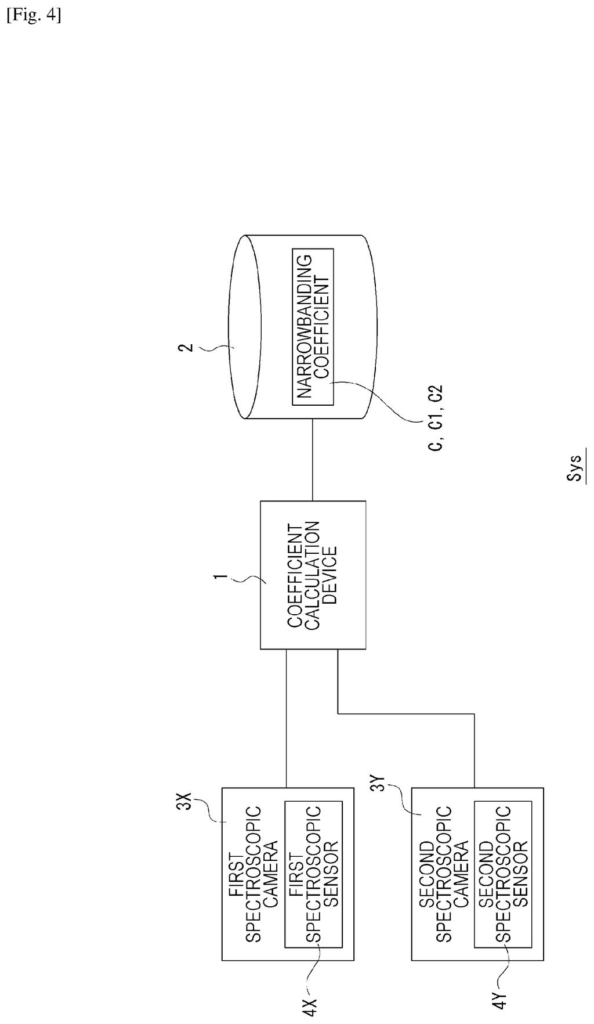
The setup involves two spectroscopic sensors (devices that measure how much light exists at each color or wavelength). The first sensor is the one being calibrated; the second is a reference sensor whose output is considered the target truth. The system compares what the first sensor reports against what the second sensor reports for the same scene or light source, then works backward to find the coefficients that, when plugged into the conversion formula, make the first sensor's output match the second's as closely as possible.
- First sensor output: raw spectral readings from the sensor under calibration
- Conversion algorithm: a mathematical function with adjustable coefficients
- Second sensor output: the reference readings the algorithm is trying to match
- Coefficient calculation unit: the component that solves for the best-fit numbers
Once those coefficients are locked in, any downstream software or image processor can treat the first sensor's corrected output as if it came from the reference sensor. The patent also covers the image processing side: applying those coefficients to produce corrected image data.
Provided is an environment in which a sensor output of a spectroscopic sensor can be handled without considering a variation in spectral sensitivity of the spectroscopic sensor.
Translation: It lets you use different color sensors without worrying about their individual hardware differences.
What this means for cameras and color-critical devices
Color accuracy matters in more places than most people think: medical imaging, food inspection cameras, industrial quality control, and smartphone photography all depend on sensors reading colors consistently. Right now, manufacturers either tighten production tolerances (expensive) or calibrate each unit by hand (slow). A software-only correction step that runs automatically could make both approaches cheaper.
For consumers, the practical payoff would be more consistent color between devices in the same product line. For Sony specifically, Sony's interest in spectroscopic sensor technology is visible across its semiconductor division, which supplies image sensors to a wide range of device makers. A calibration layer that works across sensor batches would make those sensors easier to integrate at scale.
Sony's 13th sensor filing we've tracked since June adds to a run that includes compressing 3D scan data and self-checking soil sensors, all within our broader sensor patent coverage.
The patent describes a software calibration layer, not new sensor hardware. That means the shortest path to shipping this is relatively short: if the math works, it can be implemented as a firmware or driver update on existing sensor platforms.
The harder question is whether a single conversion algorithm is flexible enough to handle the full range of unit-to-unit variation in real manufacturing, or whether accuracy degrades at the edges of that variation. The patent doesn't commit to a specific algorithm type, which is strategically broad but leaves the hard engineering problem open.
For most readers this is a quiet infrastructure patent, the kind that doesn't show up in a product announcement but determines whether a camera line is worth buying. If Sony's sensors end up in more medical or industrial devices, this kind of calibration tooling is exactly what makes that feasible.
There are more where this came from
We read every patent application Big Tech publishes and send you the ones worth knowing. Plain English, free, every week.
The drawings
34 drawing sheets from US 2026/0289731 A1 · click any drawing to enlarge


Want this weekly breakdown for a company we don't cover? Patentlyze Pro →
Be the first to weigh in