
Sony Files Patent for a Motorized Thumbstick That Fakes Clicks and Holds Its Position
Sony has filed a patent for a controller thumbstick with its own motors, so the stick can push back, hold still, or give you a fake mechanical click at an angle the game picks.
What Sony's motorized thumbstick actually does
Every time you let go of a thumbstick, a spring snaps it back to dead center. It happens thousands of times in a play session, and it always feels exactly the same, whatever game you're playing.
Sony Interactive Entertainment's filing swaps that fixed behavior for motors and sensors. The stick knows where it is, and the controller keeps choosing where the stick should want to rest. Let go and it can stay exactly where you left it. Push it partway and it can shove back gently, then suddenly tip forward, like the click of a switch.
The game or console can also change how hard the stick pushes, so one moment it feels heavy and sticky, and the next it feels light.
an operation member that is capable of being tilted or moved within a predetermined range by a user …
Translation: The thumbstick that players push around in different directions.
How the stick moves its own resting spot
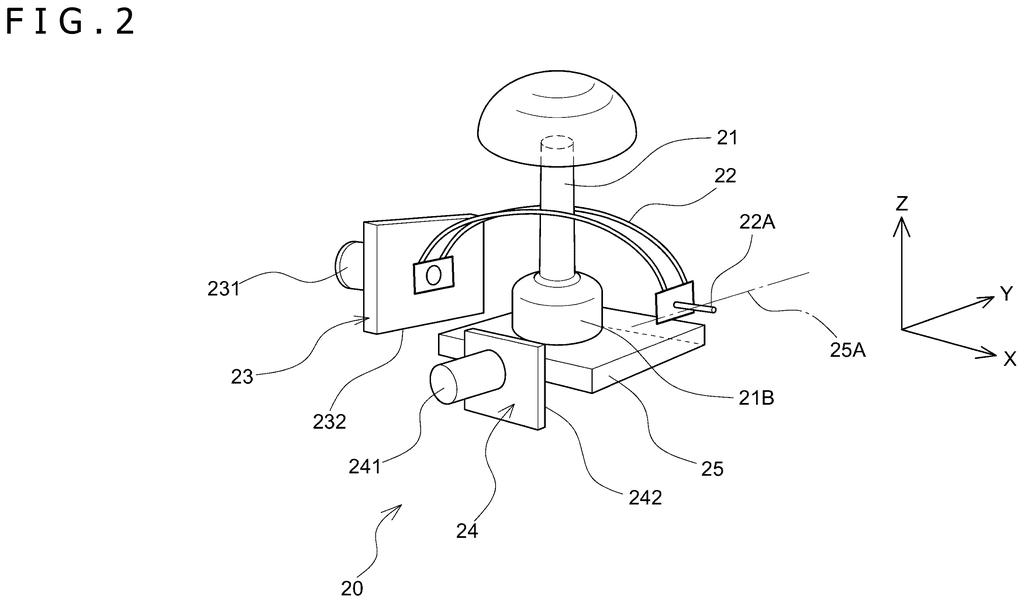
The device has a stick (the patent calls it an operation member) that tilts in any direction. Two small brushless motors (electric motors with no brushes, common in precision gear) tilt it along two axes, and two angle sensors report exactly where the stick is. The controller's processor uses those readings to drive the motors toward a target position.
The key move is that the target position isn't fixed. By default it's dead center, so the stick returns the way a normal one does. When the console sends a special instruction, the controller changes the target based on where the stick currently is. The filing describes two examples:
- Hold in place: the target is always wherever the stick is right now. Let go and it stays put. If the target updates on every sensor reading, the motors just resist movement, which feels like friction.
- Click zones: the stick's tilt range is split into bands, each with its own target, such as the middle of the band. When you cross a band's edge, the push reverses direction for an instant, which feels like a switch clicking.
The console can set how strong the push is, and the number and size of the bands. The filing also says a sliding control, not just a tilting stick, could work this way.
… a control unit ( 151 ) that drives the drive unit such that the operation member ( 20 ) approaches a prescribed target position, and changes the target position according to the position of the operation member ( 20 ) detected by the position detection unit.
Translation: The internal computer constantly adjusts the stick to fight your thumb or hold itself in place.
What this means for Sony controllers and games
If you play on a console, this points to a thumbstick whose feel changes with the game. A racing game could give you a click at each steering stage. A flight game could leave the stick where you set it. A heavy mech could make the stick physically harder to push.
The patent also describes the console doing part of the control over the wire or wireless link, which means developers could adjust the feel as the game runs. That's a lot of new control for designers, with the cost of extra motors, sensors, and battery drain in a handheld controller. The filing doesn't discuss any of those tradeoffs.
Sony's 26th filing we've tracked in input and haptics since May follows ideas like swappable sliding joysticks and remappable buttons that stay usable.
The problem here is small but constant: every thumbstick on the market feels the same, and its only job is to snap back to center. Nobody calls that a crisis, but it is the one part of a controller you touch for hours, and games have no way to change how it feels.
Sony's answer fits the size of that problem. It doesn't try to rebuild the controller. It reuses a stick with motors and sensors and changes one number, the resting spot. That makes click feel, held positions, and a heavier stick all come from the same simple trick.
The open question is cost and bulk. Motors in two sticks add parts, weight, and power draw, and the filing says nothing about them. Whether players would pay for a stick that can fake a switch is a bigger gamble than the engineering.
Get our take in your Top Stories
Liked this breakdown? Add Patentlyze as a preferred source on Google, and our plain-English take shows up more often in your Top Stories the next time Sony patent news breaks.
There are more where this came from
We read every patent application Big Tech publishes and send you the ones worth knowing. Plain English, free, every week.
The drawings
4 drawing sheets from US 2026/0339420 A1 · click any drawing to enlarge


Want this weekly breakdown for a company we don't cover? Patentlyze Pro →
Be the first to weigh in