
Samsung Patents a Flexible Screen Support That Prevents Cracking Along the Fold
Foldable phones bend in the middle, but the middle is also where they break first. Samsung's latest patent targets exactly that weak point with a smarter backing plate.
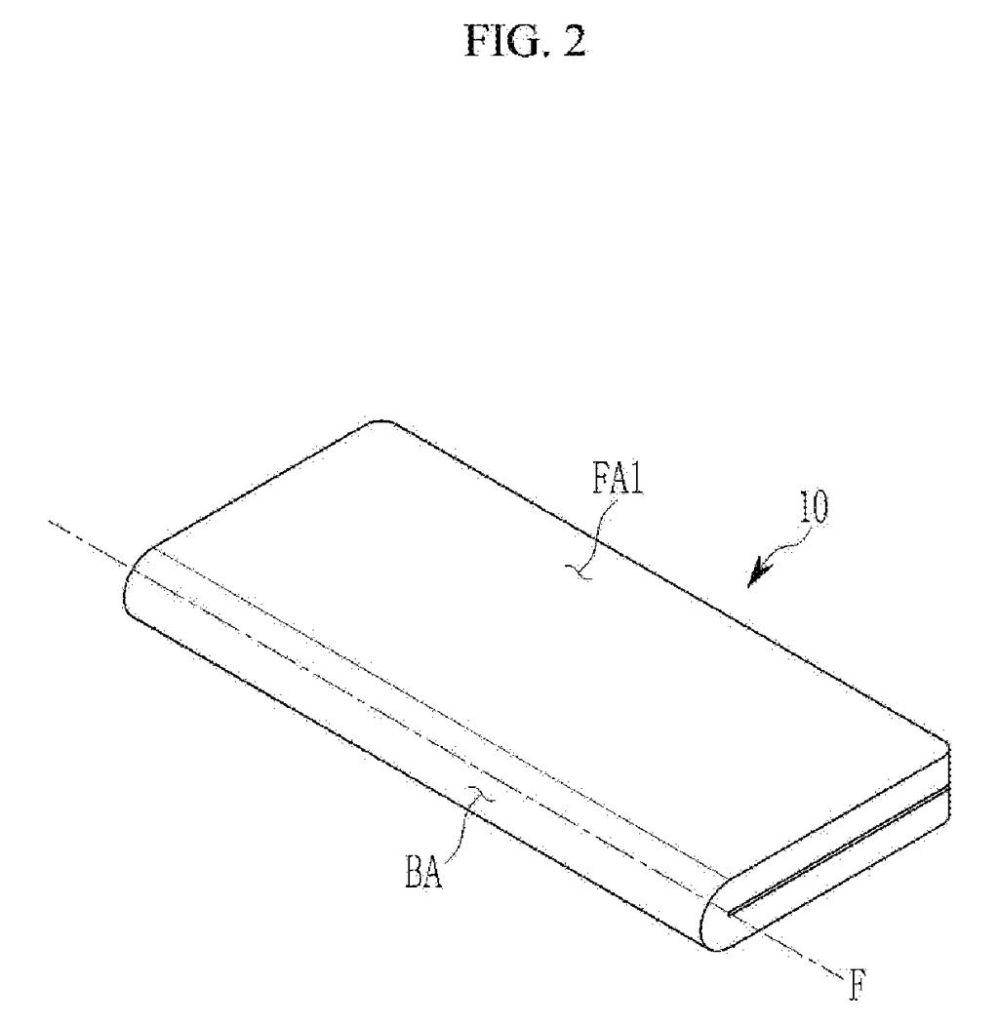
What Samsung's fold-zone support layer actually does
Imagine folding a piece of stiff cardboard in half repeatedly. The crease in the center takes far more punishment than the edges near it, and eventually it cracks. The flexible display inside a foldable phone faces the same physics every time you open or close it.
Samsung's patent describes a rigid support layer made of fiber-reinforced plastic, the kind of tough composite used in aerospace parts, placed behind the display. That layer has a grid of small holes punched through it so the hinge region can flex. The clever part: the holes at the outer edges of the fold zone are cut more cleanly than the holes in the center, meaning less material damage around each opening.
The idea is to spread stress more evenly. The center of a fold bears the most bending force, so allowing its holes to carry a slightly wider damage boundary (within controlled limits) lets the structure absorb strain without that damage propagating into a full crack. Think of it as a designed-in buffer zone that tells stress where to go.
… the supporting member includes a folding portion corresponding to the foldable area of the display panel and defining a plurality of through-holes …
Translation: The screen sits on a support layer that has a series of small holes cut into the area where the device bends.
How the affected-zone width varies across the fold
The patent centers on a supporting member (a structural backing plate) made of fiber reinforced plastic (FRP), a composite material where stiff fibers are embedded in a polymer matrix to get high strength at low weight.
The backing sits beneath the flexible display panel and includes a folding portion aligned with the phone's hinge. That folding portion is perforated with many small through-holes so the otherwise-rigid FRP can flex when the device bends. Without those holes, the panel would buckle or delaminate.
Each hole has an affected zone at its boundary: a thin ring of material where the cutting process (likely laser cutting or mechanical punching) has caused microscopic physical or chemical changes, such as heat damage, micro-fractures, or resin degradation. The key engineering claim is about the width of that affected zone:
- Holes near the outer edges of the fold zone (first regions) have a narrower affected zone, meaning cleaner cuts and less surrounding damage.
- Holes in the center of the fold zone (second region) are allowed a wider affected zone.
The gradient in cut quality is deliberate. The outer edges of the fold experience more complex, mixed stress states, so having cleaner hole boundaries there reduces crack-initiation risk. The center, which flexes more uniformly, can tolerate slightly rougher cut edges because the stress is distributed across more material.
… each of the plurality of through-holes includes an affected zone located at a boundary of the through-hole, in which a physical or chemical change has occurred …
Translation: The edges of these holes are treated or altered to change their physical properties.
What this means for foldable phone durability
Durability is one of the last big objections people raise before buying a foldable phone. Display panels on folding devices have improved markedly, but the mechanical layers behind them, the hinges, plates, and adhesives, still accumulate fatigue. A backing plate engineered to manage where micro-damage forms could meaningfully extend how many open-and-close cycles a device survives before the hinge region starts to degrade visibly.
This is incremental engineering rather than a conceptual leap, but incremental is how display longevity actually improves. Samsung Display files across a wide front of foldable-display construction details, and this patent sits alongside new Big Tech patents in the foldable-display materials space that collectively push toward devices people will trust to last as long as a conventional phone.
That makes this Samsung's 59th filing we've tracked since May in our foldable phone patents watchlist, which already covers work on a rainbow-killing cover glass and a spring-loaded hinge.
Claim 1 covers something quite specific: a plastic backing sheet where the ring of altered material around each hole must be measurably narrower toward the outer edges of the fold zone than toward the center. That is a precise structural gradient, not a general right to punch holes in a flexible support layer.
In practice, that narrowness draws a real line. A phone maker using identical damage rings across every hole, or running the gradient in reverse, would likely fall outside this claim entirely. What gets blocked is the deliberate choice to taper structural damage outward from the fold's center as a way to manage stress.
For anyone who has watched a permanent crease form down the middle of a foldable phone, the stakes are clear. Samsung is addressing that problem at the material layer itself, controlling how unavoidable microscopic damage spreads across a backing sheet so the screen above it can survive repeated folding.
Get our take in your Top Stories
Liked this breakdown? Add Patentlyze as a preferred source on Google, and our plain-English take shows up more often in your Top Stories the next time Samsung patent news breaks.
There are more where this came from
We read every patent application Big Tech publishes and send you the ones worth knowing. Plain English, free, every week.
The drawings
16 drawing sheets from US 2026/0255506 A1 · click any drawing to enlarge


Want this weekly breakdown for a company we don't cover? Patentlyze Pro →
Be the first to weigh in