
Sony Patents a New Method for Sending Data Through Signal-Bouncing Wireless Networks
Sony has filed a patent around a technique that lets a wireless network tell your device not just what signals it's sending, but how likely each one is to appear. That small extra detail could make decoding faster and more accurate in environments full of signal-bouncing surfaces.
What Sony's reflective surface signal trick actually does
Imagine you're in a busy airport, and the Wi-Fi is fighting through walls, pillars, and hundreds of other devices to reach your phone. One way engineers are trying to fix this is by adding special panels to walls that can bend and redirect wireless signals on demand, almost like mirrors for radio waves.
Sony's patent describes a system that goes one step further. The network doesn't just send signals using a particular coding scheme, it also tells your device how often each type of signal in that scheme is likely to appear. Think of it like a card game where the dealer tells you the odds of each card being drawn before you play. That extra hint lets your device decode what it receives more efficiently.
The technique ties together two ideas: those signal-redirecting wall panels and a coding format called A-PSK, which bundles data into packages that vary in both strength and angle. Together, they could let one base station serve multiple devices at the same time without them tripping over each other.
providing, to a wireless communication device of the communication network that is being served by the access node, one or more messages associated with an amplitude and phase-shift-keying (A-PSK) modulation used by the access node for transmitting …
Translation: The router sends data setup details to your phone using a specific signal modulation method.
How A-PSK probabilities guide the device's decoder
The patent centers on two connected ideas working together.
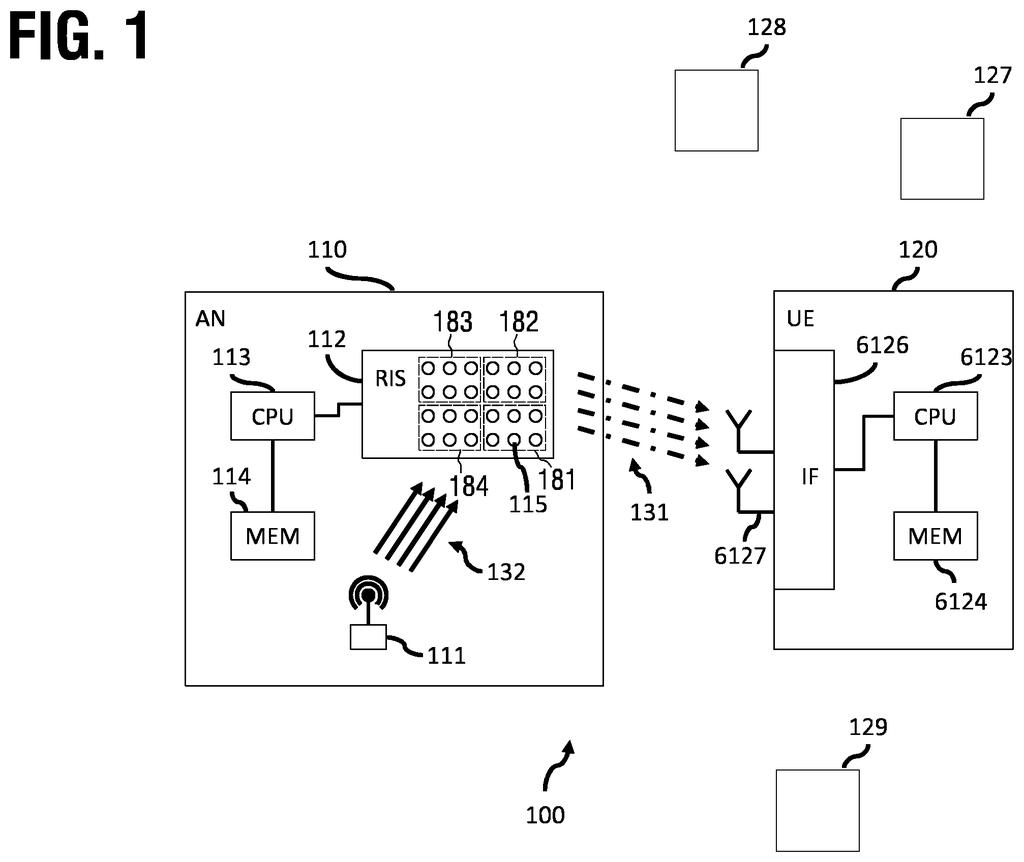
The first is a reflective intelligent surface (RIS), a panel of tiny programmable antennas that can be mounted on a wall or ceiling. Unlike a passive mirror, it can be tuned electronically to steer incoming wireless signals in specific directions. A single access point can split the surface into partitions, each aimed at a different device in the room, effectively creating separate wireless lanes.
The second idea is A-PSK (amplitude and phase-shift keying), a way of encoding data by varying both how strong a signal is and what direction it is "pointing" mathematically. This gives more flexibility than simpler coding schemes that only vary one dimension.
The patent's specific contribution is that the access node sends the device not just the alphabet of possible signal states (the full list of values the signal might take), but also the transmission probabilities of each symbol in that alphabet. That means the device's decoder (the part that translates raw radio energy back into data) knows in advance that some symbols appear more often than others, which lets it make better guesses when signals are weak or distorted.
In practical terms, the network is sharing its "cheat sheet" with every device it serves, and each device uses those probabilities to decode incoming signals with fewer errors.
Various disclosed techniques pertain to serving multiple wireless communication devices using partitions of a reflective intelligent surface.
Translation: Smart reflecting walls are divided into sections to help serve multiple phones at once.
What this means for crowded wireless networks
For everyday wireless users, this kind of technique is aimed at a real frustration: performance that drops when a space is crowded or when you are not in a direct line of sight from a router or cell tower. Reflective surfaces could extend reliable coverage around corners and into dead zones, and the probability-sharing step is what makes the decoding side efficient enough to keep up.
the pattern in Sony's wireless-infrastructure filings suggests continued investment in physical-layer signal processing, the low-level mathematics that determines how quickly and reliably data travels over the air. If this approach were adopted broadly, a base station could serve more devices simultaneously without adding spectrum or extra hardware beyond the surface panels themselves.
Sony's 524th filing we've tracked since May joins work like the glare-avoidance camera patent and the mid-play touch controls patent.
Claim 1 covers any access node that sends a wireless device both a signaling alphabet and the odds attached to each symbol in that alphabet. No reflective panels required, no specific frequency band, no particular network generation. That scope is wide.
In practice, a granted claim this broad could give Sony a say over any base station that tells a receiver how likely each signal pattern is before transmission begins. That covers a real design strategy engineers use to squeeze more data through a channel by sending common patterns more often than rare ones.
The prior art question will be sharp. Weighted symbol probabilities have roots in decades of information theory, and examiners will press Sony to show what step here is new. The claim may narrow before it grants, but as written it stakes out meaningful ground.
There are more where this came from
We read every patent application Big Tech publishes and send you the ones worth knowing. Plain English, free, every week.
The drawings
6 drawing sheets from US 2026/0291801 A1 · click any drawing to enlarge


Want this weekly breakdown for a company we don't cover? Patentlyze Pro →
Be the first to weigh in