
Sony Patents a System to Pull Connected-Device Readings Across Competing Networks
Right now, if your smart home sensors live on one provider's network and a compatible service runs on another, they can't talk to each other. Sony's new patent describes a system that lets IoT networks share sensor data across providers as if they were one.
What Sony's cross-IoT sensor data sharing actually does
Today, IoT (Internet of Things) networks are largely isolated islands. If your temperature sensor is registered with one service provider and you want a second provider's app to read it, you're mostly out of luck because each platform speaks only to itself.
Sony's patent describes a system where a first IoT service provider can reach out to a second one on your behalf, using the same simple request language your app already uses. You ask your usual app for sensor data, and behind the scenes the providers negotiate access, check whether sharing is allowed, and hand back the answer, whether the data lives next door or several network hops away.
Policy rules built into each provider control what can and can't be shared, so the cross-network lookup only happens when both sides agree. The goal is to make the patchwork of competing IoT platforms feel, from your perspective, like a single connected service.
… acquire the subject data from the second SP via a third SP other than the first SP and the second SP, the third SP being connected between the first SP and the second SP.
Translation: Data travels through a middleman network to reach your app from a rival service provider.
How Sony's protocol bridges separate IoT service providers
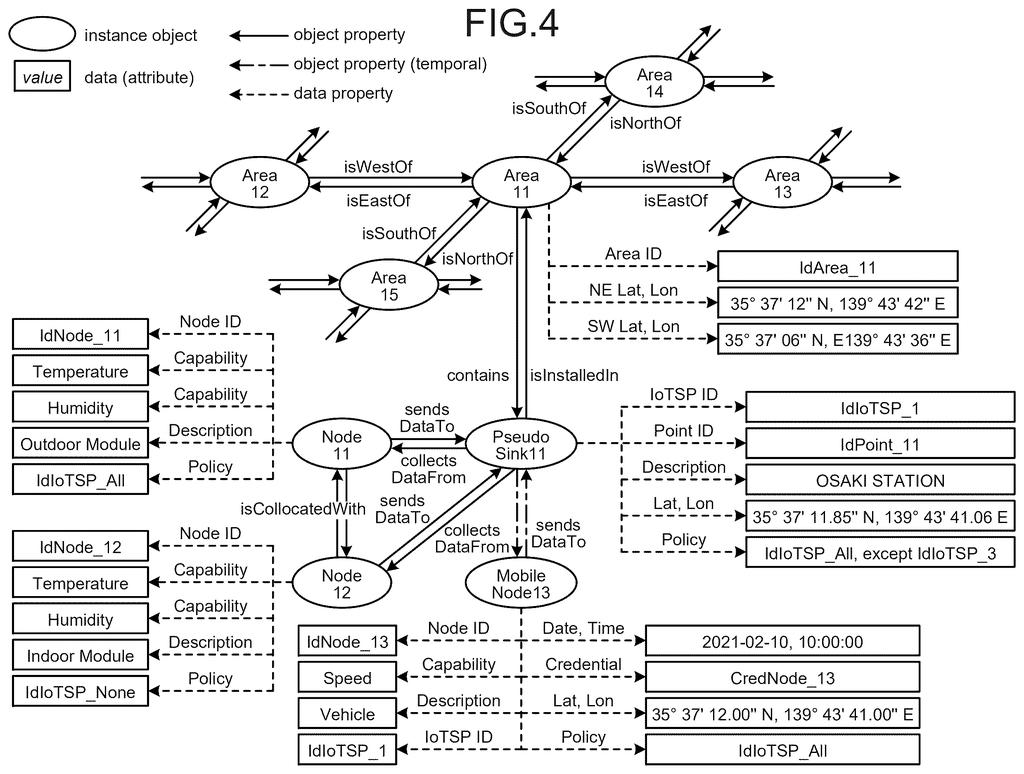
The patent describes an architecture built around what Sony calls IoT Service Providers (IoTSPs), essentially the middleware platforms that manage sensors and hand out their data to apps.
When your app sends a data request to its own provider (the first SP), the provider checks whether the requested sensor actually lives on a different provider's network (the second SP). If so, it looks up two things:
- An identifier for the second SP, included in the original request, that tells it where to go.
- Policy information, stored in a dedicated database at each SP, that says whether the two providers are allowed to share data with each other.
If sharing is permitted, the first SP queries the second SP using a query language (a structured way of asking for data, similar to how databases are queried) and the same request procedure the app used originally. That consistency means no special translation layer is needed at the app level.
The claim also covers a third SP acting as an intermediary connector between the first and second, which matters when two providers don't have a direct link. Each SP maintains two internal databases: one for its own configuration and one for the sensor data it manages.
… policy information indicating propriety of information sharing between the IoTSPs …
Translation: Rules check whether the two competing networks are allowed to share your device readings.
What this means for connected device ecosystems
For consumers, fragmented IoT ecosystems are a daily frustration. Buying a sensor that works with one platform often means it's invisible to every other platform you use. If Sony's approach were widely adopted, a single app request could silently pull data from whichever provider actually owns a given sensor, without you having to juggle multiple accounts or apps.
For the industry, the interesting detail is the policy-gate: sharing only happens when both providers have explicitly agreed to it in advance, which gives each company control over its own data. This filing sits squarely in the ongoing push to define how IoT platforms federate, and it joins a growing body of new Big Tech patents staking out positions in the connected-device interoperability space.
Sony's 358th filing we've tracked in our Sony coverage since May joins earlier work on automatic scene mapping from scripts and touch sensations stored in 3D files.
Claim 1 covers any two companies that manage connected devices sharing user information through a common question-and-answer format and a set of permission checks. A third company can also sit in the middle and pass data along, so the patent reaches arrangements where information hops through a go-between rather than traveling straight from one company to another.
If the patent office grants this at full scope, it could shut out a wide range of software products that let multiple device-management companies pool data under agreed rules. That makes the key question a simple one: has anyone already built and published something like this before the inventors filed?
Get our take in your Top Stories
Liked this breakdown? Add Patentlyze as a preferred source on Google, and our plain-English take shows up more often in your Top Stories the next time Sony patent news breaks.
There are more where this came from
We read every patent application Big Tech publishes and send you the ones worth knowing. Plain English, free, every week.
The drawings
45 drawing sheets from US 2026/0246841 A1 · click any drawing to enlarge


Want this weekly breakdown for a company we don't cover? Patentlyze Pro →
Be the first to weigh in