
Sony Patents a Soil Moisture Sensor That Reads More Often Right Before Watering
Most soil sensors waste power by checking moisture at a fixed rate, even when that data is barely useful. Sony's new patent describes a sensor that knows when watering is coming and ramps up its readings only then.
How Sony's irrigation sensor cuts its own power use
You're managing a farm or a large greenhouse, and dozens of soil sensors are buried in the ground, all constantly drawing power to check moisture levels every few minutes, around the clock. Most of that data, collected in the middle of the night or days before the next watering, doesn't actually change your decisions.
Sony's patented sensor solves that by being strategic about when it works hard. In the window right before scheduled irrigation, it increases how often it measures soil moisture. Before that critical window, it dials the frequency way down. You still get precise data when it counts, but the sensor burns far less power overall.
The practical upside is longer battery life and lower operating costs, which matters a lot when you're running a network of hundreds of sensors across a large agricultural operation. Less frequent data collection when it isn't needed is a small idea with real compounding savings at scale.
… controls a measurement frequency of the parameter within a first measurement period immediately before an irrigation timing to the soil to a value higher than a predetermined value …
Translation: It checks the soil moisture much more often right before it waters the plants.
How the sensor shifts measurement rate around irrigation time
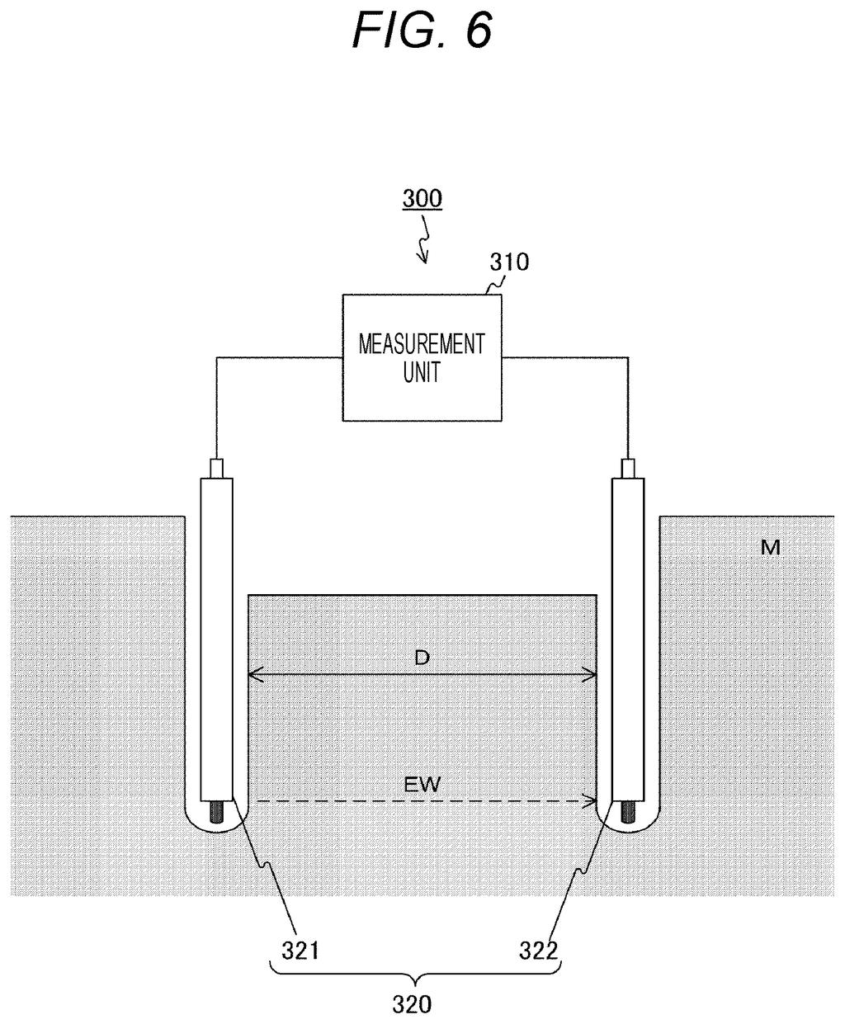
The patent describes a soil moisture sensor with two main components: a measurement section that reads a moisture-related parameter from the soil, and a control unit that decides how often those readings happen.
The core mechanism is a variable measurement frequency. The control unit defines a "first measurement period" immediately before a scheduled irrigation event. Inside that window, the sensor takes readings more frequently than a baseline rate. Outside that window, readings happen at a lower-than-baseline rate. Think of it like a doctor taking your pulse quickly right before a procedure, and only once a day the rest of the time.
The system's key assumption is that irrigation timing is known in advance, whether from a set schedule or a controller that plans watering ahead of time. That advance knowledge is what lets the sensor shift gears at the right moment.
- Low-frequency phase: Long gaps between measurements, conserving battery when soil conditions are stable and no watering is imminent.
- High-frequency phase: Dense, rapid readings in the window just before irrigation, capturing how moisture changes as watering approaches.
- Control unit: Manages the transition between phases based on the irrigation schedule.
In a system that measures a parameter related to moisture of soil, power consumption is reduced.
Translation: The main goal of the design is to save battery life while tracking dirt dryness.
What this means for smart agriculture and sensor battery life
For precision agriculture, sensor battery life is a real operational headache. Replacing or recharging sensors buried in a field is time-consuming and expensive, so anything that extends their usable lifespan without sacrificing data quality has practical value. This patent targets exactly that tradeoff: you get dense data when decisions are being made (right before watering) and lean operation the rest of the time.
The claim as written is fairly broad. It covers any sensor for any soil moisture parameter that applies this high-low frequency pattern around an irrigation event. That breadth could matter in the agricultural-tech space, where soil sensor networks are a growing product category and Sony's interest in environmental and IoT sensing stretches across several recent filings.
Sony's fourth filing in the Battery and power patents we've tracked since June joins one on reading data through skin and one on teaching robots to walk.
Claim 1 covers any soil sensor that measures faster right before watering and slower at other times. That description is deliberately wide: no specific hardware, no defined algorithm, no precise window for what counts as "immediately before" irrigation.
In practice, that breadth means almost any smart irrigation product that adjusts how often it checks soil conditions around a scheduled watering event could fall inside this claim. The patent does not require a particular method for knowing when irrigation is coming, only that the sensor speeds up before it happens.
Whether that coverage holds depends entirely on what examiners find in existing prior art, because the underlying idea, check more often when it matters, is a familiar engineering principle. If the claim survives intact, Sony holds a remarkably wide gate over a growing product category.
There are more where this came from
We read every patent application Big Tech publishes and send you the ones worth knowing. Plain English, free, every week.
The drawings
27 drawing sheets from US 2026/0298905 A1 · click any drawing to enlarge


Want this weekly breakdown for a company we don't cover? Patentlyze Pro →
Be the first to weigh in