
Sony
Sony · Display · Filed Oct 22, 2025 · USPTO published Oct 1, 2026 · Oct 1 release
Sony Patents a Touchscreen That Physically Pushes Back Wherever You Press
Most touchscreens vibrate the whole display when you tap. Sony's new patent describes something different: a single haptic unit that physically moves to meet your finger, deforming only the spot you're pressing.
- Publication number
- US 2026/0299693 A1(US20260299693A1)
- Applicant
- Sony Group Corporation
- Filed · Published
- Oct 22, 2025 · Oct 1, 2026
- Inventors
- Akira ONO, Hironobu ABE, Akihito NISHIIKE
- Status when we published
- Examiner raised objections; the company can respond
- Document
- 13 claims
- US classification
- 345/173
- Examiner
- AMADIZ, RODNEY (Art Unit 2622)
- Parent application
- National Stage Entry of PCT/JP2024/014482 (filed Apr 10, 2024)(PCTJP2024014482)
What Sony's shape-shifting touch surface actually does
Imagine pressing a button on your car's dashboard screen and feeling a real, physical click right under your fingertip, not a general buzz through the whole panel. That's the experience Sony is trying to engineer.
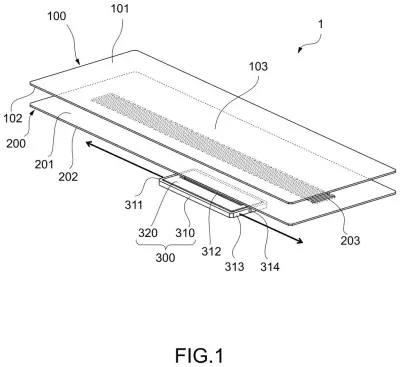
The patent describes a flexible surface you can touch, backed by a layer that controls how that surface can flex, and a separate moving unit underneath. When you touch a spot, that unit travels to the matching position and pushes up against the flexible layer, creating localized physical feedback exactly where your finger is.
Right now, most touchscreens use one vibration motor for the entire glass, so the feedback feels the same whether you tap the center or an edge. Sony's approach aims to make each press feel distinct and spatially accurate, which could matter a lot in cars, where you're often touching a screen without looking at it.
a deformable flexible layer that has flexibility, the flexible layer including a front surface that is exposed to be touchable by a user …
Translation: The screen is bendable and the part people actually touch with their fingers.
How the moving haptic unit finds your finger
The system has three stacked layers working together.
The flexible layer is the top surface the user touches. It's made of a pliable material, not rigid glass, so it can be deformed at a specific point without the whole surface moving.
The specification layer sits directly behind the flexible layer. Its job is to constrain and guide how the flexible layer can deform, essentially acting as a structural template that limits movement to the intended spot.
The haptic generation unit is the active component. Unlike a fixed vibration motor, this unit is mechanically mobile. It repositions itself behind the specification layer to align with whatever point on the flexible surface the user is touching, then actuates to push that precise area outward.
The key distinction from conventional haptics is localization. Standard devices use one motor whose vibration spreads across the whole surface. Here, the motor goes to the touch point, so the physical deformation is concentrated. The patent situates this technology in a vehicle context, suggesting Sony sees in-car interfaces as a primary application.
… the haptic generation unit being moved to a position that corresponds to a touch portion of the flexible layer that is a portion touched by the user, the haptic generation unit deforming the touch portion of the flexible layer …
Translation: A mechanical pusher moves right underneath your finger to physically warp the screen.
What this means for in-car and device touchscreens
In a car, eyes-on-the-road is a safety issue, not just a preference. If your screen's buttons feel physically different under your finger based on where they are, you can navigate controls by touch alone rather than glancing down. That's a real, immediate payoff for drivers.
For consumer devices more broadly, this could give flat touchscreens a texture-like quality that current vibration motors can't deliver. Whether Sony ships anything using this system is unknown, but the vehicle patent framing suggests the company is thinking about displays where tactile accuracy has consequences, not just as a novelty feature.
Sony's 90th filing in our Display patent coverage since May follows work like angle-based color correction and a wrist-rotation expandable screen, showing how the company keeps exploring how screens adapt to users.
Source: US 2026/0299693 A1 at the USPTO (PDF). Full patent text and figures are in the official publication.
Get our take in your Top Stories
Liked this breakdown? Add Patentlyze as a preferred source on Google, and our plain-English take shows up more often in your Top Stories the next time Sony patent news breaks.
Add Patentlyze on Google
One click.
There are more where this came from
We read the new patents from Big Tech, carmakers and more and send you the ones worth knowing. Plain English, free, every week.
The drawings · 12 sheets
12 drawing sheets from US 2026/0299693 A1 · click any drawing to enlarge


Show the other 4 sheets


More from Sony
All 722 Sony patents →
More in Display
All 746 Display patents →
Qualcomm
Qualcomm Patents a Way to Blend Sharp and Blurry VR Image Zones at the Chip Level
Qualcomm
Qualcomm Patents a Display That Adjusts Zoom Speed Based on How Far Away Your Eyes Are
Samsung
Samsung Patents a Dual-Metal Light Filter for More Precise Image Sensors
Samsung
No comments yet