
Toyota
Symbotic · Robotics · Filed Jul 1, 2025 · USPTO published Nov 19, 2026 · This week's release
Symbotic Patents a Camera System That Helps Robots Remove Warehouse Boxes One Row at a Time
A pallet that looks tidy from across the room is rarely flat up close, and this Symbotic patent application is about teaching a robot to notice. Cameras measure each layer's tilt and shift before the arm ever grabs it.
- Publication number
- US 2026/0365460 A1(US20260365460A1)
- Applicant
- Symbotic Canada, ULC
- Filed · Published
- Jul 1, 2025 · Nov 19, 2026
- Inventors
- Christian SIMON, Sylvain-Paul MORENCY, William LÉGARÉ, Benoît LAROUCHE, Robert JODOIN, Juergen CONRAD
- Status when we published
- Waiting for an examiner
- Document
- 34 claims
- US classification
- 700/214
- Parent application
- Continuation of 17/070,753 (filed Oct 14, 2020)(17070753)
What Symbotic's pallet cameras actually do
You're standing at the end of a warehouse dock, and a pallet stacked head-high with cartons of cereal rolls up. Somewhere in that stack, a few boxes have been squashed, one layer sits slightly crooked, and a carton has its flaps hanging open. A robot has to lift each full layer without dropping a thing.
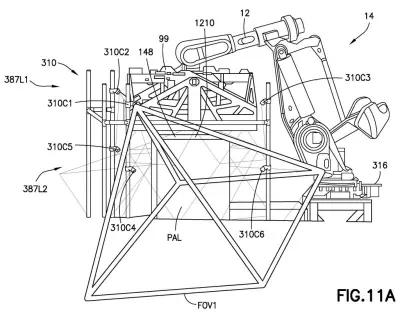
Symbotic's patent application describes a set of cameras that watch the pallet from the side and above, separate from the robot arm. They photograph the top layer, work out exactly how it sits (tilted, shifted or turned), and tell the robot where to put its gripper. Because the cameras are not attached to the arm, they can scan the next layer while the robot is still setting the last one down.
If a layer is too crooked, or too many boxes are missing, the system can refuse the pick and call a person instead.
an array of cameras disposed at a pallet unloading station so as to image a pallet load of cases received at the pallet unloading station arranged in pallet load layers …
Translation: Multiple cameras are placed at the unloading station to take pictures of stacked boxes.
How the cameras line up a layer with the grip
The claims cover a vision system for a depalletizer (a machine that takes a stacked pallet apart one layer at a time). An array of cameras sits at the unloading station, apart from the robot, and takes at least one image of the top of the topmost layer. A controller reads the image and works out the layer's position and orientation compared with the spot where the robot's grip is built to take hold. It then sends position commands so the grip can capture and hold the layer.
The filing describes how that comparison works:
- The cameras are calibrated to a shared reference structure (a flat fixture covered in uniquely shaped squares), so every image lines up with the robot's own coordinate system.
- The controller finds the corners of the top layer, fits a flat plane to its surface, and measures how far that plane is off from the gripper's plane in two directions, plus any center-point offset.
- If the tilt is too large (the example given is about 5 to 10 degrees), the pick is rejected and an operator gets an alert.
In the example described, the setup uses as many as six 3D depth cameras (time-of-flight cameras, which measure distance by timing reflected light) arranged on two levels, covering the pallet from top to bottom. The controller also respects limits such as robot exclusion zones when it picks the best grab position.
… a vision system to image the pallet load of cases and generate at least one image of a top portion of the layer(s) independent of robot motion …
Translation: The camera system photographs the top layer of boxes without relying on the robot to move.
Why crooked pallets matter to warehouses
Warehouses that feed stores with groceries and household goods unload huge numbers of pallets, and a robot that jams or drops a layer can stall a whole line. A camera system that tells the arm how a layer actually sits, and says no to a bad pick, could mean fewer stoppages and fewer smashed boxes by the time products reach your store. Nothing here changes what you buy. It changes how reliably it shows up.
The filing places this unloading cell inside a larger automated storage and retrieval system, where unloading is matched to a set flow rate of cases. Keeping the cameras off the arm lets the next layer be scanned while the last one is being set down, which helps protect that pace.
Source: US 2026/0365460 A1 at the USPTO (PDF). Full patent text and figures are in the official publication.
Get our take in your Top Stories
Liked this breakdown? Add Patentlyze as a preferred source on Google, and our plain-English take shows up more often in your Top Stories the next time Symbotic patent news breaks.
Add Patentlyze on Google
One click.
There are more where this came from
We read the new patents from Big Tech, carmakers and more and send you the ones worth knowing. Plain English, free, every week.
The drawings · 32 sheets
32 drawing sheets from US 2026/0365460 A1 · click any drawing to enlarge


Show the other 24 sheets


No comments yet