
Samsung
Samsung · Camera · Filed Jul 27, 2026 · USPTO published Nov 19, 2026 · This week's release
Samsung Patents a Robot Vacuum That Pays Closer Attention Near Obstacles
A robot vacuum has only so much computing power, and Samsung's patent has it spend that power where it counts: on camera video when something is close ahead, and much less of it on open floor.
- Publication number
- US 2026/0363501 A1(US20260363501A1)
- Applicant
- SAMSUNG ELECTRONICS CO., LTD.
- Filed · Published
- Jul 27, 2026 · Nov 19, 2026
- Inventors
- Joonyoung HEO, Minjin SONG, Jinhwi KIM
- Status when we published
- Waiting for an examiner
- Document
- 20 claims
- US classification
- 15/319
- Parent application
- Division of 18/808,519 (filed Aug 19, 2024)(18808519)
What Samsung's robot vacuum does near obstacles
Your robot vacuum is gliding across an empty stretch of living room floor when the edge of a stairway appears a couple of feet ahead. That is exactly when its camera video needs to be analyzed fast, with no lag.
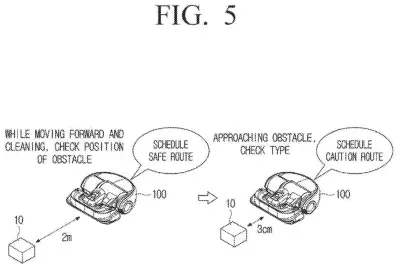
Samsung's patent describes a vacuum that sorts its path into two kinds: safe and caution. If nothing sits within a set distance, the robot eases off, with lower-quality video and some sensors switched off. When an obstacle, stairs or a handrail is close, it moves camera video to the front of its to-do list so it can react without delay.
The company's stated reasons are practical: keeping the robot's internal parts from running hot on easy stretches, and avoiding processing delays when it counts. Your robot would, in effect, save its effort for the moments that need it.
… adjusting, based on identifying that the driving route is the caution route, a processing priority order of data obtained from the video to be higher.
Translation: When the vacuum detects a tricky spot, it speeds up how fast it processes video data.
How the robot tells safe floor from caution floor
While cleaning, the robot watches video from its camera and checks whether an obstacle, stairs or a handrail is within a preset distance. If so, the route counts as a caution route, and the robot raises the priority of processing that video (the order in which its chips handle jobs), pushing less urgent tasks down the list.
On a safe route, the filing describes several ways to ease the load:
- Lower the video's resolution or frame rate.
- Switch off an infrared (IR, a sensor that measures distance using invisible light) or fall detection sensor.
- Tell the kernel (the core of the robot's operating software) to ignore a sensor's output.
The robot can also choose which chip handles a video job. The GPU (a graphics chip) is usually faster, but if it is busy, the robot compares times. In one example, waiting for the GPU would finish the new job in about 43 milliseconds, while the CPU (the main chip) needs about 40, so the CPU gets it.
If a camera, sensor or chip shows a fault, the robot can head back to its charging station. The filing also describes handing video from a working camera (stereo or RGB) to apps that relied on the failed one.
identify a surrounding environment based on a video captured using the at least one camera, wherein the video is captured while the driver causes the cleaning robot to move …
Translation: The vacuum constantly watches its surroundings through a camera as it drives around.
Why a cooler, less distracted robot vacuum matters
For you, the payoff would be a robot vacuum that reacts on time near stairs, handrails or clutter, and is less likely to overheat during a long cleaning run. The filing says easing off on safe stretches reduces heating of internal parts, and giving camera video top priority near obstacles prevents processing delays.
It also shows a design habit for home robots: treat the chips and sensors as a limited budget and spend it based on what is happening around the machine. Samsung's filing also describes backups, such as using one camera's video when the other fails, and returning to the charging station when a part has a fault. It names no specific product and gives no performance figures.
This is the 61st Samsung filing we've tracked in our home robot patents since May, adding to work like the self-dropping mop cloth and the furniture-bouncing vacuum mop.
Source: US 2026/0363501 A1 at the USPTO (PDF). Full patent text and figures are in the official publication.
Get our take in your Top Stories
Liked this breakdown? Add Patentlyze as a preferred source on Google, and our plain-English take shows up more often in your Top Stories the next time Samsung patent news breaks.
Add Patentlyze on Google
One click.
There are more where this came from
We read every patent application Big Tech publishes and send you the ones worth knowing. Plain English, free, every week.
The drawings · 13 sheets
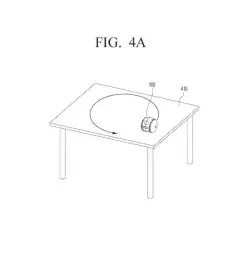
13 drawing sheets from US 2026/0363501 A1 · click any drawing to enlarge


Show the other 5 sheets


More from Samsung
All 1,662 Samsung patents →
More in Camera
All 271 Camera patents →
Sony
Sony Patents a Visual Map That Shows a Robot Every Angle It Can Photograph From
Sony
Sony Patents a Robot That Uses Touch and Distance Sensing Together to Understand Objects
Sony
Sony Patents a Camera That Keeps Fast-Moving Objects Locked in Frame
Sony
No comments yet