
Tesla
Tesla · Automotive · Filed May 7, 2025 · USPTO published Nov 12, 2026 · This week's release
Tesla Patents Air Suspension Valves That Ease Your Car Up Instead of Jolting It
Most air suspensions move a car with valves that are either fully open or fully shut, which is why a height change can end in a lurch. Tesla's new patent describes valves that open partway so the car glides to a stop.
- Publication number
- US 2026/0356153 A1(US20260356153A1)
- Applicant
- Tesla, Inc.
- Filed · Published
- May 7, 2025 · Nov 12, 2026
- Inventors
- Julian Pitt, Kevin Tovson, Anthony Cusato
- Status when we published
- Approved; patent expected soon
- Document
- 26 claims
- US classification
- 701/37
- Examiner
- STECKBAUER, KEVIN R (Art Unit 3747)
What Tesla's air suspension valves actually do
Today, most air suspension systems raise or lower a car using valves that are either fully open or fully shut, like a light switch with no dimmer. That makes the start and the end of a height change abrupt, and you can feel a small lurch in your seat.
Tesla's patent swaps in valves that can open partway, so the car controls how fast air moves. The car begins rising gently, speeds up through the middle, then eases to a stop at the target height, a slow, fast, slow pattern.
It also helps when the trunk is heavy. Older systems pulse the valves on and off to keep the car level, which makes it rise in visible steps. Here, each corner of the car can get its own smooth flow of air instead.
… at least one of the one or more variable-flow air valves is positionable, independent of a supply pressure to the at least one variable-flow air valve, at one or more positions intermediate a fully open position and a fully closed position to define a variable flow area through the at least one variable-flow air valve …
Translation: The valve can hold partial openings regardless of air pressure to fine-tune the airflow.
How the valves slow down near the target height
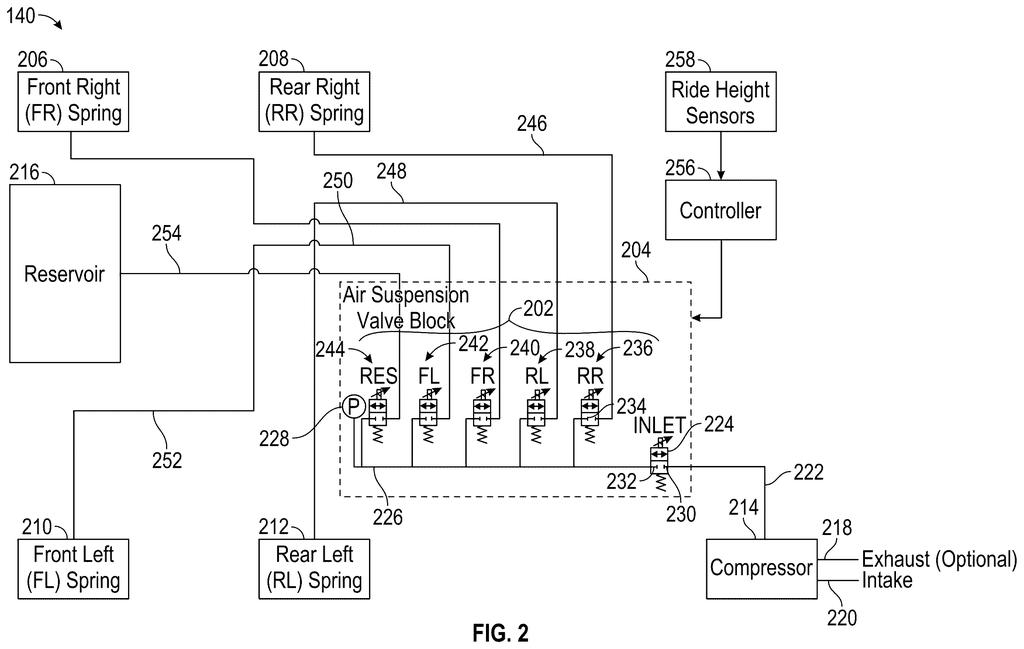
The system has the usual parts: air springs (the air-filled cushions that hold the car up), a compressor, an optional air reservoir (a storage tank for compressed air), and a valve block that routes air between them. The difference is the valves. Instead of on/off solenoid valves (electric switches that are fully open or fully shut), it uses variable-flow air valves that can sit at positions in between, and can hold them regardless of the air pressure feeding them.
A controller watches ride height sensors and adjusts the valves during a height change. It opens them gently, opens them wider through the middle, and closes them down as the car nears its target, tracing an S-shaped curve of height over time. Each corner of the car can run its own PID loop (a feedback routine that keeps nudging a setting toward a goal), with its strength turned down at the start and end and up in the middle.
- Balance: different valves open to different amounts for each air spring, so a heavy rear load does not require pulsing valves.
- Power: the valves can be driven by variable current, voltage or power, and the controller lets air pressure help hold a valve in place to cut the current needed.
- Profiles: the controller picks a leveling profile based on speed, road roughness, location, load or a direct user request. A request from you gets a more responsive profile, and automatic changes stay subtle.
This approach enables smooth transitions at the beginning and end of leveling operations, reducing vertical jerk experienced by vehicle occupants.
Translation: Adjusting the valves gradually prevents sudden bumps when the car changes its ride height.
Why a gentler lift matters for Tesla owners
If you drive a car with air suspension, you have probably felt it lurch as it raises or lowers. This design aims to remove that lurch, keep a loaded car level while it moves, and let the car pick a gentler or quicker profile depending on the situation. The description also mentions precise stops for jobs like lining up with charging equipment, and raising the car ahead of a high curb or steep driveway.
The patent office has approved this application, and once Tesla pays the final fee it should be issued as a granted patent. The filing describes the idea for an electric vehicle but names no specific model, so read it as a comfort and accuracy improvement without a product date.
Tesla's 57th filing in our Tesla coverage since May adds to a run that includes the seat spray idea and the battery fluid recipe.
Source: US 2026/0356153 A1 at the USPTO (PDF). Full patent text and figures are in the official publication.
Get our take in your Top Stories
Liked this breakdown? Add Patentlyze as a preferred source on Google, and our plain-English take shows up more often in your Top Stories the next time Tesla patent news breaks.
Add Patentlyze on Google
One click.
There are more where this came from
We read every patent application Big Tech publishes and send you the ones worth knowing. Plain English, free, every week.
The drawings · 4 sheets
4 drawing sheets from US 2026/0356153 A1 · click any drawing to enlarge


More from Tesla
All 57 Tesla patents →

More in Automotive
All 360 Automotive patents →
Sony
Sony Patents In-Car Scents That Match the Burger Ads You Drive Past
Waymo (Google)
Waymo Files Patent for Freeze-Frame Replays of Its Self-Driving Car's Decisions
Intel
Intel Files Patent for Robots That Turn Down Their Own Noise Near Hospitals and Schools
Amazon
No comments yet