
Red Hat Files Patent for Cars That Lock Down Features During a Hack
Most car hacking fixes are all or nothing. Red Hat's patent application describes a five-step dial that switches off only as much of your car as the threat demands, and waits until it's safe to do it.
What Red Hat's car lockdown levels actually do
A modern car sits in your driveway with a lot of small computers inside it. The filing's example car has 150 of them, each running a different job, from the stereo to the brakes. Many can talk to the outside world, which makes a car a target in the same way your laptop is.
Red Hat's patent application describes a dial of danger levels, from zero (no danger) to four (critical danger). When the car spots trouble, it moves up a level, and each level turns off more of the risky stuff. At a low level, the entertainment system might be paused. At a higher level, important parts might stop accepting software updates. At the top, a central unit can be cut off so other parts stop talking to each other.
The twist is that the car checks whether the switch is safe first. If you're doing highway speed, it can wait, or suggest you pull over somewhere safe.
obtaining, via a service, a request to transition a vehicle from a first safety level to a second safety level, wherein the first safety level and the second safety level are associated with an embedded system of the vehicle …
Translation: The car receives a command to change its security mode based on a potential threat.
How the car decides when it's safe to switch
The patent covers a software service inside the vehicle that manages moves between safety levels (the filing also calls them security levels). Each level is linked to an automotive security profile, a simple written rulebook (the filing calls it declarative, meaning it lists what is allowed rather than giving step-by-step instructions) for how each onboard computer should behave. Those computers are called electronic control units, or ECUs: small dedicated chips that run one part of the car, like the brakes or the infotainment screen.
The flow in the claims has four steps:
- The service receives a request to move from one level to another. The request can come from a detected threat, an ECU, a cloud system, or the driver.
- It checks the request against a set of security conditions: the environment, a user request, the car's current state, or a functional safety rule (an automotive standard for avoiding dangerous malfunctions).
- It switches the old profile off and the new one on, and sends a notification to the affected ECUs.
- The ECUs change how they work: shutting down, disabling a feature, refusing to talk to other ECUs, or refusing updates.
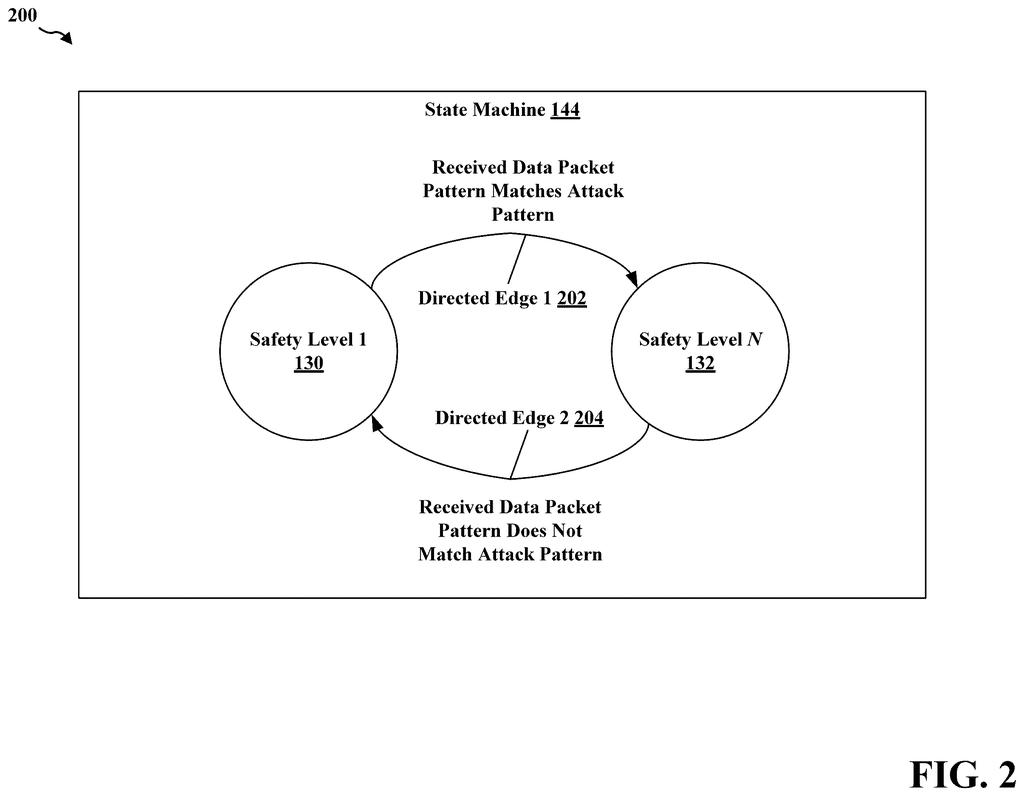
The checking can lean on a state machine, a map of the car's possible states and the allowed moves between them. The filing also describes making the car wait, for example until it has come to a full stop, and sorting out conflicting requests that arrive at different times. The claims also cover boats and aircraft, not only cars.
Why connected cars need graded defenses
For you as a driver, the practical question is what happens to your car when something goes wrong with its software. Under this approach, a minor scare could cost you only your streaming account or USB input, while a serious one could cut off the systems that matter most. The car would pick a response sized to the danger, and time it so a defensive move doesn't create a new hazard at 70 mph.
The filing also ties the profiles to safety standards, so the same car could follow different rules in different countries. A carmaker could update those rule sets, which the filing says could happen overnight while the car sits unused. It is a patent application, so it shows an approach Red Hat has described, not a feature you can expect in a car.
One more thing to know: the patent examiner has already issued a final rejection on this application. Red Hat can still amend the claims or appeal, and nothing described here has been approved yet.
IBM's 392nd filing we've tracked since May in our IBM coverage adds to a run that includes a chip mirror for stray light and a two-layer sensor surface.
The benefit you would notice is mostly about what keeps working. Instead of one panic switch that either does nothing or shuts everything down, your car would give up the least important features first. Losing your music app's connection is a much better outcome than losing the steering computer's ability to talk to anything.
The best detail for drivers is the wait. A car that refuses to cut power to a system at highway speed protects you from a security response causing a real accident, and the filing even has it ask you to stop somewhere safe first.
The weak spot is communication. Features could vanish with little warning, and the filing says little about how the car would tell you what it turned off or why. Still, a graded response is a sensible way to protect a vehicle that is also a computer on the internet.
Get our take in your Top Stories
Liked this breakdown? Add Patentlyze as a preferred source on Google, and our plain-English take shows up more often in your Top Stories the next time IBM patent news breaks.
There are more where this came from
We read every patent application Big Tech publishes and send you the ones worth knowing. Plain English, free, every week.
The drawings
5 drawing sheets from US 2026/0307617 A1 · click any drawing to enlarge


Want this weekly breakdown for a company we don't cover? Patentlyze Pro →
Be the first to weigh in