
A New Qualcomm Patent Plans Your Drive Around Where Cell Signal Is Strong
Qualcomm's patent describes navigation that picks your route partly by how well your phone, car and passengers' apps will stay connected along the way, and then asks cell towers to set aside bandwidth for your trip.
What Qualcomm's signal-aware navigation does
Ever had a video call freeze the moment you drove into a dead zone? Or watched a streaming show stall halfway through a long road trip? Standard navigation apps only care about distance and traffic, not whether the signal holds up.
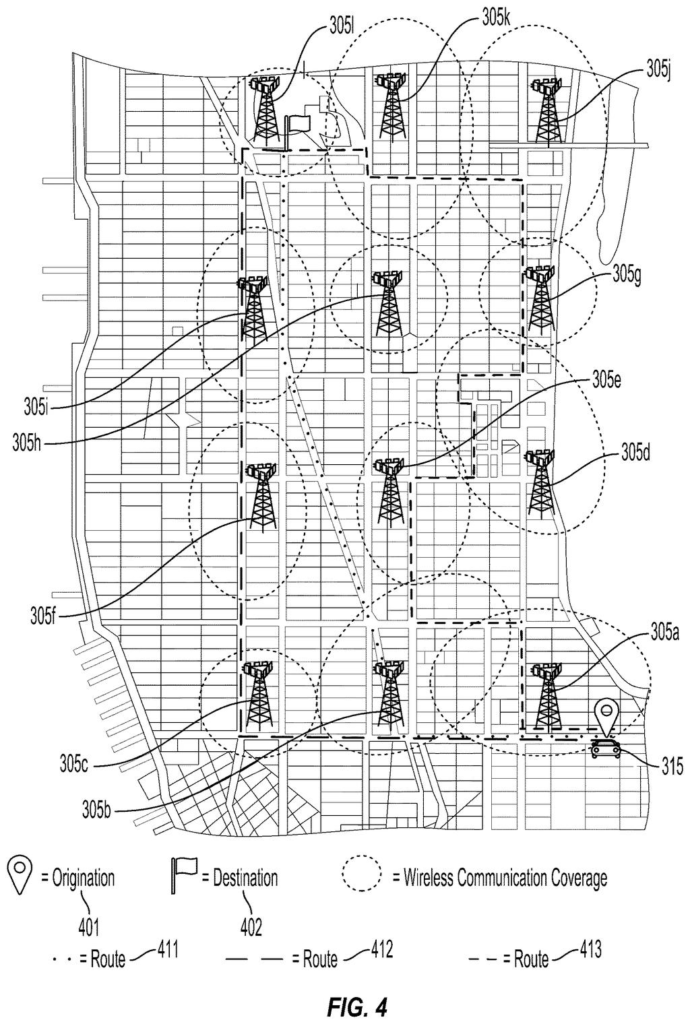
Qualcomm's patent changes what the map weighs. Your car or phone sends a trip request that includes where you're going and which apps you or your passengers plan to use. A routing system then builds routes using a map of signal quality along each road. A gaming or video-streaming trip might get a route with steadier coverage, even if it's a bit longer.
The filing goes one step further. The routing system tells the cell towers along your chosen route to reserve bandwidth or give your vehicle priority while you pass through.
receive, from a wireless communication device, a routing request message for one or more communication-aware routes associated with a radio map for roadway areas of a region associated with a plurality of network nodes; …
Translation: The system gets a request for travel paths that factor in cell signal strength along different roads.
How the routing system reserves bandwidth ahead
The core claim covers a routing system that receives a request from a wireless device in or tied to a vehicle. The request refers to a radio map (a record of how strong and reliable wireless service is on each stretch of road in a region). The system generates one or more routes and, in response to the request, sends reservation/priority information to a cell tower (network node) along the route.
That reservation can take two forms. A bandwidth reservation sets aside an amount of capacity, with start and end times matching when the vehicle is expected to pass. A priority message gives the vehicle's traffic a higher place in line for uplink (data sent from the car), downlink (data sent to the car), or both. If a tower says it is already oversubscribed with higher-priority vehicles, the system can change part of the route.
The request can also list which apps are active or wanted, such as web browsing, video streaming, gaming, VR or autonomous and remote driving. The filing sorts needs into flexible ones (web surfing) and strict ones (self-driving, remote driving). A strict-need route may be more roundabout but avoids gaps.
The filing also describes pre-sending HD map data (highly detailed road maps used by self-driving systems) from a tower before the car reaches a weak-signal stretch, and updating plans if traffic or new passengers' apps change the picture.
Reservation/priority information regarding communication resources of a network node associated with at least one roadway of a communication-aware routing selection may be provided to the network node.
Translation: The car can reserve network bandwidth along the chosen route ahead of time.
Why car connectivity needs this kind of planning
Cars are becoming rolling data hubs. Passengers stream video, play games, and join calls, while driver-assist and self-driving systems may need steady connections to download maps or let a remote operator step in. A dropped connection that is a minor annoyance for a movie can be a safety problem for a self-driving car.
The idea gives the network a role in trip planning instead of just reacting to demand. For you, that could mean a route that trades a few minutes for a connection that holds. For carriers and automakers, it hints at selling or managing guaranteed connectivity for vehicles. It is a patent application, so none of this describes a shipping product.
Filing 498th in our Qualcomm coverage since May, this application builds on finding misplaced tags and guiding shoppers to products.
Losing a call on a highway is annoying. Losing a self-driving car's connection to its maps is a different category of problem, and that gap between inconvenience and danger is exactly what this filing is trying to close.
The approach fits the scale of that risk. Rather than leaving a car to discover a dead zone mid-trip, the system has the network reserve bandwidth in advance and push map data to the vehicle before the weak spot arrives, the way a flight attendant briefs you before turbulence rather than during it.
The real obstacle is coordination. Carriers, navigation companies, and automakers would all need to share data and agree on who gets priority when a cell tower is crowded, and the filing is clearer on the mechanics than on who brokers that agreement. The problem it targets will only get harder to ignore as more cars depend on live connections to move safely.
Get our take in your Top Stories
Liked this breakdown? Add Patentlyze as a preferred source on Google, and our plain-English take shows up more often in your Top Stories the next time Qualcomm patent news breaks.
There are more where this came from
We read every patent application Big Tech publishes and send you the ones worth knowing. Plain English, free, every week.
The drawings
10 drawing sheets from US 2026/0313315 A1 · click any drawing to enlarge


Want this weekly breakdown for a company we don't cover? Patentlyze Pro →
Be the first to weigh in