
Tesla Patent Would Open Your Trunk Before You Even Reach For It
Carrying grocery bags to the car and fumbling for the trunk release is one of those small daily frustrations that cars still haven't solved. Tesla's newest patent describes a system that would open the trunk the moment you walk up to it, using precise radio signals rather than a clumsy button or kick sensor.
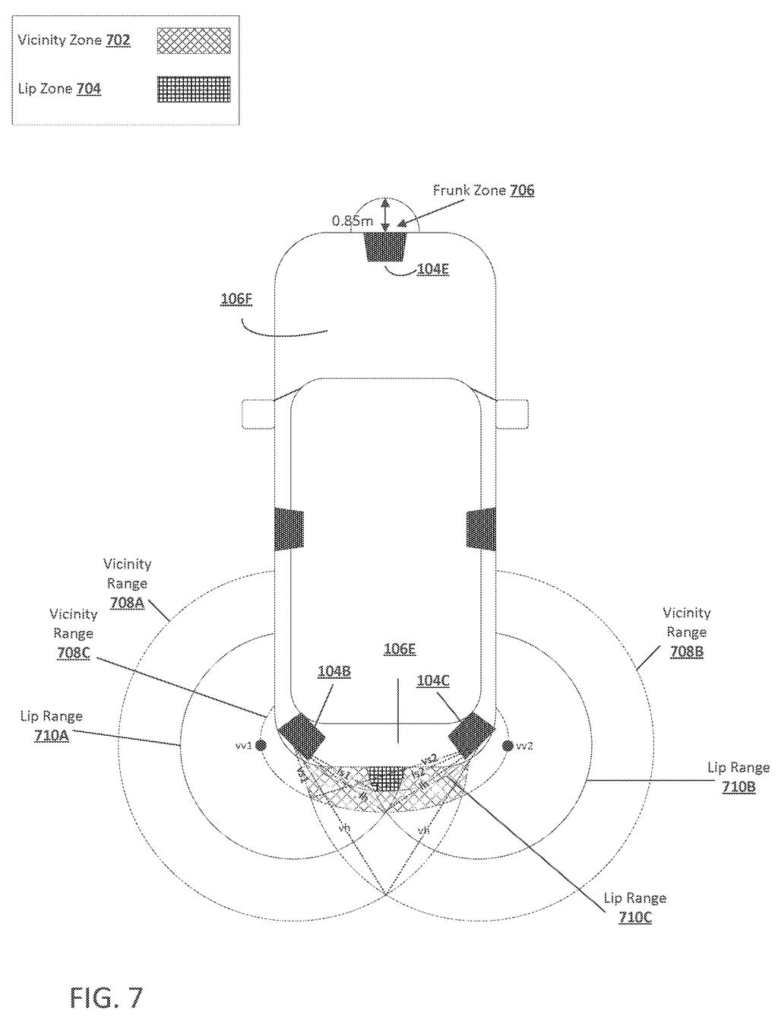
How Tesla's proximity-based trunk opening would work
Today's hands-free trunk systems typically use a foot-kick sensor or require you to stand still for several seconds near the bumper, and they're notoriously prone to triggering at the wrong moment. Tesla wants to replace that with something far more deliberate: a system that tracks exactly where you are relative to the car.
The idea is that your phone constantly broadcasts ultra-wideband (UWB) radio signals, the same technology that lets an iPhone tell you which room your AirTag is in. Tesla's car picks those signals up and builds a precise picture of your position. If you walk into a specific zone around the trunk, the trunk opens on its own.
Critically, the patent emphasizes preventing false opens, meaning the system is designed to distinguish you deliberately approaching from someone just walking past on the sidewalk. You'd get a trunk that opens when you mean it to, not one that pops open every time a neighbor strolls by.
determine whether a user device is located within a trigger zone, wherein the trigger zone represents a real-world area positioned about a trunk compartment of a vehicle …
Translation: The car checks if your phone has entered a specific invisible boundary near the back of the vehicle.
How UWB pinpoints your phone and triggers the latch
The system described in the patent uses ultra-wideband (UWB) radio, a short-range wireless technology that can measure distance and angle with centimeter-level accuracy, far more precise than Bluetooth or Wi-Fi. Multiple UWB sensors placed around the vehicle triangulate the position of a paired user device, like a smartphone, in three dimensions.
Once the system knows where the phone is, it checks whether that position falls inside a trigger zone: a defined real-world area mapped around a specific trunk compartment. The patent notes the vehicle may have more than one trunk (Tesla's Model S and Model X have both a rear trunk and a front trunk, or "frunk"), and each compartment can have its own independent trigger zone.
- If the phone enters the trigger zone, the system initiates an opening sequence for the corresponding closure (trunk lid, hatch, etc.).
- The system actively works to prevent false opens, filtering out accidental triggers caused by people nearby who aren't the vehicle's owner.
- The patent also leaves room for additional actions beyond opening, such as turning on interior lights or adjusting the closure height based on context.
The false-open prevention is the engineering crux here. UWB's precision is what makes it possible to draw a tight enough virtual boundary that only someone standing directly behind the car, not on the sidewalk two feet away, triggers the action.
… detect a user device is within proximity of the vehicle using ultra-wideband signals. The system may then determine a location of the user device …
Translation: It uses ultra-wideband radio waves to precisely track where you and your phone are standing.
What this means for hands-free access on Tesla vehicles
For anyone who has ever walked up to their car with both hands full, a trunk that opens without any button press or foot-wave is a real quality-of-life improvement. The existing foot-kick sensors on many cars today work inconsistently on slopes or in rain, and they require you to know exactly where the sensor is. A UWB-based system tied to your phone's location would be far less fussy.
Tesla already uses UWB in its phone-as-key system, so the hardware foundation for this feature may already exist in current vehicles, making this one of the shorter paths from patent to production in Tesla's recent filings. The main remaining question is software: how the trigger zones are tuned to avoid nuisance opens in crowded parking lots. For readers who follow Big Tech patent news in the automotive access and keyless-entry space, this filing is a clear signal that UWB is becoming the standard positioning layer for smart vehicle interactions.
That makes this Tesla's 28th filing we've tracked since May in our Tesla coverage, which has followed everything from a soda ash cabin filter to fume-absorbing plastic parts.
The sensors this feature depends on are already built into recent Tesla vehicles for keyless entry, which means the gap between patent and product is almost entirely a software problem. The real work is in defining where the "open zone" begins and ends around the trunk, and making sure the car doesn't pop open for the wrong person in a crowded parking garage.
That second problem, preventing unwanted openings, gets serious attention in the document itself, which is a good sign. Engineers who treat the failure mode as a core requirement rather than a footnote tend to ship things that actually work.
A feature like this, hands-free trunk access when your arms are full of groceries, solves something people run into every week. When the underlying hardware already exists and the main remaining task is tuning software, the shortest path to a product is usually just time.
There are more where this came from
We read every patent application Big Tech publishes and send you the ones worth knowing. Plain English, free, every week.
The drawings
9 drawing sheets from US 2026/0249814 A1 · click any drawing to enlarge


Want this weekly breakdown for a company we don't cover? Patentlyze Pro →