
IBM Patents a Universal R-Squared Metric for Comparing ML Regression Models
R-squared is the classic 'how well does your model fit the data?' score — but it breaks down badly when you try to compare a linear regression against a neural network or a gradient-boosted tree. IBM's new patent proposes a single, unified version of that score that works across all of them.
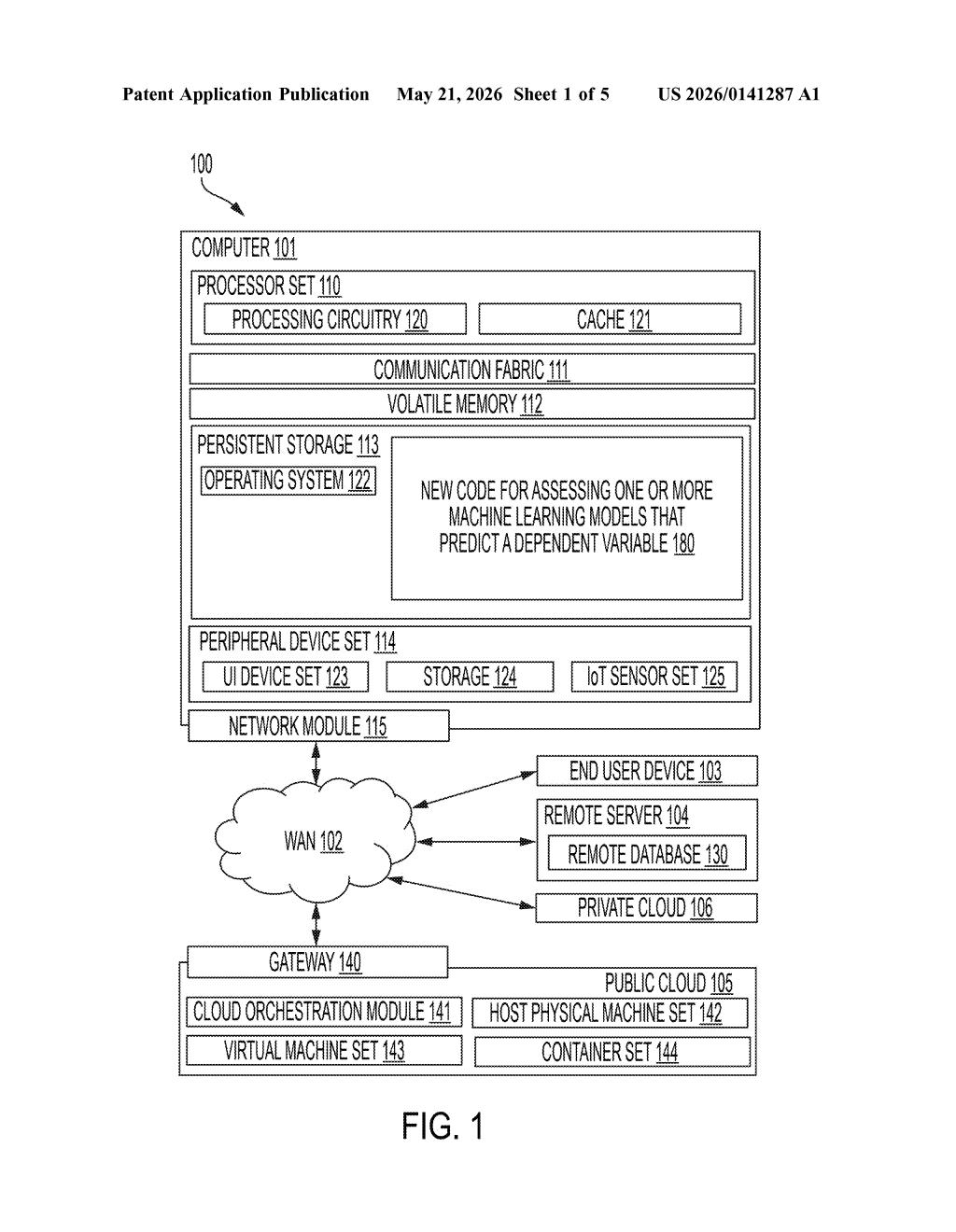
What IBM's universal R-squared actually measures
Imagine you're a data scientist who built three different models to predict, say, customer churn: one simple linear regression, one neural network, and one decision tree. You want to know which one is best. The problem? The standard goodness-of-fit score — called R-squared — was designed for linear models and gives you misleading or incomparable numbers when you apply it to fancier, nonlinear ones.
IBM's patent describes a method for computing what they call a Universal R-squared — a version of that score that works consistently across any type of regression model, regardless of how it was built. The idea is that you can train as many models as you want, and each one spits out this universal score alongside its predictions.
The payoff: instead of juggling different evaluation metrics for different model types, you'd have one number that means the same thing for all of them, making it much easier to pick the best model or explain your choice to a non-technical stakeholder.
How the universal R-squared score gets computed
The patent describes a training-and-evaluation loop that runs over N machine learning models simultaneously (or sequentially). For each model, a regression algorithm fits predicted values to observed data points — that part is standard. The new piece is step (ii): computing a Universal R-squared (UR²) for each model's predictions.
The classic R-squared formula measures the proportion of variance in the dependent variable that is explained by the model. It works cleanly for ordinary least-squares linear regression because the math lines up. For nonlinear models — neural networks, polynomial fits, kernel methods — the standard formula can produce values outside the 0–1 range, or simply can't be compared across model families in a meaningful way.
The patent's claim is that the Universal R-squared corrects for this by producing a bounded, interpretable score regardless of the underlying regression method. Each model outputs:
- Its predicted values f(x) for every training data point
- Its UR² score — a single number summarizing fit quality
With all N models scored on the same scale, a practitioner can rank them directly. The patent covers the computation as a method, a computer program product, and a deployable system — suggesting IBM sees this as something that could be embedded in an ML pipeline or model governance tool.
Why consistent ML evaluation scoring is a real problem
Model evaluation is genuinely messy in practice. Teams routinely compare models using different metrics — R² here, RMSE there, MAE somewhere else — which makes it easy to cherry-pick the metric that flatters your preferred model. A universal, normalized score that applies equally to linear and nonlinear models would make model selection more defensible and auditable, especially in regulated industries where you have to justify your modeling choices.
For IBM, this fits neatly into their AI governance and AutoML positioning. If you're building a platform that lets users train and compare models automatically — like IBM's Watson Studio or AutoAI tooling — a consistent cross-model quality score is exactly the kind of feature that differentiates an enterprise platform from a research notebook.
This is a useful-but-narrow statistical methods patent. The problem it solves is real — anyone who has tried to compare R² values across model types knows the frustration — but the core idea is incremental rather than transformative. The patent's value is mostly as an infrastructure claim: if IBM ships this in an AutoML or model governance product, the underlying metric needs IP protection.
Get our take in your Top Stories
Liked this breakdown? Add Patentlyze as a preferred source on Google, and our plain-English take shows up more often in your Top Stories the next time IBM patent news breaks.
There are more where this came from
We read every patent application Big Tech publishes and send you the ones worth knowing. Plain English, free, every week.
Want this weekly breakdown for a company we don't cover? Patentlyze Pro →