
Samsung
Samsung · Cell phone · Filed Apr 18, 2025 · USPTO published Jun 18, 2026 · Jun 18 release
Samsung Patents a Payment System That Confirms You Are Close Enough to Pay
Your phone already handles contactless payments, but Samsung wants to add a layer that verifies you're physically standing at the right register before any money moves — using the same ultra-wideband radio that helps AirTags find lost keys.
- Publication number
- US 2026/0170480 A1(US20260170480A1)
- Applicant
- SAMSUNG ELECTRONICS CO., LTD.
- Filed · Published
- Apr 18, 2025 · Jun 18, 2026
- Inventors
- Jonghoe GU, Jieun KEUM
- Status when we published
- Waiting for an examiner
- Document
- 15 claims
- US classification
- 705/39
- Examiner
- KWONG, CHO YIU (Art Unit 3693)
- Parent application
- National Stage Entry of PCT/KR2023/016292 (filed Oct 19, 2023)(PCTKR2023016292)
What Samsung's UWB tap-to-pay actually does
Imagine walking up to a checkout counter and your phone quietly confirming not just that a payment terminal is nearby, but exactly how far away it is — down to centimeters. That's the core idea here. Samsung's patent describes a payment flow where your phone and a store's terminal talk to each other using ultra-wideband (UWB) radio, a short-range signal that's far more precise about distance than Bluetooth or NFC.
The terminal broadcasts a message that includes two things: what payment method it supports and a code that identifies the specific store location. Your phone reads that broadcast, uses UWB to measure the exact distance between the two devices, and only then completes the transaction — if you're close enough to be the person actually standing at the register.
The practical upside is a checkout experience that's harder to spoof. With regular NFC tap-to-pay, any reader that gets near your phone could theoretically try to charge it. Tying the payment to a precise distance check adds a physical confirmation step that's much tougher to fake from across the room.
How UWB ranging triggers the payment transaction
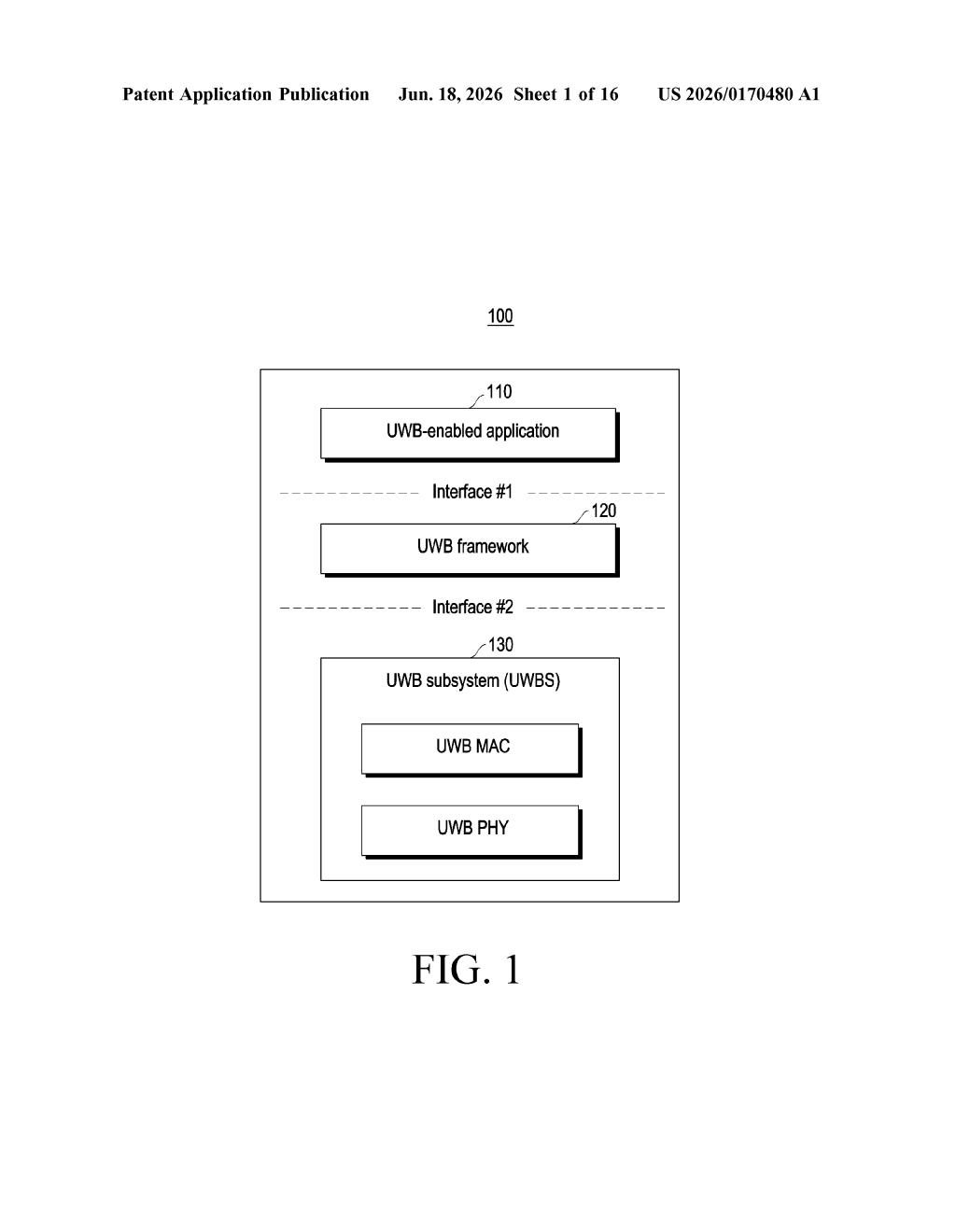
The patent describes a two-device system. A first UWB device (your phone or wearable) receives an advertisement message from a second UWB device (the payment terminal at a store). That message carries two key pieces of information:
- UWB payment identifier — a code indicating which payment method or network the terminal supports
- Retail identifier — a location code pinpointing the specific store or register where the transaction should happen
Once the phone receives that broadcast, it performs UWB ranging — a technique that uses timed radio pulses to calculate the precise physical distance between the two devices, typically accurate to within 10–30 centimeters. This is fundamentally different from NFC, which just checks proximity in a vague sense, or Bluetooth, which gives a rough signal-strength estimate.
The payment transaction only proceeds if the ranging result confirms the phone is at the expected location and distance. Think of it as a physical handshake: the terminal says "I'm here, at this store, accepting this payment method," and the phone verifies it can actually "see" that terminal at arm's reach before authorizing anything.
What this means for phone-based payments at checkout
Most contactless payment systems today rely on NFC, which works at very short range but doesn't verify where you are — only that a reader is close. UWB can place your phone within a few centimeters in three-dimensional space, which means a payment terminal can confirm you're the person standing at register 4, not someone else in the same store or a fraudulent reader planted nearby.
For Samsung, this fits into a broader push around UWB in Galaxy devices, which already use the technology for features like Nearby Share and device finding. Extending it to payments would give Samsung Pay (or a successor service) a security and precision angle that Apple Pay and Google Pay don't currently advertise. Whether retailers would need to upgrade their terminals to support UWB is the practical question — and the answer is almost certainly yes, which is the real adoption barrier.
Source: US 2026/0170480 A1 at the USPTO (PDF). Full patent text and figures are in the official publication.
Get our take in your Top Stories
Liked this breakdown? Add Patentlyze as a preferred source on Google, and our plain-English take shows up more often in your Top Stories the next time Samsung patent news breaks.
Add Patentlyze on Google
One click.
There are more where this came from
We read every patent application Big Tech publishes and send you the ones worth knowing. Plain English, free, every week.
More from Samsung
All 1,629 Samsung patents →

More in Antenna & radio
All 32 Antenna & radio patents →
Apple
Apple Patents a System to Sort Nearby Device Signals Before Your Phone Responds

Google
Google Patents a Multi-Antenna Method for Precise Device Distance Measurement

Qualcomm
Qualcomm Patents a System That Budgets RF Radiation Limits Across Multiple Antennas
IBM