
Nvidia
Volkswagen · Automotive · Filed May 16, 2025 · USPTO published Nov 19, 2026 · This week's release
Volkswagen Files Patent for a Car That Understands 'I Feel Hot'
Tell your car 'I feel hot' and it works out that you want the air conditioning on. Volkswagen has filed a patent application for a car that skips the exact-phrase commands.
- Publication number
- US 2026/0365020 A1(US20260365020A1)
- Applicant
- VOLKSWAGEN AKTIENGESELLSCHAFT
- Filed · Published
- May 16, 2025 · Nov 19, 2026
- Inventors
- Alireza Shamsoshoara
- Status when we published
- Examiner raised objections; the company can respond
- Document
- 20 claims
- US classification
- 701/36
- Examiner
- HOLMAN, JOHN D (Art Unit 3667)
What Volkswagen's talk-to-your-car system does
Today, talking to your car usually means learning its language. You say a trigger word, then a request in a specific format, or you take your eyes off the road to find the right button on a touchscreen. Volkswagen's patent application describes a way to skip all that.
Instead, the car would listen to ordinary speech and work out what you mean. Say I feel hot and it could turn on the air conditioning and set a colder temperature. It's getting dark outside could switch on the headlights, My body feels sore could start a seat massager, and I don't like this song could skip to the next track.
Behind it sits a large language model, the same type of AI that powers chatbots. It reads what you said, looks at what the car is able to do, and picks the controls to use. It can also ask you to confirm first.
obtaining audio data, wherein the audio data represents speech of one or more users in a vehicle; selecting a set of vehicle functions from a plurality of vehicle functions based on a large language model and the audio data …
Translation: The car listens to passengers talk and uses AI to figure out which vehicle controls to adjust.
How the AI picks controls from a list of car functions
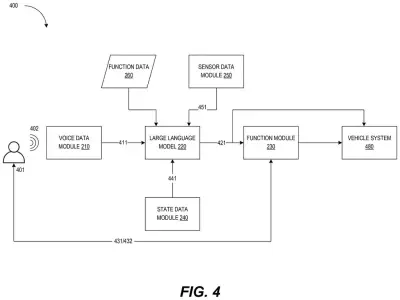
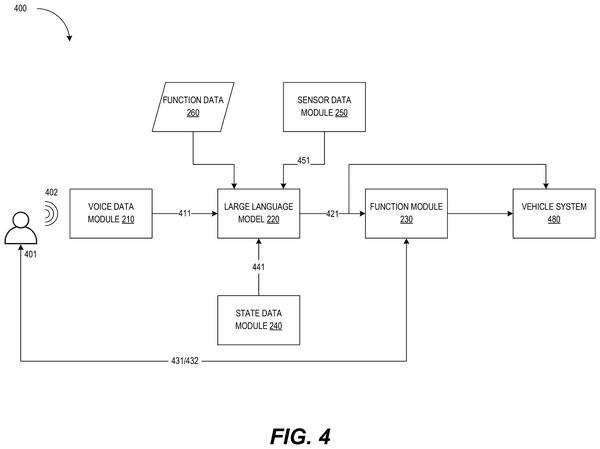
A microphone in the cabin records what you and your passengers say. A voice module turns that recording into tokens (small chunks of text, each one a word or part of a word). Those tokens go into a large language model, an AI trained on huge amounts of text so it can interpret everyday language.
The model does not guess in a vacuum. It also receives a list of everything the car can do. Each entry is a short text definition with a name, a purpose and the settings it takes. The filing's example is a function for setting the rear passengers' cabin temperature. The claims also cover feeding the model extra context:
- Sensor data, such as cabin temperature or conditions outside the car
- Vehicle state data, such as whether the air conditioning or wipers are already on
The model outputs a list of functions to run, plus values for their settings, like a temperature of 72. Those commands can go straight to the relevant car system, or through a middle function module that forwards them. That module can check the values first (for example, keeping a temperature between 60 and 80) and can ask you to confirm on screen.
The filing says the model can run inside the car as a shrunken version of a larger model. Your confirmations and rejections can be sent back to a training system to fine-tune it (adjust it with a small amount of extra data) so it gets better at reading your requests.
Why this could mean fewer glances at the touchscreen
If this ever reached a car, you could stop memorizing commands and stop poking at a touchscreen while you drive. Volkswagen's own pitch is safety and ease: fewer distractions, and speech that sounds like a normal person talking. The car's list of functions can be tailored to a specific make and model, so one approach could cover very different vehicles. Nothing in the filing says a product is planned.
Keep the stage in mind. The examiner's first review rejected the claims as filed, which is routine and usually followed by amendments. The claims as filed are short and broad: speech goes in, an AI language model picks functions from a list, and the car carries them out. Safeguards such as confirmation prompts and range checks appear in narrower claims.
Source: US 2026/0365020 A1 at the USPTO (PDF). Full patent text and figures are in the official publication.
Get our take in your Top Stories
Liked this breakdown? Add Patentlyze as a preferred source on Google, and our plain-English take shows up more often in your Top Stories the next time Volkswagen patent news breaks.
Add Patentlyze on Google
One click.
There are more where this came from
We read the new patents from Big Tech, carmakers and more and send you the ones worth knowing. Plain English, free, every week.
The drawings · 7 sheets
7 drawing sheets from US 2026/0365020 A1 · click any drawing to enlarge


No comments yet