
Nvidia
Nvidia · AI / ML · Filed May 16, 2025 · USPTO published Nov 19, 2026 · This week's release
Nvidia Files Patent for Game Alerts You Create Just by Asking
Ever wished a game would just tell you when your backpack is full? A new Nvidia filing describes an AI assistant that builds that alert the moment you ask for it, with no developer involved.
- Publication number
- US 2026/0368442 A1(US20260368442A1)
- Applicant
- NVIDIA Corporation
- Filed · Published
- May 16, 2025 · Nov 19, 2026
- Inventors
- Vladimir Getselevich, Anjul Patney, Deep Shekhar, Ram Rangan
- Status when we published
- Waiting for an examiner
- Document
- 20 claims
- US classification
- 715/708
What Nvidia's ask-for-an-alert assistant does
Most alerts in games and apps are whatever the developers decided to build in advance. If you want a ping when your backpack is full and nobody coded that, you are out of luck. Nvidia's patent describes an AI assistant that lets you make your own alerts just by asking.
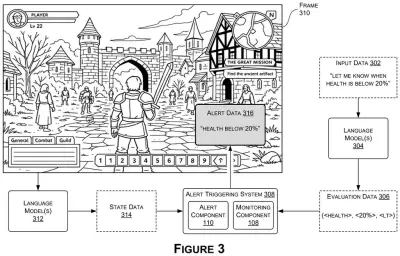
You type or say something like 'let me know when I have enough materials to build a ship.' A language model, the same kind of AI behind chatbots, turns that sentence into a precise rule. The assistant then keeps checking the game in the background. When your condition comes true, it flashes a highlight, pops up a message, or plays a sound.
The filing also covers requests that need some game knowledge. For a ship, the AI first looks up what ships require, such as workers and a steel factory, so the alert matches the game's real rules.
obtaining input data representing at least one natural language expression of a user associated with an interactive application, the at least one natural language expression indicating one or more requests to issue one or more alerts responsive to one or more events associated with the interactive application …
Translation: The system listens to what you say in plain English while playing and figures out what kind of alert you want.
How a request becomes a rule the game checks
The system starts with a request in everyday language, typed or spoken, such as 'notify me when my inventory is full.' A language model (the AI behind chatbots) converts that into text a computer can test, called a logic condition.
The filing describes three formats for that condition:
- A three-part rule: a game variable, a limit and a comparison, such as timber count of 25 or more.
- A small program: for tangled requests like 'health below 30% and fewer than two healing potions.' It can be compiled (packaged into a ready-to-run file) and executed while the game runs.
- A repeating question: for fuzzy requests, a second AI model is asked every few seconds something like 'has the player lost a significant advantage?'
To check a rule, the system reads the app's state, a live list of values like health, time and inventory. It gets them directly from the game's software hooks (an API) or by reading video frames with a vision model. It can also pull game rules from a database first (a technique called retrieval-augmented generation, or RAG) so the AI knows what 'build a ship' requires.
When the rule comes true, the alert shows up as a popup, a highlight box, a color change or a sound. Alerts can be snoozed, listed by name, or turned off.
… such as “notify me when my inventory is full,” the systems and methods of the present disclosure may convert the request into a structured format that allows an AI assistant to dynamically monitor application state and alert the user when the condition is met.
Translation: It translates your casual request into code that constantly watches the game and pings you when the goal happens.
Why Nvidia's alert idea matters for gamers
For players, the practical upside is an assistant you can customize on the fly. Instead of waiting for a developer to add an 'inventory full' warning, you ask for it and get it. That could help in busy strategy games, crafting games, or any app with dense dashboards where you cannot watch everything at once.
For Nvidia, the filing describes the assistant running in a cloud gaming setting such as its GeForce NOW service, where servers could draw the alert straight onto the streamed video. The claims are broad and cover any interactive application, so games are only the lead example.
That makes this Nvidia's 13th filing we've tracked since July in our AI agents that act for you watch, adding to earlier applications like one on self-organizing AI tasks and one guiding engineers through server failures.
Source: US 2026/0368442 A1 at the USPTO (PDF). Full patent text and figures are in the official publication.
Get our take in your Top Stories
Liked this breakdown? Add Patentlyze as a preferred source on Google, and our plain-English take shows up more often in your Top Stories the next time Nvidia patent news breaks.
Add Patentlyze on Google
One click.
There are more where this came from
We read every patent application Big Tech publishes and send you the ones worth knowing. Plain English, free, every week.
The drawings · 12 sheets
12 drawing sheets from US 2026/0368442 A1 · click any drawing to enlarge


Show the other 4 sheets


More from Nvidia
All 665 Nvidia patents →
More in AI assistant & agent
All 436 AI assistant & agent patents →
Google
Google Patents a Way to Train Chatbots on Plain-English Task Descriptions
Google
Google Files Patent for Telling a Robot Dog What to Do in Plain English
IBM
IBM's New Patent Covers a Chatbot That Spins Up New AI Assistants Mid-Conversation
Samsung
No comments yet